When
you will later see , the diets charted out for you, it will be clear
that your diet will consist of these groups of foods ( except
sweets!).
How much of each item in the Food Groups should you eat, when
should these be eaten and importantly, how you can vary items in
your diet so that you can have a meal which is not only acceptable
to you but also offers a rich variety of different foods.
FOOD EXCHANGES EXPLAINED
The next step is understanding the basic concepts of food
exchanges. You will need to know this in order to make your diet
as varied and rich an experience as you would have eaten if you
did not have diabetes, and possibly, even more so!
Concept
of 'Food Exchange'
So what are food exchanges? Basically foods, as we have seen, are
divided into different groups. Different food items are placed in
each of these groups as they contain similar amounts of
carbohydrates, fats and proteins and therefore, calories. In view
of this, each food item in any one group can be EXCHANGED, or
substituted, for one another.
The system of grouping foods is used in many ways. For example, we
can create a calcium-rich food group as a tool for teaching people
how to eat a high calcium diet.
Here is how it would work:
Foods placed in the calcium-rich food group must contain a
significant amount of calcium. The serving size of each food in
the group is adjusted to contain 300 mg of calcium. This ensures
calcium equality between foods.
1-1/2 ounce of hard cheese = 300 mg calcium
1 cup fluid milk = 300 mg calcium
1 cup calcium fortified juice = 300 mg calcium
Once we have developed a group of calcium-rich foods, we can
simplify the diet instructions to anyone who needs more calcium by
saying, " If you need 300 mg of calcium in your diet you
should take either 1 cup of milk OR 1to 1½ of hard cheese OR 1
cup of calcium fortified fruit juice!"
Say you require 600mg. Of calcium in your diet, then you could
either eat 3 ounces of hard cheese, OR 1 to 1 ½ ounces of hard
cheese and one cup of fluid milk, OR drink two cups of fluid milk
OR have one cup each of fluid milk and calcium fortified fruit
juice. We know that each of these options will give 600 mg. of
calcium in the diet.
Thus, you can choose the type of food item which you like and get
the desired nutrients in your diet.
If you still think it seems difficult, think back to your days in
Nursery School. Remember how you would be given blocks of
different sizes and then asked to use these blocks in various
combinations to fill in some empty spaces?
Now think of one exchange in any food Group as consisting of an
empty container which had to be filled in by using the various
blocks available.
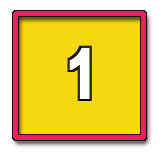
Let us say that Block 1 is an empty container.
Now
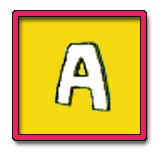
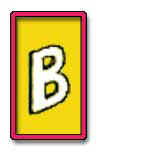
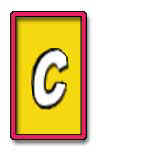
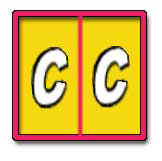
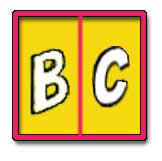
you have the following blocks A, B, and C. You will notice that
you can use Block A to fill in the container completely. If you
use only Block B, the container remains half empty. So what can
you do? Add another Block B or add Block C and you have full
container!
But
if you try and put in Blocks A and B you will see that you will
see that these will not fit as the container will not have so much
space.
Thus, you can either use one Block A or two Block B's or one each
of Block B and Block C!
This,
in essence is the concept of food exchanges. Block 1 can stand for
a food group whilst Blocks A, B and C stand for the different
items in this Food Group. It not only explains the food exchange
system but as importantly, points out the importance of amounts or
sizes of each food item in the food groups which you should eat.
Considering the huge numbers of food items in each food exchange
group, you can mix and match a diet which gives you the desired
nutrients and calories, but as importantly, offers you a rich and
varied choice of food items.
Who said diabetes diets were boring!
In reality, things may be a bit more complicated as we have to
take into consideration three nutrients and also the fact that
each food item may have nutrients which spill over into other food
groups. But things can still be simple.
Let us go back to Nursery School.
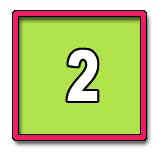
Let us now have two empty containers 1 and 2. Each stands for a
different food group, and therefore are shown in different colors..
Now
we have the same blocks again A, B, C. As we have shown above they
can be used, either singly or in combination to fill Container 1.
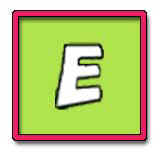
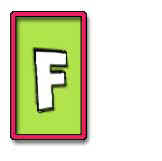
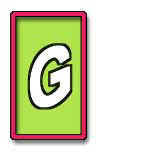
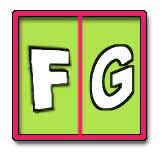
We
have Blocks E, F and G which are of a different colour (as they are items in a different food
group). They too can be used either singly or in combination and
can fill up Container 2.
Thus,
using these six blocks, both the Containers can be filled in. In
other words, using the food items in each Food Group one can fill
up the amounts of foods required to be eaten in your diet in each
of the two food Groups.
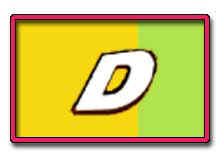
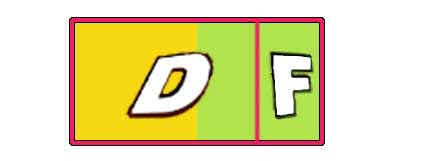
But
this time we have another block D. If you notice this block, it is
the same colour as Block A, and so could fill up Container 1, but
it is larger and size and this extension is of a type which in
reality should belong to Container 2. Now if you insist that you
would like to use Block D, then you will see that it fills up the
whole of Container 1. and also half of Container 2.
There
is no place for Blocks A, B, or C as Container 1 is already full.
But Container 2 is still half empty. We cannot use Block E to fill
up the rest of Container 2 as this would go beyond the boundaries
( and there are no "sixers" here as this is not
cricket!). But we can use either Block F or G to fill up the rest
of this container and we would then have both containers full.
It is important to realize this as some food items as we shall see
later have nutrients and/or calories which are more than allowed
for in one serving of a Food Group. Thus, if you eat an item which
spills over into a second Food Group, you have to subtract some
items from the second Food Group in order to keep the total
amounts of servings the same in your daily diet.
Simple, isn't it? If you could do this in Nursery School, you can
surely do it now. It's as easy as A,B,C !