| Operas |
| Choral works |
| Works for piano |
| Settings for voice |
| Other works |
| Biography (home page) |
| Links |
Ivan Bootham´s works include settings of poems by New Zealand poets Peter Jacobson and Niel Wright. He has also composed a setting of William Blake´s "The Sick Rose".
Peter Jacobson settings
Ivan Bootham has provided the following comments on his song cycle "For One Who Went Away" (2004).
"For One Who Went Away" is a song cycle for low voice piano. It is a setting of seven poems by the poet Peter Jacobson (1925-1998). He was a friend with whom my wife and I had spasmodic contact from 1966 until 1986, when he and his wife moved to Akaroa. To the best of my knowledge, only two volumes of his poetry have been published: "Poems" (1985), with illustrations by Michael Smither, and "The Unfashionable Goddess" (1995). The poems I chose to set (after gaining his widow’s permission) come from the latter volume, whose existence I did not know of until late 2003, when I came across a copy in a secondhand bookshop. The subject of all the poems in "The Unfashionable Goddess" is love. The poems have a sensual warmth that often analogises the fluctuating emotions and the physicality in human relationships to the natural world, both in its beauty and changeability.
Inevitably, the poems, being love poems, are lyrical and often in their expressiveness tinged by a poignancy that reflects an awareness of the inevitable loss that often follows on, sooner or later, from our pleasures. The term magic realism, well, my understanding of it, which has been used to describe the writings of various South American writers during the latter half of the 20th century, seems to me a not unsympathetic term by which to characterise the poems in "The Unfashionable Goddess". However, I don't know that Peter was actually influenced by any South American author: Neruda would be the most likely candidate if anyone, I suppose. Given the style of metaphoric imagery Peter uses in his poems, perhaps a more likely influence was Japanese haiku: a poet such as Basho, for example. Anyhow, what is also important to me about the seven poems of Peter’s I selected is that, though not printed sequentially, they infer a narrative thread. Briefly stated, the song cycle begins from a moment of reconciliation in a love affair that is in meltdown.
Niel Wright settings
Ivan Bootham has composed "Three Lejjoon Poems" (2000), a short song cycle to poems by Niel Wright. The composer comments:
It will be noted that I call this group of songs "Three Lejjoon Poems" not, as might be expected "Three Lejjoon Songs". The word "poems" is indicative in that it relates not only to the nature of the words but also to the nature of the music. The songs are miniature tone poems. This may be thought most obviously so of the first and third songs and less so of the second, which could be thought more of as being a little raver. Even if true, it is nonetheless, a tone poem.
Though I have referred to this composition as a short song cycle, and for convenience sake retain that classification, it would be more accurate to classify it as "a song group". In a song cycle the songs would normally have subject matter in common or, preferably, a linking narrative thread. The link in "Three Lejjoon Poems" is simply that the words are by the same author and the music by the same composer. Composing a song cycle was not my intention when I set the first of the "Lejjoon" poems to music.
The following are some extracts from the composer´s letters to Niel Wright:
1 June 2000.
As a gesture of thanks for the unsolicited support you have given to many of my creative efforts, I herewith present you a copy of my setting in music of your poem '"The Garden". In addition to the music manuscript I enclose a tape of two takes of me pooerforming [sic] the piece - the third word back is a genuine mistype, but it is certainly indicative of the quality of my singing! Other than my singing, the recording quality is not a true record of my piano playing - the recording does not clearly pickup the piano ambience, sustained sounds and harmonic overtones. Consequently, piano playing of subtle transitions between struck sounds seems less in evidence . . .
My musical interpretation of your poem may come as a surprise. Should you be anticipating a sung-through song, then you will be disappointed. Sung-through songs usually have a directness of story line and/or readily comprehensible emotional content. "The Garden'" nearly, but not quite, falls into such categorisation. The words can be given their generalised everyday accepted meanings, but also in them are inferences and ambiguities, individually and collectively. My approach to your poem has been to make a piece of music of it; a miniature tone poem or piece of music drama. As in words, so too in music can there be a multiplicity of meanings. I could give you a verbal commentary on the music, why it sounds as it sounds bar by bar, its inferences, but your poem does that for me . . .
23 June 2000.
Perhaps straining my little finger [slipping on the lawn while carrying firewood] and being unable to fully practise "Venus" was all for the best in this the best of all possible worlds. The calamity allowed my mind to drift off and become entangled in your poem "Probably". My only escape from it was to charm it by setting it to music. I enclose a manuscript transcript of the sounds that charmed. The poem is one that has a distinctly New Zealand tone [particularly noticeable] when read out loud in a certain manner . . . But that [tone] is all a manner of reading, diction, rhythm. Your vocabulary, the references beyond the seeming first meaning of the poem, and the double entendre metaphoric via naturalistic vocab are to a different purpose. To match the poem's colloquialism - the tang of slang - my music has a popular character, being coloured by rock, blues, jazz, and other. I must admit I did see the poem as a little raver!
In keeping, I thought, with the character of my music I did take three liberties with your words. I hope they are not offensive to you. I further colloquialised 'Probably' to 'Prob'bly. Your fourth line "I probably put the hard word" is a clever and satisfying way into a variant of the refrain motif and works well within the reading time scale of the poem. When set to music though, its meaning seemed to hang in the air, then come down to the next line with a bump. I took the liberty of adding on the words you use in the opening and closing refrain: they being 'on you'. What also necessitated their use, in my opinion, was my interpolation of eleven bars of instrumental music between the third and fourth lines. The last liberty I took was to make a rapid-fire four times repetition of the words "No wonder".
[Niel Wright approved the word changes, as he did for the third and final song.]
20 July 2000.
Apart from "The Garden" I certainly did not plan to set any other of your "Lejjoon" poems to music, but here I am with number three, "To Paddy Dying". . . A setting of "To Paddy Dying" I would not have thought on the cards two months back, when, still immersed in the backwater of "The Death of Venus", I did not wish to contemplate more words about death. Besides wanting to round off two songs with a third, I suppose my mind was made more open to ways the poem could be musically interpreted by such factors as: the "Paddy" poem being more congenial to a musical treatment than the remaining "Lejjoon" poems (their word play and imagery being less amenable to musical voicing), your stated affection for the poem and your hope it might one day be set to music.
On examining the poem further, and in the light of a musical idea that had come to mind, I saw a more oblique approach to setting the words in music was possible and preferable. Rather than doom-laden my music would be reflective of the life rather than the death of the character. This approach was supported by my recognising that the poem though imbued with personal feeling. particularly in the first stanza, has a dramatic poeticised rhetorical tone that is characteristic of the "Lejjoon" poems as a whole. (I do not mean that as a negative comment - I use the word rhetoric in its classical sense.)
The second stanza seems to support my approach to the poem even more than the first stanza does. The second stanza steps close to a public rhetoric, it puts a more positive spin on the situation. the words are as supportive, consoling, to those left behind as to Paddy.
"Three Lejjoon Poems" was first performed in Wellington in 2002 by Craig Beardsworth (baritone) and Christine Archer (piano).
Ivan Bootham´s most recent work is "Prologue to an Opera - for Voice and Piano" (2006), based on Niel Wright´s verse novella "The Sun Wheel" in the collection titled "Only a Bullet Will Stop Me Now" (part of Wright´s epic cycle "The Alexandrians").
He describes the circumstance of its composition as follows:
In 2004, after reading Niel Wright's long narrative poem "The Sun Wheel", I told him I thought a chamber opera libretto could be made from it. He approached Jeremy Commons with the idea. I believe Jeremy made some tentative writing moves about the poem but his other commitments stopped him from going further.
To prove my opinion a libretto could be made from the poem, I supplied Niel with a fairly detailed outline for a libretto with cross-reference to the various parts of the poem on which the libretto could be based. As it happened, shortly after reading the poem I came up with a instrumental idea and vocal line I thought suitable for the prologue to the opera. Given the uncertainty as to whether or not a full chamber opera would come of my suggestion, I decided late last year to develop and complete those musical ideas for the "Prologue to the Opera".
William Blake setting
Ivan Bootham has composed "The Sick Rose" (2001), a setting for unaccompanied choir of words by William Blake*. Of this work, the composer says:
The rose I drew happened to be in our garden. Of course, as we know, the poem is not the lament of a gardener with a blight problem, but an allegory about the state of England as perceived by Blake. That's the primary meaning, but as befits the work of an outstanding poet, it can also be read as a metaphor about the fragility of beauty, its transience and the mystery of its seemingly sudden decay, which leaves the observer saddened, yes, but more importantly the shift, the change in reality, is an experience that leaves the observer, for that moment, almost thinking of him/herself as a displaced person.
| The cover the composer designed for his manuscript copy of the revised version of ‘‘The Sick Rose‘‘. | 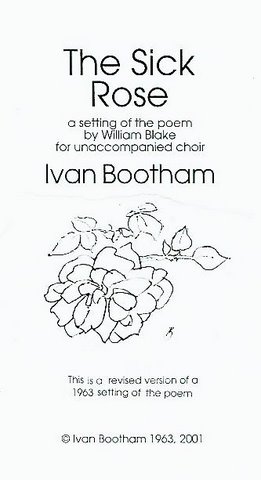 |
*A revision of the composer's 1963 version.