| Operas |
| Choral works |
| Works for piano |
| Settings for voice |
| Other works |
| Biography (home page) |
| Links |
Ivan Bootham's works for piano include "Play On A Debussy Motif" (2004) for piano,"Spinning Jenny" (2005) for piano duet, "Zuweilen" - six short pieces for piano, and "Longview - a Piece for Piano" (2006). The composer has provided the following commentary on these works:
Play On A Debussy Motif
"Play On A Debussy Motif " is a short piano piece. Anyone who has some familiarity with Debussy’s "Preludes" should have no trouble naming the "Prelude" alluded to by the motif, which, initially at least in my piece, I only slightly disguise.
Spinning Jenny
"Spinning Jenny" is for piano duet. The name "Spinning Jenny", which actually has no relevance to the character of the piece, is for me the name given to a sycamore seed; it is known as such in the north of England. The piece is not a visualisation in music of a spinning jenny. I simply liked the name and possibly what it evoked in my mind: none of which have I attempted to translate into music. Thinking of a spinning jenny while playing or listening to the piece is inappropriate. Other than it was a coincidental, yet felicitous association of names, nothing other than that should be read into the fact I wrote the piece to be performed by myself and pianist friend Jennifer Timmings. "Spinning Jenny" is propelled by sound, nothing else.
Zuweilen
"Zuweilen" means "sometimes"; thus there is reference in the music's meaning to the fleeting, transient moment, to change and changeability. I draw upon "Zuweilen" not just to mean sometimes as being a reference to a single significant moment, but as an embrace of the many significant moments that may come to a person's mind when it is given over to reflection; which in itself can be a relatively brief moment in time, but in that instant more of an all-encompassing one. This may suggest I was drawing on specific memories when composing "Zuweilen". I wasn't. The situation I was in was more one in which music itself recalled some "memories" from a few areas of its vast sound world. So, for me, the " Zuweilen" sounds are suggestive more of fleeting evocative emotions, visceral and intellectual, of music itself. The sounds did not, do not, bring sharply defined visual images to my mind.
Longview
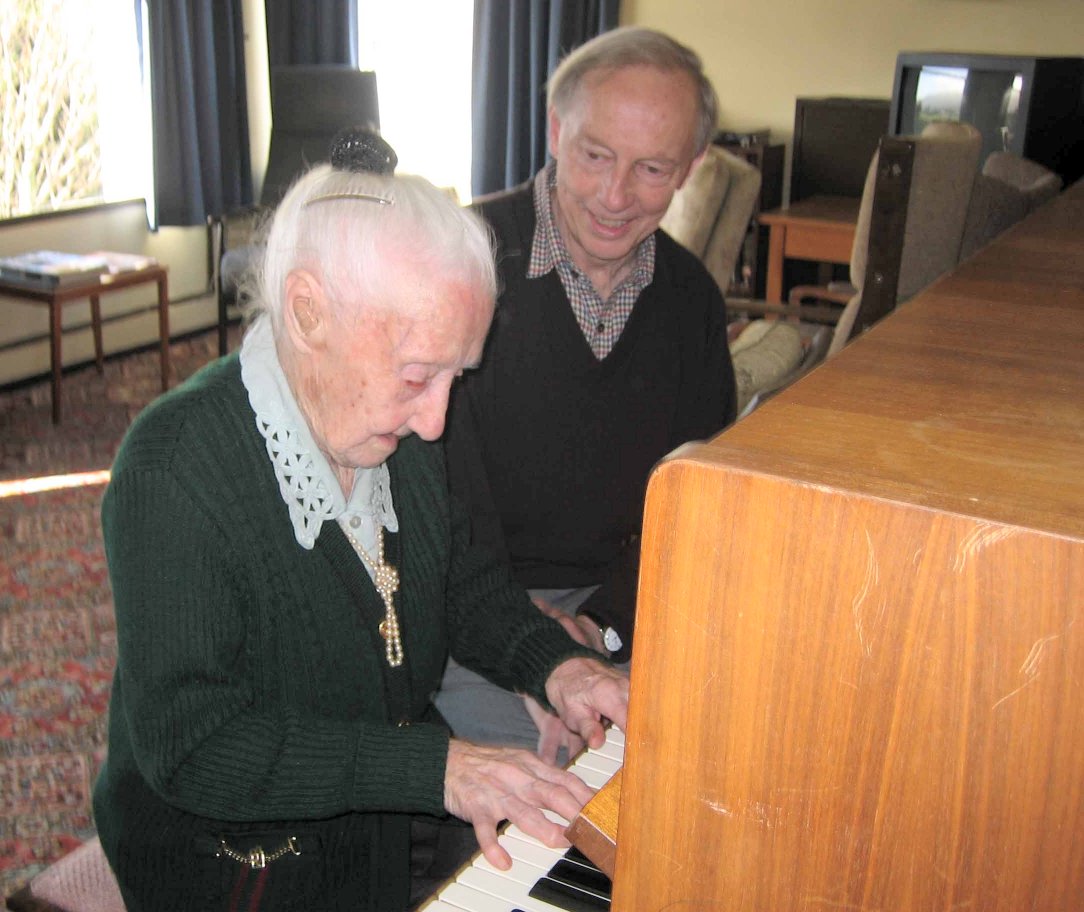
This piece evolved from a visit to the rest home where my mother lives. I quite often on my visits take my mother into one of the lounges and sit her down at the piano. She is 98; most of her memory has gone and with it her ability to play the piano as she once could. She can, though, sort of move her fingers about the keyboard and she has retained a very responsive feel for rhythm.
It is my habit to sit alongside her (secondo) and play a fairly basic and repetitive rhythm while encouraging her to improvise in the above middle C register of the piano. Occasionally the results are very satisfying and musical. On one occasion I deviated slightly from my basic rhythm role, adding a counter melody to what my mother was playing. Afterwards, I realised I could do more with my improvised melody. I worked on it at home and the piece "Longview" is what came of it.
Below: Ivan Bootham pictured with his mother on the occasion of her 98th birthday.
Black and White Movie
Ivan Bootham's interest in film is reflected in "Black & White Movie - a Piece for Piano" (2006). Of it he says:
Hopefully, in this piece, I avoid irony and superficial pastiche to evoke the atmosphere of the many black and white films from the 1940s and 50s I admire so much.
Occasional works
Last year Ivan Bootham completed three short piano pieces which he describes as "of marginal significance (though "Birthday BaRhumba" I wrote for Audrey* is enjoyable, I think!)".
*The composer´s wife
Riff Rap
In 2007, Ivan Bootham composed "Riff Rap", a piece whose title evokes two different musical genres.
"Riff Rap" - the title says it all. Rhythm in various guises is "Riff Rap"'s game. This 2007 piano piece is not without some hints of lyricism, and in one section extempore-like flourishes, but its main concern is with the propulsive possibilities of rhythms at medium and slow tempos, rather than at a fast tempo, at which it is easier for music to have a visceral effect on listeners, to be physically engaging. That parts of "Riff Rap" seem to be at a fast tempo is an illusion created by the use of cross rhythms and the increased number of notes articulated per beat.
The words "Riff Rap" are associated with two different genres of music-making. Riff is a jazz term for a short phrase that is repeated over changing harmonies. It's a technique I take some liberties with in that my piece is an assemblage of different rhythmic groups, each to a limited extent repeated, with changing harmonies, melodic fragments above them.
Rap is a style of communication categorized as popular music, though for some people music rap isn't. Within the context of popular music rap is not a mode of expression I warm to, but the rhythmical delivery, the walkie-talkie-like patterning of speech and its possibilities, is of interest to me, if not the meaning of the words. Rap, as percussive,rhythmical voice projection, along with sprechstimme and singing, is a technique I hope to explore further in a musical setting of a short story of mine. I'm not sure if setting one's own words is a kind of nepotism or narcissism, or perhaps both, but I think it only fair to first experiment on my own words! Incidentally, relatively straight forward narration of words to music is a juxtaposition I rarely find satisfactory; invariably the voice and the music sounding, to my ears, to be in conflict with each other.
The above description of the sound character of "Riff Rap" and my aside on rap is not an attempt on my part to add a veneer of seeming erudition to the piece. That "Riff Rap" is not intended to be thought-provoking will be obvious to anyone listening to it. "Riff Rap" is visceral, physical music.