| Operas |
| Choral works |
| Works for piano |
| Settings for voice |
| Other works |
| Biography (home page) |
| Links |
Ivan Bootham has composed two operas: "The Death of Venus" and "Pictures".
"The Death of Venus"
The "Death of Venus" is a fictional variation on an historical event. On 17 June 1806, the brig "Venus" was seized at Port Dalrymple (Tasmania) by its first mate Kelly, with the aid of some convicts. It put to sea with eleven persons on board, including two convict women and a baby. In December the "Venus" reached the Bay of Islands where Kelly, the women, the child, and a convict named Lancashire were put ashore and abandoned. The brig sailed aimlessly about the coastline until taken by Maori who killed and ate the crew. Kelly and Lancashire were quickly taken by the masters of visiting vessels. One of the women died soon after landing. The fate of the other woman and her child is not known. The women are believed to have been the first white women to live in New Zealand.
This libretto is based on "The Death of Venus", a radio play for voices by Ivan Bootham. It was broadcast by the New Zealand Broadcasting Corporation on 24 February 1972. A revised version of the text was published privately in 1982.
The libretto owes its start in life to the enthusiasm of F.W. Nielsen Wright, who, after reading the radio play, suggested making an opera version of it. The author attempted to shrug off the suggestion, not wishing to revisit an old piece of writing. Dr Wright was not easily deterred and sent a copy of the play to Jeremy Commons, who speedily extracted a draft libretto from it.
Though Ivan Bootham subsequently made extensive changes to the draft libretto, without it to start work from, a music drama version of "The Death of Venus" would not have come to fruition. Work on revising the draft and composing the music began in late 1998 and was completed in March 2000. It was a project the author time-shared with other creative work he had under way.
"The Death of Venus" was given its first fully staged performance in Wellington on 7, 9 and 11 May 2002. Produced by Jeremy Commons, who co-wrote the libretto, the predominantly young cast included: Christopher Leach (first mate Kelly), Nicola Hooper (Charlotte), David Skinner (Lancashire), and Linden Loader (Kate), with a chorus of eight. The pianist was Christine Archer.
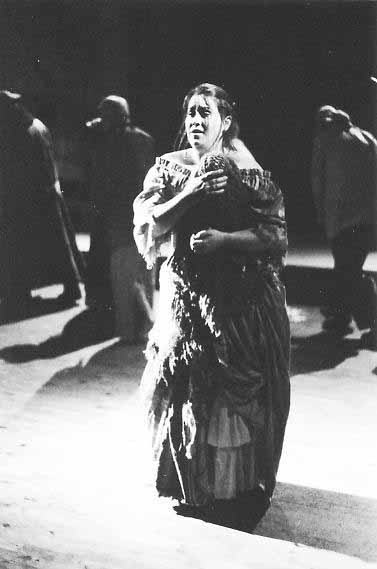 |
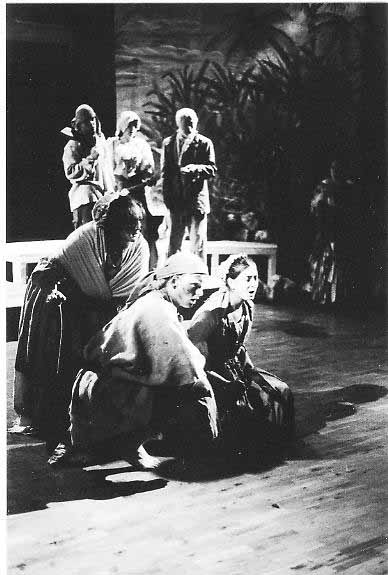 |
| Nicola Hooper as Charlotte | Some ot he convict chorus |
Jeremy Commons discusses "The Death of Venus"
The choice of the subject of "The Death of Venus", both as a radio play and as an opera, is indicative of Ivan’s gift for recognising and selecting the excellent. Not only is this a story which will appeal to us as New Zealanders, since it tells of the first white women known to have reached these shores, but it shows an ability to penetrate the psychology of a group of people caught in desperately alien and testing circumstances:
Kelly, who seeks to justify his mutiny as a protest against the inhumanity of transportation, but who is really motivated by his passion for Charlotte; Charlotte who knows she should be grateful to Kelly, but who does not love him, and who is driven primarily by her instinct to preserve her own life and that of her child; and Lancashire, who throws in his lot with Kelly, not through any genuine sympathy or friendship, but because he believes the first mate offers him a chance of freedom: a chance to escape the horrors of the chain gang.
The idea of presenting the story as a narrative for four voices and chorus is also unusual and effective, with each character in turn emerging from the shadows of time to relate the incidents in which he or she was most intimately involved. The result is a work which is highly evocative, and which increasingly gains a haunting and hypnotic hold over the listener.
Reviewsat the critics said about "Venus"
Writing in "The Dominion", John Button said: "There might be little variety, but there is powerful insistent force at work, and the writing for the various voices and the highly effective chorus is extremely well managed. The occasional foray into a wildly jazzy idiom is a touch disconcerting, but, overall, there is a lyrical power that makes a telling and cumulative impact."
"The Evening Post" critic Lindis Taylor wrote:"The music was often agreeable and expressive, offering effective choruses and attractive solo passages, supported with clarity by pianist Christine Archer."
RECORDING
"The Death of Venus" has been recorded on CD by Sirius. The CD is available from Jeremy Commons, 63 Hawker St., Mt. Victoria, Wellington, New Zealand. Price NZ$25 plus $5 p&p.
Ivan Bootham on "The Death
of Venus"
You use the term music drama for "Venus",
rather than opera. Why?
In a journal entry of 17/9/99 I defined, for my own satisfaction, my reasons for opting for the term music drama as a genre definition for "The Death of Venus". In the early stages of thinking about setting the text to music, a couple of possible genre terms came to mind: cantata and opera.
My journal entry began by explaining why I did not favour the term cantata, irrespective of it having in my mind all the wrong evocations.
In "Venus" we are told of what happened by the participants. The action happens in the narrative, which is expressed through music. This is not the situation usual to opera, in which the action occurs alongside an interacting dialogue. But, as the narrative is divided amongst various characters, it does create an interacting sense of drama.
In telling their sides of the story, the characters do create some interaction between themselves - the listener is aware of this even if the interaction is more distant than in a dialogue situation.This dramatic involvement of the characters, if only through narrative-type words, is the reason why I refer to "Venus" as a music drama, which can also be regarded as a stylized form of opera. Though the characters perform narratively, they are talking of themselves and of each other. This creates a recognisable dramatic tension, and in directing their words to the listeners they involve the listeners even further in the sense of drama.
The music drama/opera reaction to "Venus" would be reinforced by its being presented through minimal staging and movement. I envisage the staging as austere and abstract. For me, in the term cantata there is simply not enough inference in the word of the drama contained within "Venus". An analogous comparison. A public meeting with speakers up on the stage can become drama, however static and limited the speakers' movements are, because of the interaction of their words. These need not be personal.
That the speakers' messages are in conflict can be sufficient. Their listeners, as the listeners to "Venus", have an awareness of the drama evoked. The listeners interact with the drama in the words.
As for the music's involvement in the drama; the music is expressive of the characters (their past and present) and of the words' wider relevance. If the music does express wide-ranging word meaning, character psychology, the characters' social ground, then it ought to end up as music drama, even if action for the most part is not made visible. Thus music drama is probably the preferable term for "Venus".
"Pictures"
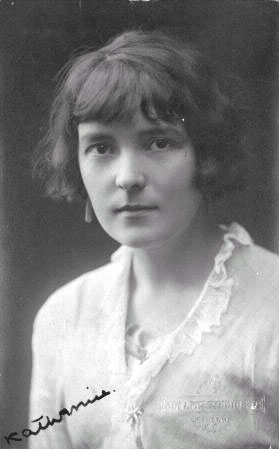 Katharine Mansfield |
Based on the short story by Katharine Mansfield, "Pictures" is the tale of Miss Moss
- a lady of indeterminate age and an out-of-work singer. It tells of her search for
work, a search made all the more desparate now that her landlady has demanded to
be paid the outstanding rent - or else. Often out-goingly rhythmical, the music for "Pictures" is distinguished by the lyrical quality that is an notable feature of Ivan Bootham's first opera, "The Death of Venus". "Pictures" is scored for five singers and piano. Four of the singers perform multiple roles, which is done for practical reasons and because role-playing changes are in keeping with the cabaret -like spirit of "Pictures". At the time of writing, "Pictures" has not been performed. |
Ivan Bootham on "Pictures"
What was it in Mansfield’s story that appeals to you?
Firstly its musical/theatrical context. The near cabaret-like character. This was partially some justification for my having four of the cast perform multiple roles - role-playing changes being in keeping with a cabaret-like spirit. The story’s basic theme may seem conventional: out-of-work singers struggling to find employment, landlady demanding unpaid rent. But, Mansfield’s singer has characteristics that are less conventional. Her personality and precarious situation have the potential to evoke deep and wide-ranging audience sympathy. She is not a conventional heroine. She is an anti-heroine heroine.
What also appealed to me about Mansfield’s rendering of the story was the ease with which a libretto could be extracted from it. It is fairly direct in its telling and has a lot of conversation in it that tells the story. In fact, it was so easy, comparatively, to extract a libretto from the story that I did not bother to write up a libretto before proceeding with the composition of the music. I worked directly from the story as I composed the music.
How closely does your libretto follow
the story?
Most of the words in the libretto for "Pictures" are Katherine Mansfield’s. The libretto also stays very close to the structure and content of her short story. Other than condensing the story, my principal contribution has been to make clear the links between the short scenes that constitute the whole and in doing, that emphasise the predicament of the main character, Miss Moss.
In the Mansfield story, Miss Moss is a contralto singer, but for the purpose of the opera I chose to make her a mezzo-soprano, the voice range of the latter being more suited to the music I had in mind. For the sake of timbre and character variety, I also changed the sex of a minor character from female to male.
What may be more disconcerting to those persons who have read the story is my interpretation of how it ends. I believe the story does allow for other more open-ended interpretations than just the obvious one. It seems to indicate the down-on-her-luck Miss Moss may not be off to make rent money by degrading means. For the first time in the story, someone admires her for her appearance. This could point to a relationship and future more positive than that first thought of by the reader.
More indicative, however, of a positive future is the tone, the imagery of the story’s final sentence: “And she sailed after the little yacht out of the café.” The sentence is optimistic, rather than negative. The upshot of this interpretation was my decision to end the opera somewhat triumphantly, with music I like to think of as having a dancing-in-the-aisle feel about it.
Within the context of my interpretation, I have given two possible endings to the opera. The first is perhaps more purist in that it is verbally closer to the Mansfield story and is musically only in the spirit of my interpretation of how the story ends. My alternative ending is more theatrical and, in partially repeating words sung by Miss Moss in Scene 1, adds a verbal layer to the musical statement.
Are there any similarities with "Venus"?
I had in mind when composing "Pictures" that it could, if need be, serve as a companion piece to "Venus" (though, without overstating it, they do share a concern for the underdog).