| Operas |
| Choral works |
| Works for piano |
| Settings for voice |
| Other works |
| Biography (home page) |
| Links |
Ivan Bootham´s two major choral works are the "Missa Creator Spiritus" (2006) and a setting of the "Corpus Christi Carol" (1963,2007). He has also composed "A Wild Garden of Doggerel" (2003), settings of nonsense poems by the composer for unaccompanied choir.
In 2006, Ivan Bootham composed the mass "Missa Creator Spiritus" for unaccompanied choir. On this work the composer has provided the following comments:
Was there any particular challenge in composing a mass?
The hardest part of its composition was putting together a text I could relate to. In saying that it's obvious I do not find the text of the traditional mass, well, not in its entirety, one I can spiritually relate to - particularly those parts that so seemingly demand a literal acceptance. I can find the music of the traditional mass very spiritual, but not all the words! I recognise that I perceive the religious spirit as closely related to the Art-creating spirit - if they are not one and the same.
Many composers have said they didn't know how they managed to compose certain pieces of music, even going so far as to state they were no more than a vessel for God. I make no such claims for myself, but yes, there are always certain parts of my music - and writing - that leave me wondering how I managed to do it. Did I do it by my own efforts or was there another player in the game that directed me to the conclusion I eventually came to? That is why I title my mass "Missa Creator Spiritus".
How did you treat the traditional language of a mass?
The mass opens not with a Kyrie, but with a Creator Spiritus: "Veni creator Spiritus". Other than that Latin phrase, and a couple of easily understood words associated with the Latin Mass, the rest of my text is in English. "Veni creator Spiritus" I think is close enough to English to be understood, while evoking and acknowledging the language of the traditional mass. I regard the text I finally arrived at as an adaptation, my slant on traditional sources (besides the mass, the Bible - King James Version - the Book of Common Prayer); a text that in part leans towards a spiritual/mystical ambience.
I suppose it's interesting to reflect on what I think appropriate for a text of a spiritual nature as opposed to a text for a song cycle. For the latter, in simple terms, an attractive understandable surface with depth. The surface, however, of a spiritual text may not evoke a readily comprehensible, easy-to-put-into words meaning. In my view, understanding of a spiritual text of substance does demand a sympathy with religious spirit mysticism. To a person who does not recognise this ambience, some of the language could well impress that person as being nonsense, or at best ambiguous.
How would you describe the work´s musical style?
I'm very wary about trying to describe the sounds of music in words.The reader can so often imagine a soundscape that doesn't eventuate when it is eventually heard, either live or on CD. The music didn't match the words (or vice versa!). I could say of my music that it comes within a flexible tonal soundscape, but even of that description I'm nervous; the word tonal could have some readers thinking the music is boring, bland, conventional.
To them I say: most of Stravinsky's music, falls within a tonal categorisation. Boring, bland, and conventional are not the usual terms used to describe his music. And, just in case it should be thought that my evoking the spirit of Stravinsky indicates he's been a significant musical influence on me, he hasn't, other than being one of many exemplars of the modernist ethos, which exists in al of the arts, and which has been an influence on my thinking and approach to music and literature.
It may seem strange that I, as an author, am reluctant to engage with words about music, but I tell myself that in my other guise as a composer that the act of composition is about sound construction not word assemblage. Admittedly, when words are being set to music they can have some bearing on the resulting sounds. Thus, I suppose, in a roundabout way, I have commented on the musical style of "Missa Creator Spiritus". What is the likely soundscape a spiritual-type text would suggest, bearing in mind the influence of the modernist ethos infered above?
In May 2007, Ivan Bootham completed a revision of his 1963 work, the "Corpus Christi Carol".
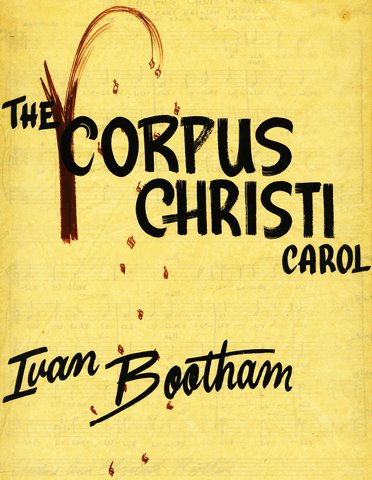
I was drawn to revising my 1963 setting of the Corpus Christi Carol by a recent visit of my "Australian" sister, whose unmarried initials (C.A.E.B.) I used as a thematic motif for my setting of the Middle English poem for soprano and unaccompanied choir. I also did a cover for it (on brown wrapping paper!) that is hand lettered and illustrated.
As for the music, however, I was aware that my setting could be improved by some revision, which I'm pleased to say did not turn out to be extensive In rewriting my musical history I did not want to hide my 1963 approach to composition, which meant any "improvements" should not seem out of character with the totality of what I wrote in 1963; they had to be musically in character. My revisions, which are contained within the same bars as on the original manuscript, consist of changes to a few notes, alteration of time duration to one or two notes (so effecting a rhythmic change), sustaining some sounds for longer periods, and over one such period inserting another declamation for the soprano soloist of her preceding statement, but to a different melodic line.