| Operas |
| Choral works |
| Works for piano |
| Settings for voice |
| Other works |
| Biography (home page) |
| Links |
Ivan Bootham has composed various works for French horn, and pieces for such combinations as harmonica and piano, trumpet and piano, and clarinet and piano.
Works for French horn
Ivan Bootham's works include: "Three Musics" (1965) for French horn, strings and harp; "Winter Garden" (1988) for wind quintet and "A String of Clichés" (1996) for French horn and piano. On this group of works, the composer comments:
"A String of Clichés" is one of eight pieces of music I've written with Paul Sawbridge in mind as performer (Paul's a horn-playing friend who lives in England).
The first of those pieces was "Adagio and Allegro" (1960) for French horn and piano. Paul gave its first public performance that year, I think, at a Liverpool University concert. The piece recently resurfaced into my consciousness when I decided to partially revise another early work of mine, "The Corpus Christi Carol". As I said in an email to Paul:"My musical concern of late has been to revise my 1963 setting of "The Corpus Christi Carol" for soprano and unaccompanied choir. The trick in such an activity is not to overdo what one supposes to be musical improvements. Essentially the piece must remain something I composed in 1963.
"I've also had a look at the first piece I wrote for you, the 1960 "Adagio and Allegro" for horn and piano. I approached it expecting I'd do some revision, surely, but fairly quickly decided to leave it as is. It's beyond revision! Not because it's perfect, but because it is what it is; consistent within the approach I believe I had towards its composition at the time. I see it now as a collage, an assemblage of musical gestures. I was being postmodern without knowing that and before the term was invented! To say I was eclectic I think would be wrong. Eclectic, to me, seems to infer a reverential absorption of other composers' modes of expression. At the time of composing "Adagio and Allegro" I was too knowing of my intention, of knowing what I was doing, or wanting to do with my musical material for the resulting composition to be a true example of eclecticism.
"Another reason I became aware of for leaving the piece as is is because fundamentally, the constructional approach I then had to musical material is at the basis of my present approach to composition; albeit applied with greater subtlety and depth of expressive insight. What does seem rather quaint in this day and age about "Adagio and Allegro" is its title; even though such tempo terms are associated with some of the greatest music written. I suppose the increased emphasis on individualism throughout the 20th century played some part in how composers thought about titles for their music. I've no intention of giving any thought as to what up-to-date appellation I could apply to the above "Adagio and Allegro". Certainly not "Eclipse and Spring Moon Phase II", that being an off the top of my head example of the sort of fanciful title a modern composer might give to a piece of music."
That first piece was followed by "Our Winter Days" (1967) for French horn and piano. I'm rather fond of winter days, particularly when they're not spoilt by rain and wind. The piece "Our Winter Days" is, if anything, an evocation, of their quietness, freshness, the potential they infer in their clarity, even in the stark outline of leafless trees against a backdrop of sky, of grey mist.
The catch in "Three Musics" (1965) for French horn, harp, and strings is that there's only one music. I never got around to composing the other two intended movements. Incidentally, the struggle to compose "Three Musics", while having to work in a nine-to-five job, I eventually transformed into one of the narrative threads in my first novel, completed in 1968. Though placed second in a national competition, it remains unpublished. Like most of my writing it mixes the jocose and the serious, a combination that many people find difficulty in coming to terms with. I did revise the novel somewhat in the mid-1970s and changed its title from "First Things First" to "The Yelling of Dry Bones". The latter, which seemed more appropriate at the time, came about from my initial misreading of the artist Colin McCahon's hand-painted title on his religious painting "The Valley of Dry Bones" (a reference to Ezekiel 37:1).Since then I have decided that a more temperate title for the novel would be "Unequal Temperament". It, besides defining character relationships, is resonant with meaning for a musician. Unequal temperament was a method (with variants) of tuning musical instruments that was not universally displaced by equal temperament tuning until the mid-1800s, even though Bach had proved its overall superiority in 1722 and 1744 when he published his two books of "Das Wohltemperierte Clavier". The seemingly contradictory aspect in the term unequal temperament is in the fact that when applied to music with simple key signatures its tuning is more perfect than that in equal temperament tuning. But unequal temperament is not adaptable to more complicated key signatures. What equal temperament tuning does is accept slight discrepancies in the relationship of certain notes, which the ear adapts to or doesn't pick up.
"Winter Garden" (1988) for wind quintet was written when Paul was a member of a regularly performing wind quintet. The title refers not only to a garden in winter but also to a winter garden, that is, a building designed to be a place of entertainment."Elegy" (1992) for French horn and piano is a not as sombre a piece as its title might suggest. It is not an elegy for any specific person or thing. It is a generalised genre piece, just as many blues-based jazz pieces are.
"Two for Two" (1969/2001) and "Easy Duets for French Horns" are reworkings of two short pieces I originally wrote for myself and my wife to play on descant recorders.
"1982" (1982/2001) for French horn and piano is a reworking of music I wrote in 1982 (hence the title) for a would-be pop song.
Pulsation - for Trumpet and Pianotruments
Ivan Bootham has also composed "Little Blue Peep" (2002) for harmonica and piano and "Pulsation - for Trumpet and Piano" (2005). Of the latter, he says:
"Pulsation" is for the most part a quietly lyrical piece. Its tempo is moderately slow. The pianist is instructed to perform the piece in strict time, but the trumpeter is instructed to perform it with a restrained jazz inflection, so as to give the impression of floating across the beat. |
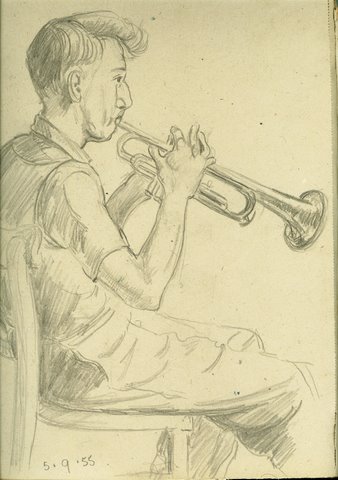 Ivan Playing the Trumpet. A pencil drawing (1955) by Ivan Bootham´s father, the artist Joe Bootham. |
A Piece Apiece for Twin Sisters
"A Piece Apiece for Twin Sisters" (1980) is a a composition for clarinet and piano which Ivan Bootham wrote wrote for his twin daughters to play and which he recently (June 2007) revised.
I was pleased to find that after changing a few notes (I could hardly call it revision) the piece, though essentially pleasant (my original intention), wasn't characterless. Also, what impacted on the nature of the composition was my attempt to keep it within my daughters´ technical capabilities as at that time. In addition I confined the piece to a classic and readily comprehensible form: A-B-A. But of course, as in any piece of music, whatever its technical requirements and form, what matters is what it sounds like, what happens within its structure.
A perhaps simple description of "A Piece Apiece" would be: it begins with the piano playing a gentle, rippling motif, moderato grazioso: the clarinet enters with a lightly soaring, slightly wistful plein-air suggestive tune: it is followed by some interplay between the clarinet and piano that leads to a middle section (B), which has something of a folk dance foot stomping character about it, pesante e ritmico: this gradually subsides and from its quietness the opening tune returns, but this time played an octave lower by the clarinet: this allows for a climatic build-up in which the clarinet and piano play the tune in unison in the higher original clarino range: this tune metamorphoses into a repeated motif, with some variation, that crescendos to a double forte, which suddenly cuts off for one beat of silence: out of this the piano plays a chord, in sound not untypical of jazz, while the clarinet plays a jazz-inflected acciaccatura, which prefaces a five-note descending motif, which comes to rest in the surrounding harmony of a piano chord appropriate in sound to the character in which the piece began.
And I wouldn't be surprised if it takes longer to read that description than it does to play the piece!
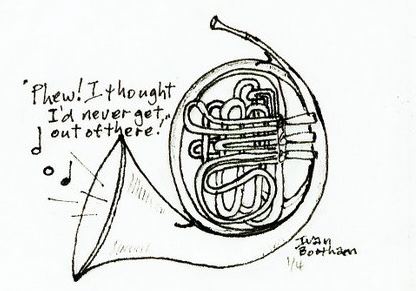 |
| A cartoon by Ivan Bootham intended as an envoi to "A String of Cliches" (1996). The intention was to place it at the end of the written music. |
.