























View My Guestbook
Sign My Guestbook


View or Post to our
Family Tree Message
Board!


|
|


Whether over here or over there, what will the weather be in Edinburgh or Rome.


World War II - Italians in Scotland - ALIENS INTERNED !!
 When Italy entered the war in June 1940, many Italians in Scotland were rounded up.
Wives and mothers of most Italian families living in the UK had to fend for
themselves - not only were their movements severely restricted but many of their
adult males were shipped to Northern Ireland, the Isle
of Man or Orkney with the intention to deport them to such places as Canada and
Australia.
When Italy entered the war in June 1940, many Italians in Scotland were rounded up.
Wives and mothers of most Italian families living in the UK had to fend for
themselves - not only were their movements severely restricted but many of their
adult males were shipped to Northern Ireland, the Isle
of Man or Orkney with the intention to deport them to such places as Canada and
Australia.
The Tragedy of the Arandora Star
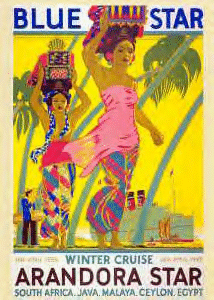 The
Arandora Star was built by Cammel Laird & Company of Birkenhead in 1927,
operated by the Blue Star
Line for cruises mostly to South America and South Africa. At the time
the ship was regarded as the height of luxury and was popular with the rich and
famous. She was referred to a The Wedding Cake because of her
white hull and violet stripe.
The
Arandora Star was built by Cammel Laird & Company of Birkenhead in 1927,
operated by the Blue Star
Line for cruises mostly to South America and South Africa. At the time
the ship was regarded as the height of luxury and was popular with the rich and
famous. She was referred to a The Wedding Cake because of her
white hull and violet stripe.
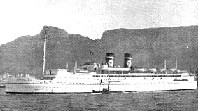 With
the arrival of World War Two the
Arandora Star was
called up to Liverpool for its orders. It's main purpose was to deport prisoners
of war, many bound for
Canada. However, the Arandora Star met its fate on July 2nd
1940 when a torpedo from a German submarine, the U-47, struck the ship, off the
Irish coast. There were 734 Italians on board the ship, 486
died. Of the 479 Germans on board, 175
died.
With
the arrival of World War Two the
Arandora Star was
called up to Liverpool for its orders. It's main purpose was to deport prisoners
of war, many bound for
Canada. However, the Arandora Star met its fate on July 2nd
1940 when a torpedo from a German submarine, the U-47, struck the ship, off the
Irish coast. There were 734 Italians on board the ship, 486
died. Of the 479 Germans on board, 175
died.
This incident caused an immediate investigation and though the British Government considered reversing their decision to transfer prisoners in this manner, it appears that many of the survivors were temporarily housed in Greenock (in a disused factory) before resuming their journey to Australia. En-route they again suffered torpedo incidents and maltreatment from some of the guards.
One of the survivors, Sgr. Baldelli recounts his experience in the form of a ballad (the translation of which I shall post on the website soon).
 Ironically, one of the Italian internees who perished in the Arandora Star was a
Silvestro d'Ambrosio, a confectioner and restaurateur from Hamilton.
Unbelievably, Silvestro lived in Scotland for 42 years, had one son in the British, and another in the
Canadian Army.
Ironically, one of the Italian internees who perished in the Arandora Star was a
Silvestro d'Ambrosio, a confectioner and restaurateur from Hamilton.
Unbelievably, Silvestro lived in Scotland for 42 years, had one son in the British, and another in the
Canadian Army.
It is also understood that there was a significant number of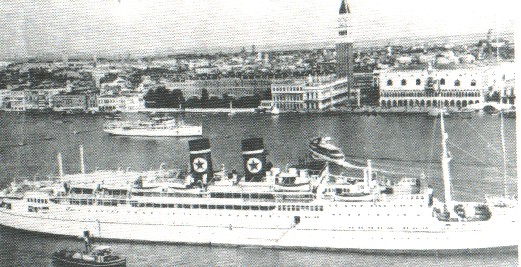 people of
Italian parentage who were actually born in Scotland, yet they too were on board
the Arandora Star.
people of
Italian parentage who were actually born in Scotland, yet they too were on board
the Arandora Star.
Today there have been countless calls to commemorate the tragic sinking of the Arandora Star with a day of remembrance.
Perhaps a poignant thought on this tragedy as recalled by Bruno Sereni in They took the low road.
'Our countrymen left no memoirs, no diaries, no scribbled notes. The little that we know has been related to us verbally.'
To some degree I believe that this also extends to the history of the Scots-Italian.
Isle of Man
 The
Isle of Man was the central focus for Italians interned in the UK during World
War II. I believe there still exists a number of survivors who formed the
original Prisoners Committee from the camp to this day.
The
Isle of Man was the central focus for Italians interned in the UK during World
War II. I believe there still exists a number of survivors who formed the
original Prisoners Committee from the camp to this day.
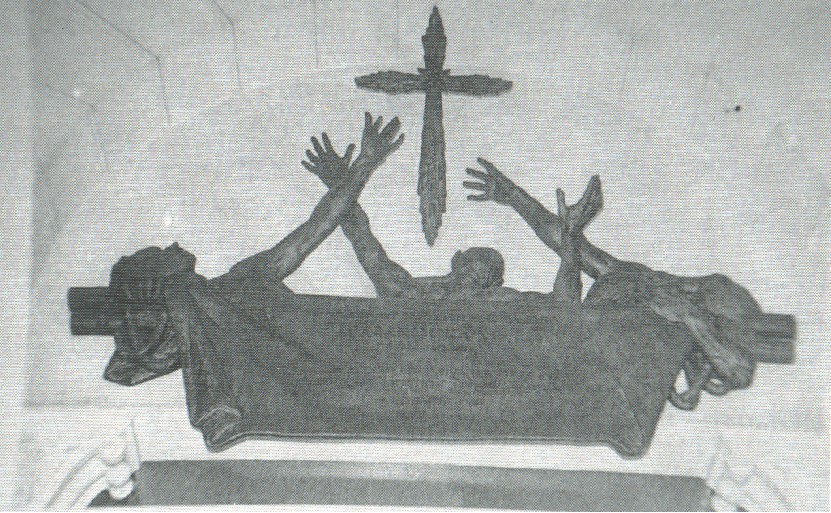
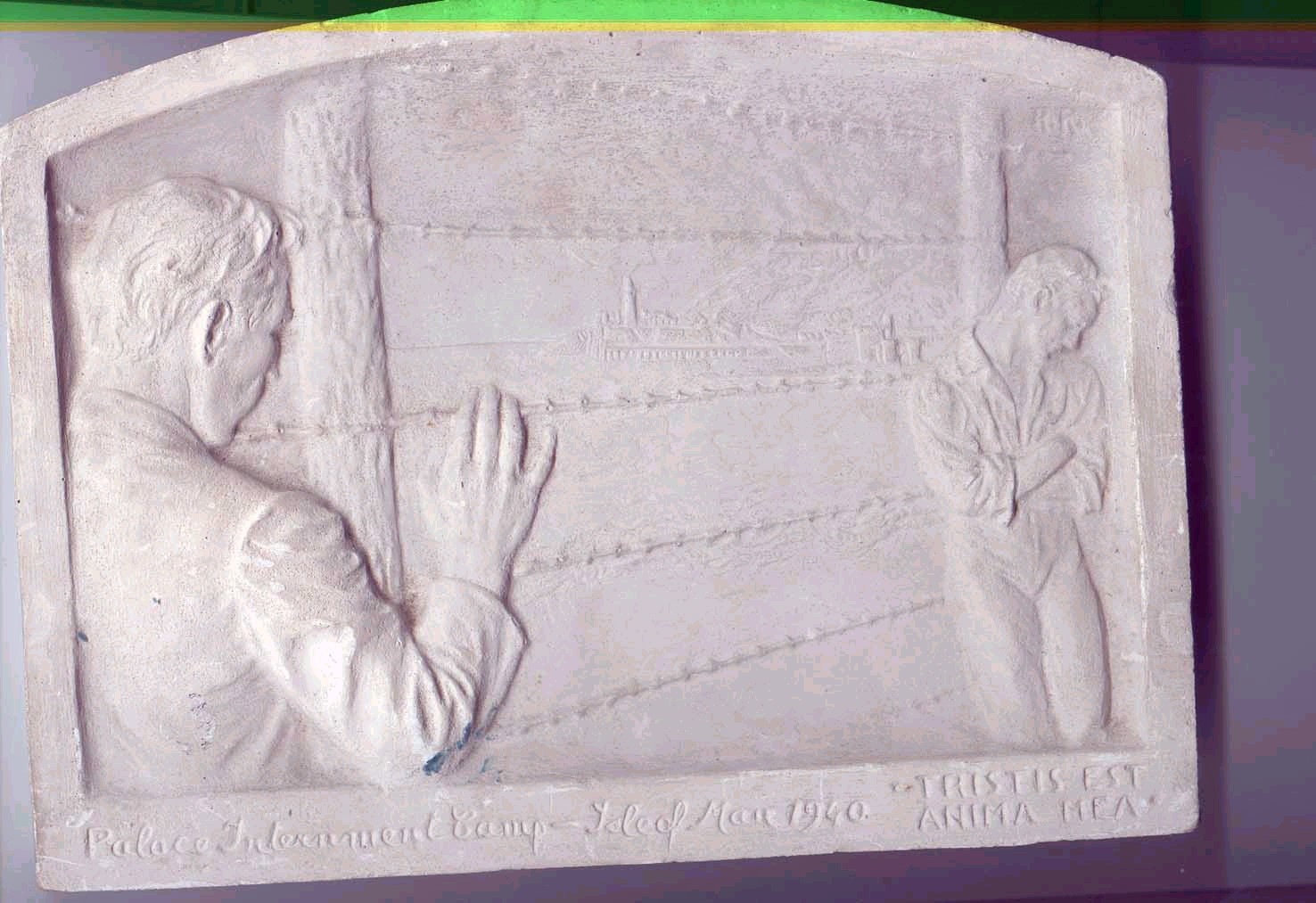
To the left is featured a plaster cast made in the camp, the
inscription reads "Palace internment camp- Isle of Man 1940 TRISTES EST ANIMA MIA"
(click on to enlarge).
Riccardo Verrecchia, owner of La
Scarpetta restaurant of Balloch, tells me that his father, Giuseppe (Joe) was perhaps the
youngest internee on the Isle of Man, aged just 15.
Accomplished author Peter Muccini recounts his experiences as a child growing up in Scotland during World War II in the following article.....
Blood, sweat, tears and….mushrooms.
“
This was how Prime Minister Winston Churchill ordered the arrest of all Italian nationals within minutes of Italy declaring war on Britain on June 10, 1940 and thousands of Italian families throughout the country had the police knocking at their doors in the dead of night.
Our family was awakened by a distressed Mrs Agolini who lived near us in Kilmarnock. The police had arrested her husband Vittorio and thrown her out on the street while they searched her house. She warned they would soon be calling on us and, sure enough, just as she said this, there was a loud banging on our door. One of the lawmen was Sergeant Nairn, a good friend of my Dad and he was very embarrassed and apologised profusely. However, the two others in plain clothes, probably from Special Branch, were cold and unpleasant. They told us they were going to confiscate any material they considered could be useful in espionage work. So they seized the wireless, an atlas, a Kodak camera, a pair of binoculars and a toy microscope, none of which was ever returned.
We spent the night in the cells (which I found exciting) and were released the following morning. Dad was not interned because he had been in the country for almost 40 years, but his brother, Alessandro, was taken to the Isle of Man. Dad’s business was given to a local businessman who paid the absurd rent of £2 a week. This was dad’s only source of income so he was forced to become a garzone, an employee. To most of the older Italians of the time, used to being their own boss, this was humiliation and rather like being declared bankrupt.
We were exiled to Newmilns, a sleepy village nine miles up the Irvine valley because Kilmarnock was a prohibited area with 20,000 troops stationed there including Poles, French and Canadians. We were under curfew and forbidden to leave our home between 1030 at night and eight in the morning. At first some of the villagers treated us with suspicion. Mum who used a small torch to find her way around in the blackout was reported once or twice for allegedly signalling to enemy aircraft. However, the hostility soon vanished. Some of the Italian girls had married local lads then serving in Dad’s Army (the LDV or Local Defence Volunteers, as it was then called, which later became the Home Guard). This and the fact that the younger generation of Italians were serving in the British forces persuaded the villagers that we were not fifth columnists. Nevertheless we were still kept under curfew and had to apply for permission to travel more than five miles from our home.
There had been heavy rains followed by the warmth of an Indian summer and Dad said the local woods would be full of funghi porcini, those delectable wild mushrooms irresistible to Italians. The problem was that they had to be gathered before dawn because they would either be eaten by slugs or rot in the sun. Despite the curfew the exiles decided to rise early and go into the woods nearby. They reckoned they could fill their baskets and be back within an hour without anybody noticing it so they left me blissfully asleep and unaware of their expedition.
“The
Germans have invaded,” he told me. All around me the grown-ups were pale
with fear while the kids seemed to be enjoying it all.
“Where’s my Mum and Dad,” I asked.
His reply filled me with dread.
“They are under arrest for helping the
Germans.”
Scared out of my wits I ran to the police station and was met by Sergeant Harper, a large, kindly, red-haired Highlander who was a friend of Dad’s. The sergeant tried to cheer me up with a mug of cocoa and a copy of the Beano but I was too upset and kept calling for my parents.
“I shall ask you once more,” he thundered. “What were you doing in the woods?”
“I have
already told you,” Dad replied with a hint of desperation in his voice.
“Gathering mushrooms.”
“Mamma! Papà” I screeched.
“Shut that door,” the man in the trench coat commanded.
I carried on wailing and then, as Sergeant Harper kept trying to comfort me, the telephone rang. The call was for the man in the trench coat. He strode out of the interrogation room, picked up the phone and listened for a few moments before saying: “Good. Message received and understood.” Then he went back to the interrogation room and told the detainees: “All right you lot. Pick up your rubbish and clear off home.” Scarcely believing their luck, Mum, Dad and the others made themselves scarce.
What had happened? That morning a gamekeeper told the police he had found dozens of German parachutes scattered about the woods. The police sounded the alarm and Newmilns was swiftly invaded by armed troops. They fanned out across the countryside and when they got to the woods they were confronted with Mum, Dad, Mr and Mrs Biagioni and Mrs Peri carrying baskets of mushrooms. They came to the conclusion that they were spies supplying sustenance to the enemy and immediately arrested them.
“I thought they were going to put us up against a wall and shoot us,” Dad said later.
Peter also reflects on how some others coped with the War years, living in Scotland under suspicion....
The contrast between the older generation who had retained their Italian citizenship and their offspring born in Britain was heavily tinged with bitter irony. Moreno Agolini subsequently served in the Royal Air Force (as did my brother Romeo) and his brother Elio joined the Cameronian Highlanders where he cut an imposing figure whenever he came home on leave in his dress uniform of kilt, tunic and Glengarry. The older generation, resident in Scotland for decades and known and well liked by the local population, were locked up as potential spies and many perished on the Arandora Star while their children were called up for military service and several gave their lives.
There was the shameful case of Dennis Donnini, a 19-year-old private in the Royal Scots Fusiliers, who won the Victoria Cross, Britain’s highest award for valour, in February 1945. Fusilier Donnini, who was actually a Geordie Italian from Easington Colliery in Northumberland, saved the lives of a dozen of his comrades by single-handedly fighting back a German detachment in a Dutch village street battle. The citation tells how Donnini lost consciousness when he was struck on the head by a ricocheting bullet. After coming to, he ran 30 yards down the street through a hail of bullets, lobbed a grenade into the house from where the enemy were firing and put them to flight. Donnini then pursued the Germans firing his Bren gun until he fell fatally wounded.
It was the normal practice for the King to present the Victoria Cross either to the recipient or posthumously to his next of kin. Donnini’s elderly parents, technically classified as enemy aliens, were not allowed to go to Buckingham Palace and the Victoria Cross was sent to them in the mail.
Many thanks to Peter for this interesting insight.....
Garibaldi and his Scottish connections
One of our readers, Michael Bacarella kindly emailed me with some interesting
information on General Giuseppe Garibaldi and his connections with the Scots and British.
As you are probably aware, Garibaldi's campaign to unify Italy began in 1860.
What you might not know is that the very boat he began his campaign on was the EMMA,
a ship that originated from the city of Aberdeen.
As a prelude to eventual unification of Italy Garibaldi formed the Italian Legion in Montevideo, Uruguay in1843. This force of brave volunteers coupled with his tactical military strategy and opposition to both Brazilian and Argentinean imperialism not only assured the freedom of Uruguay but made him and his followers heroes in Italy and beyond.
It is no surprise then that Garibaldi recruited many Scottish volunteers to go with him to Italy and fight for unification. They served in the British Legion and after this particular campaign many went on to fight in the Union or the Confederate armies during the American Civil War.
Their story is really unknown today and much more research and documentation is required to gain a clearer picture. For this purpose if there is anyone out there who has any information or old photographs on this topic then please email me. I understand they wore white and lavender uniforms.
Those soldiers documented are as follows:
(Notice many had Italian surnames)
 | Adams Peter, Edinburgh British Legion. |
| Bastiani-Urry, Johana or Joseppe Giusepp,British Legion, b. 1830 Sicily. |
| Chamberlain Philip, Edinburgh British Legion. |
| de Gallo F.Italian, Glasgow British Legion |
| de Gallo, Jeannie Deans,Glasgow British Legion (wife of F.). |
| Fraser H, Glasgow British Legion. |
| Gabriel Cueto, Glasgow Captain British Legion (led 50). |
| Gibb John, Edinburgh British Legion. |
| Gray Daniel, Edinburgh British Legion. |
| Henderson George, Edinburgh British Legion and an Italian/Polish unit |
| Law Jon, Glasgow British Legion. |
| MacCallum Donald, Edinburgh British Legion. |
| Matthew William, Edinburgh British Legion. |
| Matthews N, Edinburgh British Legion. |
| Matthews N, Glasgow British Legion. |
| Mauchline, Glasgow British Legion. |
| McFarlane George, Glasgow British Legion |
| McIver Henry Ronald Hislop (aka H.M. Hislop), b. 1841 Virginia of Scottish parents d.
1907, had strong Glasgow connections during his life; British Legion; CSA; biography "Under Fourteen
Flags:Being the life and adventures of Brig. Gen. MacIver, a soldier of
fortune." London Tinsely Bros. 1884. 2 vols; in later life fought for Maximilian in Mexico; he explored and made observations about the Berber tribes of North Africa he then travelled to Rhodesia in 1905 to explore Zimbabwe river in South Africa. |
| Mitchell, Glasgow British Legion, KIA Capua; |
| Monteith John, Glasgow British Legion. |
| Morastier Albert; Doctor; British Legion. |
| Munro , British Legion. |
| Nichol James, Glasgow British Legion. |
| Paterson George, Edinburgh British Legion. |
| Patterson Alexander B, ;British Legion; WIA Milazzo; |
| Pearson P, Glasgow British Legion. |
| Ritchie William, Edinburgh British Legion. |
| Ross Jon, British Legion |
| Rutherford William, Edinburgh British Legion. |
| Sarsfield, British Legion. |
| Scott James, Edinburgh British Legion. |
| Scott Robert, British Legion; joined the CSA, KIA Gettysburg. |
| Scott R, Glasgow British Legion. |
| Scrivener B, Glasgow British Legion. |
| Seaton Dan, Stirling British Legion. |
| Sinclair James, Glasgow British Legion. |
| Smith W. Adams, correspondent at Milazzo. |
| Stevenson J, Edinburgh British Legion. |
| Tucker Ensign, artist Illustrated London News, KIA Capua |
| Tweedale, Edinburgh British Legion. |
| Wigand Jon, Glasgow British Legion. |
| Williamson William, Edinburgh British Legion. |
| Wilson William, Edinburgh British Legion. |
After the War Garibaldi visited England and Scotland and lived for a time in Freshwater, Isle of Wight with Alfred
Tennyson at Farringford House, this occurred in April 1864. Garibaldi was also a guest of Charles Seely at Brook House.