





















View My Guestbook
Sign My Guestbook


View or Post to our
Family Tree Message
Board!


|
|


Whether over here or over there, what will the weather be in Edinburgh or Rome.


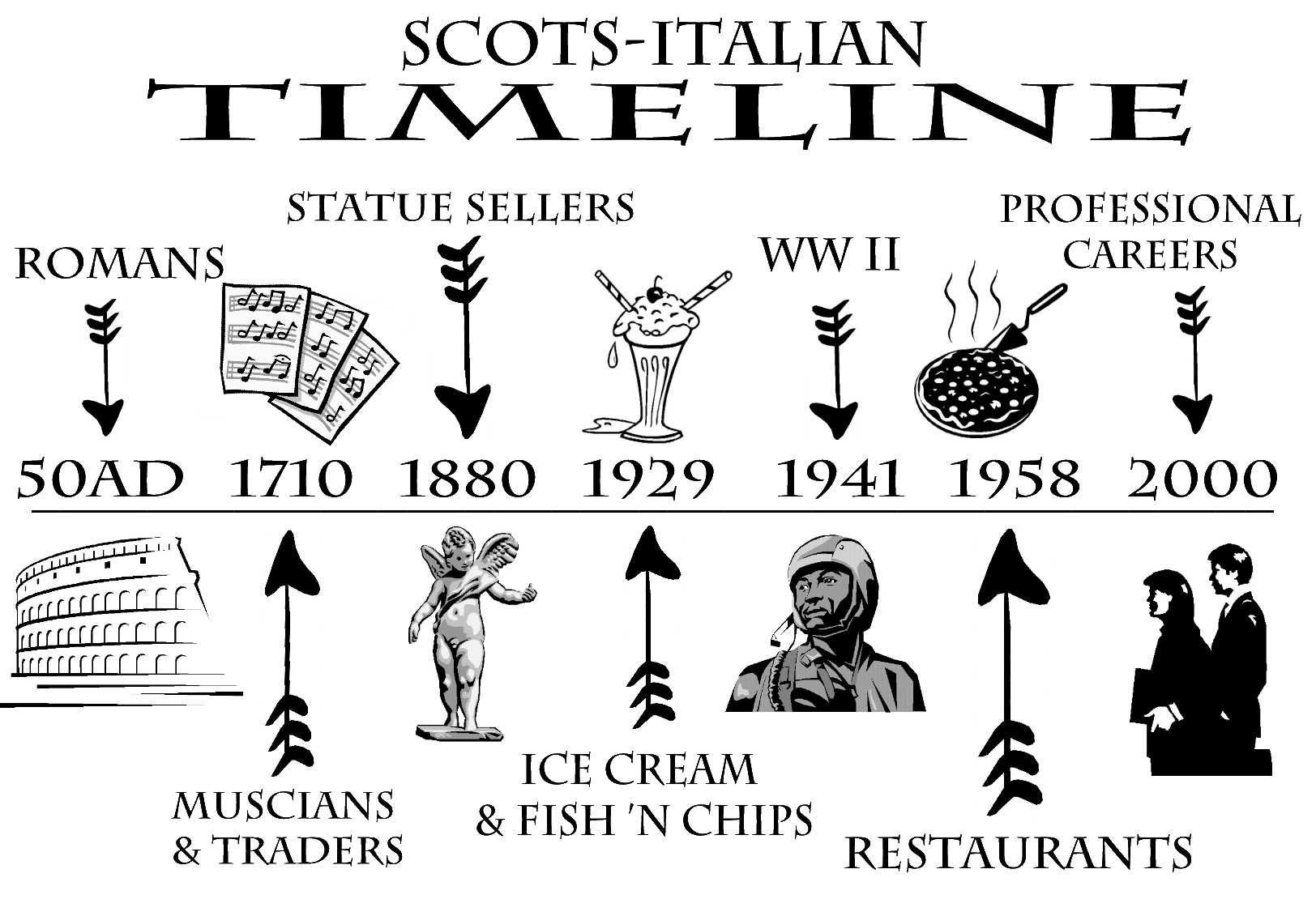
It is believed that the first Italians to reach the Scottish shores were the Romans in and around 50AD but once dispatched back to Empire HQ it wasn't until the mid 18th century that the next batch began to arrive in numbers, most of them artists, musicians and merchants. There even is an accredited Scots/Italian style of music from this period, one of the most famous protagonists being James Oswald (1710-1769) appointed court composer to George III in 1761.
However many of today's Scots-Italians can trace their history directly back to the mass migration of the late 1800's where their forefathers escaped famine, drought and poverty in their homeland for a better life in this country.
Let me expand on that a little and carry you on a journey through time to the present day......
 |  Scotland
was the Roman
Empire's furthest flung outpost - never fully conquered, the Romans left
'Caledonia' (as it was known to them) around 400AD - nearly
350 years since they first landed on British soil. Much of this was due to
the resistance from the Pict and Celtic tribespeople, who
overcame bribes and both Hadrain's Wall and the Antonine
Wall. Scotland
was the Roman
Empire's furthest flung outpost - never fully conquered, the Romans left
'Caledonia' (as it was known to them) around 400AD - nearly
350 years since they first landed on British soil. Much of this was due to
the resistance from the Pict and Celtic tribespeople, who
overcame bribes and both Hadrain's Wall and the Antonine
Wall. |
| One of Scotland's favourite sons Bonnie Prince Charlie, was born in Rome in 1720. |
| Perhaps some lessons were learnt from Roman Times as only a trickle of Italians came to Scotland thereafter, and it wasn't until the early 1800's that a significant number began to return! Those that did were mostly artists, merchants or musicians. |
| During this period it was musicians that were prominent throughout the musical societies of Scotland. This was mostly down to the energetic Scottish melodies and dance with the Italian influence becoming standard fare in musical circles. |
| 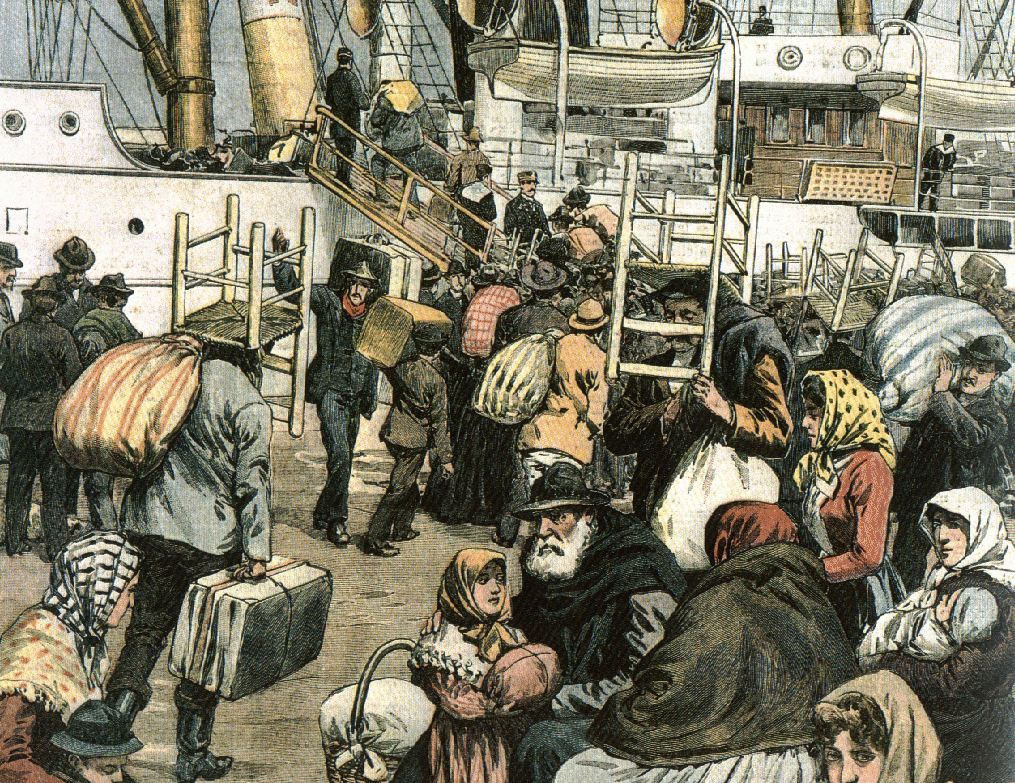 However the greatest influx of Italians to
Scotland can be traced back to the late 19th Century as many escaped famine
and corruption in their homelands for the brighter prospects offered abroad.
The first settlers were known as Ciociari from the Ciociaria region located
in southern Lazio. However the greatest influx of Italians to
Scotland can be traced back to the late 19th Century as many escaped famine
and corruption in their homelands for the brighter prospects offered abroad.
The first settlers were known as Ciociari from the Ciociaria region located
in southern Lazio. |
|
Fresh off the boat they would sell their wares in the port, anything from humble statuettes to blocks of ice. Many remained in the port cities of Glasgow, Greenock and Edinburgh, opening shops there. With dairy produce and seafood in abundance it wasn't long before ice cream serving Fish 'n Chip shops began to sprout. |
|
|
 However, it wasn't until the First World War
that a sizeable Italian community, over 4,000 in fact began to emerge in
Scotland, with Glasgow housing the third largest community in Great Britain.
Many left their family behind initially with a view to bringing them over
once a job and housing had been secured.
However, it wasn't until the First World War
that a sizeable Italian community, over 4,000 in fact began to emerge in
Scotland, with Glasgow housing the third largest community in Great Britain.
Many left their family behind initially with a view to bringing them over
once a job and housing had been secured.
|
Unlike many other communities, the Italian's soon diffused across the whole of Scotland rather than focus on any particular area. Much of this was to do with the need to accommodate expanding families and new arrivals from Italy. As many of them worked in businesses owned by Italians there was little threat to native workers. |
|
Before the advent of the Second World War many Italians were now second or even third generation and were developing a distinct culture all of their own. |
| Italy and the Fascist involvement in World War Two brought many hardships - families were separated as adult males were interned and the remaining family members who were left to run dilapidated businesses had to cope with mistrust and persecution. |
| Of those imprisoned many were held on the Isle of Man and Northern Ireland, some were even shipped off to Australia and Canada. A number met their fate on the last tragic journey of the Arandora Star whilst others created the wonderfully ornate chapel on Orkney. |
|
Some managed to escape back to Italy, my grandfather made it back to Barga the day before international relations between the UK and Italy were suspended. (Incidentally, the town was located on the Gothic Line - an area fiercely contested between Allied and German troops, so much so that today some buildings still sport the bullet holes. He was one of many that assisted retreating British Prisoner of Wars by sharing supplies despite the very real threat to their lives.) |
| Perhaps as a result of the trauma that WWII caused, the period that followed was one of a greater understanding and need for a certain degree of assimilation for Italians living in Scotland. Marriages between the two became more commonplace and the traditional backdrop of the fish and chip business began to slowly disappear as more and more Scots-Italians drifted into other professions. |
|
A sizeable minority of Scots-Italians felt that they had no choice but to leave Scotland shortly after the war. In essence they were to re-emigrate, with most heading for the 'lucky country', Australia. There is an article called But I'm From Planet Earth which appears in the Migration Heritage website of NSW, recounted by Michael Arrighi, Phd. In it he discusses his experiences as young boy growing up in Scotland - with parents of Italian extraction - and how World War 2 impacted on his "origins" when Italians were not the flavour of the day, and also having to cope in adulthood on becoming a 'New Australian'. |
|
Emigration to Scotland from Italy almost stopped after the War, visas were harder to come by and many chose to assist in the rebuilding of France and Belgium. As had been the case before the War, the USA and Australia were equally popular destinations. There was a small blip during the early 1950's however as the Duke of Argyll called on a number of foresters from the Barga region to work in his estate at Inveraray. |
|
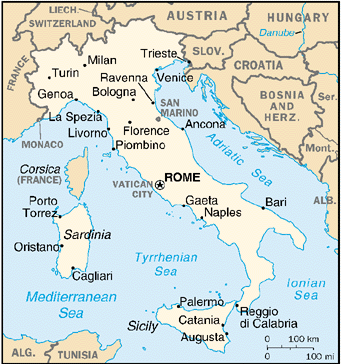
A curious fact is that the majority of Scots-Italians can trace their roots back to just six distinct areas:
It is believed that almost 70% As a rule of thumb it seems that most of those from Tuscan origins settled in the Glasgow area and most of those from Lazio in the Edinburgh vicinity. (Click on the icon to the right to enlarge and view a detailed Map of Italy.)
| ||||||||||||
| These limited number of areas of origin, coupled with the fact that unlike the rest of the UK, Scotland experienced very little post war migration from Italy, may explain the close links that Scots-Italians have retained with these communities. |
 Moving
the clock forward to the present day, Scots-Italians form an integral part
of our diverse society and appear in a wide variety of professions from Arts
to Media to Sport and more.
Moving
the clock forward to the present day, Scots-Italians form an integral part
of our diverse society and appear in a wide variety of professions from Arts
to Media to Sport and more. 
|
Changed days indeed from the humble Statue Seller of the 1860's. |