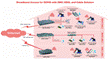
Usage of IP services via internet and networking connectivity will definitely go up as the public and businesses realign their strategy to adopt cheaper mode of communication and or provision of commercial and public online services. One of the factors that will drive the usage of IP services is the implementation of the new Internet Protocol known as IPv6. The current protocol is IPv4 which is 32-bit IP address scheme would be replaced by a 132-bit scheme of IPv6 enabling more and more devices that could be run via the IP services. The following are some the alternatives that could be considered for deployment:





HomePlug is a standard body for power line communication. This organization of about 50 companies sets the global HomePlug standard, currently at v 1.0. HomePlug 1.0 is the specification for a technology that connects devices to each other through the power lines in a home. HomePlug certified products connect PCs and other devices that use Ethernet, USB, and 802.11. Many devices made by alliance members have HomePlug built in and to connect them to a network all one has to do is plug the device into the wall in a home with other HomePlug devices. The current HomePlug standard allows for speeds up to 14 Mbit/s although they are developing HomePlug AV which allows for speeds greater than 100 Mbit/s, suitable for HDTV and VOIP, but still compatible with Homeplug 1.0. They are also working on a HomePlug BPL standard. HomePNA 3.0 is a relatively new technology, which allows you to network your home computers like a LAN using your existing telephone wiring. Internet access received by a single computer can be shared among several others without a router. Computers can access each other?s peripherals from printers to storage devices, files and play multiplayer games through
HomePNA
HomePNA 3.0 is a relatively new technology, which allows you to network your home computers like a LAN using your existing telephone wiring. Internet access received by a single computer can be shared among several others without a router. Computers can access each other's peripherals from printers to storage devices, files and play multiplayer games through HomePNA 3.0.HomePNA 3.0 uses different frequencies while conducting data across the phone line. A frequency is reserved and prioritized for phone calls and fax so that they take precedence over all other data transfer. V.92 modems have already incorporated this concept.
Wi-Fi (also WiFi, Wi-fi, Wifi, or wifi)
Wi-Fi (also WiFi, Wi-fi, Wifi, or wifi) is a set of product compatibility standards for wireless local area networks (WLAN) based on the IEEE 802.11 specifications. New standards beyond the 802.11 specifications, such as 802.16 (WiMAX), are currently in the works and offer many enhancements, anywhere from longer range to greater transfer speeds. Wi-Fi was intended to be used for mobile devices and LANs, but is now often used for Internet access. It enables a person with a wireless-enabled computer or personal digital assistant (PDA) to connect to the Internet when in proximity of an access point. The geographical region covered by one or several access points is called a hotspot. WiMAX is an acronym that stands for Worldwide Interoperability for Microwave Access, a certification mark for products that pass conformity and interoperability tests for the IEEE 802.16 standards.
WiMAX
WiMAX is a standards-based wireless technology that provides high-throughput broadband connections over long distances. WiMAX can be used for a number of applications, including "last mile" broadband connections, hotspots and cellular backhaul, and high-speed enterprise connectivity for business. Products that pass the conformity tests for WiMAX are capable of forming wireless connections between them to permit the carrying of internet packet data. It is similar to WiFi in concept, but has certain improvements that are aimed at improving performance and should permit usage over much greater distances. A WIMAX wireless internet map of coverage is being publicly developed now.