 HOMECLOWNS CIRCUS
 Role of ClownsHonorable MentionsPerformersCircus MusicP. T. BarnumBonkersReferencesABOUT USLINKS
| |
| HOME |
| CLOWNS |
| CIRCUS |
| Role of Clowns |
| Honorable Mentions |
| Performers |
| Circus Music |
| P. T. Barnum |
| Bonkers |
| References |
| ABOUT US |
| LINKS |
The history of the circus spans from the days of the
Roman Empire complete with lions, pachyderms, horses, chariot races and
performances to today's modern circus, Cirque de Soleil. The early Roman
circuses would not be considered a circus in the way we think of them today.
They were wild arenas filled with gladiators who fought for their freedom with
each other and against wild animals, to the thrills, cheers, and excitement of
the Romans. After the fall of the Roman Empire and during the subsequent
dark ages of Europe, the circus ceased to exist.
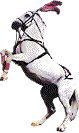
An Englishman, Charles Hughes,
was famous for his English Royal Circus and his ability to train first-class
trick riders. A pupil of his, John Bill Ricketts, brought the circus to the
American colonies around 1792. George Washington, a cousin to Ricketts, attended
his circus in Philadelphia during his presidency
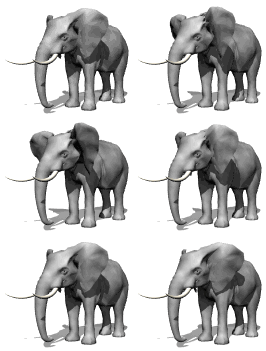
There were no elephants in American circuses until 1797.
The great circus pioneer, Phineas T. Barnum, bought Jumbo, a huge elephant, from the
London zoological society for $10,000. Jumbo arrived in New York City on Easter Sunday in 1882.
Jumbo was one of the most famous circus elephants around until he was killed by a
freight train in Canada, on September 15, 1885. During his history with the circus,
Jumbo had carried more than a million children on his back, including a young Winston
Churchill.
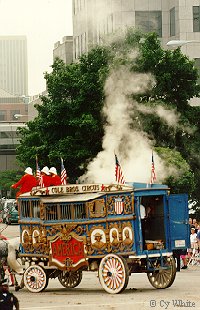
Until the late 70's, the large circuses would ride into town by train and proceed by
a parade through the town to the fair grounds to begin assembly of the big top and the
smaller tents. These tents include the wild animal menagerie, tents for the sideshows,
the dressing tents for the performers, the kitchen and dining hall tent, and a hospital tent.
Animals were kept in cages and stalls under tents. In large cities, the circuses performed
in large stadiums or auditoriums and did not have to unload the tents.
The first railroad circus cars built exclusively for circus travel were built
in 1872 by William Cameron Coup to move the Barnum Circus. Before the use of the
railroad, the circuses moved very slowly from town to town by wagons pulled
by the elephants and horses.
James A. Bailey, generally recognized as the greatest circus organizer of all time,
was operating the Cooper and Bailey Circus in 1873. By 1879 he had created a
tremendous show equaled only by Barnum's. In 1880, Barnum and Bailey combined to
form one mammoth combination.
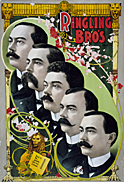
A few years later, in 1882, an ambitious group of
brothers, the Ringling brothers, took to the road with a small show, the
"Ringling Bros. Classic and Comic Concert Co." Within ten years,
this dedicated family of five brothers had turned their small show into a
complete three-ring circus and were particularly noted for their fine
music played by the great circus bands.
In 1891, the greatest showman on earth, P. T. Barnum, passed away. The circus continued under the guidance of James Bailey. By the turn of the twentieth century, there were two giant rival circuses, Barnum and Bailey and the Ringling Bros. When James Bailey died in 1906, the Ringling brothers purchased the rival circus and "The Greatest Show on Earth�," the Ringling Bros. and Barnum & Bailey Circus was formed.