|
together is better
the website of Dejan & Julie
Serving in Serbia
|
 Location and Geography
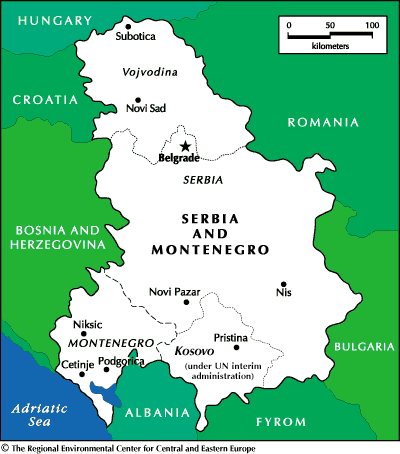
The Republic of Serbia is located in Eastern or South-Central Europe. Her neighbors are
mostly Slavic, with the exception of Romania to the east and Hungary to the north.
Serbia has a population of over 10 million, and it is estimated that approximately 8,000
evangelical Christians are living there (that's 0.008%).
The country is divided into several regions, both politically and geographically. Vojvodina
(VOY-vo-DEE-nah) is the northernmost region, mostly flat and the country's main
agricultural producer. It extends from Subotica (SUE-bo-TEETSA) in the north to Novi Sad
in the south.
Serbia proper is the heart of the country, within which is the capitol city of
Belgrade (in Serbian, Beograd), extending south into Kosovo towards the Macedonian border.
Many hills and mountains mark this region, and a large percentage of the nation's population
inhabit it.
Extending southwest to the Adriatic Sea is the republic of Montenegro, literally
"Black Mountains" (an independent nation since fall 2006). The republic's population of 785,000
is largely sustained economically through tourism, while goods and services are supplied
through Serbia or imported.
Religion
There is no state religion, but the Government gives preferential treatment to the Serbian
Orthodox Church, to which the majority of Serbs nominally belong (Orthodox 65%, Muslim 19%,
Roman Catholic 4%, Protestant 1%, other 11%). Holiday church attendance (rather than weekly)
is the normal practice. Under Communism, the Yugoslavian government made efforts to curtail church
influence. Special government-sponsored weekend activities and entertainment competed with
church attendance. Religious beliefs--and those who practiced them--were ridiculed in schools.
The nation was all but closed to missionary work, certainly that of evangelicals, leaving a void
of true spirituality for over 99% of its people.
After the fall of Communism in 1989, Yugoslavians
were extrememly open to the Gospel, and many came to faith in Christ through missionary efforts
at that time. However, the Serbian Orthodox Church is the recognized, though unofficial spiritual
authority in the nation, and many are hindered from even hearing the Gospel if the person
presenting it is from outside of its bounds.
Presently, an estimated 8,000 believing Christians live in Serbia (that's 0.008%).
So few are evangelical believers that almost every area, city, social and ethnic group
in the nation could be called unreached.
Politics
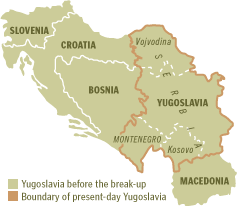
The Kingdom of Serbs, Croats, and Slovenes was formed in 1918; its name was changed to
Yugoslavia in 1929. At the end of World War II, Communism ruled for four and a half decades.
In the early 1990s, Yugoslavia began to unravel along ethnic lines: Slovenia, Croatia, and
Macedonia all declared their independence in 1991; Bosnia and Herzegovina in 1992.
President Slobodan Milosevic led the remaining republics of Serbia and Montenegro in
various unsuccessful military intervention efforts to unite Serbs in neighboring republics.
In 1999, war in the autonomous republic of Kosovo provoked an
international response, including the NATO bombing of Serbia and the stationing of
international peacekeepers in Kosovo. In Sept. 2000, federal elections in Yugoslavia
formally ended the autocratic rule of Milosevic, who had entangled his country in almost
continuous war, besides dragging Yugoslavia into economic collapse and relegating it to
pariah status throughout much of the world. In the spring of 2003, Serbia and Montenegro
formed a joint independent state of the same name.
Brief Yugoslavian History
The Slavs entered the western Balkans in the sixth and seventh centuries. From the 12th
century to about the middle of the 14th century the kingdom of Serbia was the center of
independent south Slav power. The Turks eventually conquered Serbia and the region of Bosnia, and held on
to them until the 19th century; meanwhile the northern areas of the peninsula came under the
control of the Austrian Empire. Only mountainous Montenegro kept its independence. Serbia
regained its independence during the 19th century, but the Balkans continued to be the
theater for rivalry among the great powers, chiefly Austria and Russia. It was the murder
of an Austrian archduke by a Bosnian-Serb revolutionary which finally sparked off the First
World War.
The kingdom of Yugoslavia, founded in 1919, suffered the beginning from Serb-Croat
rivalry, and tension between the two lay behind virtually all the country's political
problems between 1919 and 1941. The Serbian King Alexander followed a policy of
centralization although Croatians preferred a federal state with considerable local
autonomy. The king's policies led to his institution of dictatorship in 1929. From the
1920's groups organized on fascist lines aiming to set up an independent Catholic Croatia.
 In 1941 Hitler invaded Yugoslavia and the country was dismembered. The only nominally
independent part was Croatia which allied with Germany. Nazi policies sowed the seeds of the hatred
which persists to this day.
Meanwhile, the Partisans, the indigenous resistance movement led by the communist
Josip Broz (Tito), were working to free Yugoslavia from German occupation. A long
guerilla campaign led in 1944 to formal Allied support for Tito. The Croatian government
disintegrated and its members fled at the end of the war. With the help of the Soviet
Red Army, Tito finally succeeded in liberating the whole of Yugoslavia.
In 1941 Hitler invaded Yugoslavia and the country was dismembered. The only nominally
independent part was Croatia which allied with Germany. Nazi policies sowed the seeds of the hatred
which persists to this day.
Meanwhile, the Partisans, the indigenous resistance movement led by the communist
Josip Broz (Tito), were working to free Yugoslavia from German occupation. A long
guerilla campaign led in 1944 to formal Allied support for Tito. The Croatian government
disintegrated and its members fled at the end of the war. With the help of the Soviet
Red Army, Tito finally succeeded in liberating the whole of Yugoslavia.
The Federal People's Republic of Yugoslavia was proclaimed November 1945. Initially,
Tito followed a strict Leninist line and dealt harshly with any opposition, including
that based on religious belief. Soon, however, he found himself in disagreement with
the Soviet leaders and Yugoslavia was expelled from the Soviet bloc in 1948. From that
time, the country followed its own road and evolved a relatively humane political system.
In the late 1960's and 70's, many laws were created that kept the ethnic boundaries
established within Yugoslavia, as Tito foresaw that the unity among the south Slavs
was unstable. This act proved to be devastating to Balkan residents in Yugoslavia not
even 10 years after his death in 1980. Since ethnic lines were drawn, it left the door
open for battle lines to be drawn as well, but the complexity of the ethnic makeup of
Croatia, Bosnia-Herzegovina, and Serbia would make it extremely chaotic; and chaotic
it was. The break-up of Yugoslavia during the 1990s was accomplished through major
international political involvement which spurred devastating civil war.
A Little Bit of Trivia
Because the entire Balkan region was ruled by the Turks for over 500 years, there was
of course a change in the religious climate of some regions (namely Bosnia), as the
style of conquerors typically included a very persuasive "option" to convert to the
religion of the oppressing kingdom. However, a physically noticable demographic change
and a cultural imprint remains from the time of Turkish rule as well.
Unlike other slavic nations such as Ukraine, Poland, or Russia, the recessive blond-haired,
blue-eyed traits are difficult to find in any of the Balkan states, and the most common
hair and eye color today is brown. However, due to this blend of slavic "fair" and eastern
desert "exotic" beauty, women of this region are noted among the most beautiful on the
planet.
Also interesting to note is that much of the music of the Balkans carries with it a
Turkish flavor, ranging in intensity from hardly distinguishable to almost identical,
especially among current popular, so-called "national" or "country" music. Half a
milennium of exposure to this outside culture left its indelible mark.
top of page
|
|