| PRESIDENTIAL POLITICS: Fashionably Shallow? All rights reserved. Please give appropriate attribution for this article. The following material originally appeared on Tolerance.org, a project of the Southern Poverty Law Center. |
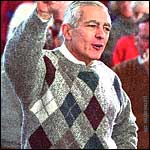
| By Brian Willoughby | Senior Writer/Editor, Tolerance.org Jan. 9, 2004 -- A recent New York Times story about the 2004 presidential race opened not with Gen. Wesley K. Clark's stand on the issues, but rather with a discussion of fashion: "Gone are his navy blue suit, red tie and loafers, replaced by argyle sweaters, corduroys and duck boots." Clark, the story says, "has begun to show a softer side" in an effort to attract female voters. Sexism aside � Do all women like argyle sweaters? Do women care more about duck boots than issues? � many observers say the thing that has gone soft in presidential elections is a substantive focus on the issues. U.S. presidential politics, they say, has become a personality-driven, horse-race analysis of who's leading in the opinion polls and who's likely to win the Iowa caucuses and the New Hampshire primary � and, in the case of this story, who's wearing argyle sweaters instead of navy blue suits. It isn't until the 13th paragraph � after mentions of Madonna and a brief discussion of opinion polls � that the Times story begins to address any significant issues, in this case abortion and judicial nominations. The New York Times isn't alone. A Los Angeles Times story this week called New Hampshire's primary "the state's version of the Olympics." A Seattle Post-Intelligence columnist, using phrases such as "odds-on favorite," spent more time discussing the impact of early wins and losses than the candidates' stands on issues. And a Slate story compares the primaries to a Miss America pageant, discussing the bridesmaid role of the first runner-up. With sports and beauty-pageant metaphors flying, Tolerance.org asked some informed media observers to discuss presidential politics. Have we lost sight of the issues? Do we spend more time talking about opinion polls and campaign strategies than we do about candidates' stands on such issues as racism, sexism, discrimination and poverty? "Right now, presidential politics could not be more discouraging," said Rita Henley Jensen, editor in chief of Women's eNews. "I rarely hear issues discussed that are of enormous importance. "The Democratic field has narrowed foreign policy concerns down to Iraq with occasional mentions of Israel," she added. "I am interested in events in those countries, but I also am very interested in the global gag rule [known by its proponents as the global family-planning policy] and its effects around the world." Domestically, education and other issues are getting short shrift, Henley Jensen said. And with a male-dominated field seeking a so-far male-only position in the Oval Office, Henley Jensen laments that women's issues "are being virtually ignored by all the candidates except Carol Moseley Brown." (Unless, disturbingly, the Times coverage of Clark's argyle sweater counts to mainstream journalists as a "woman's" issue.) Even when the media or political candidates do address specific issues, said Cathy Renna, spokeswoman for the Gay and Lesbian Alliance Against Defamation, the result is "frequent oversimplification." Consider same-sex marriage. "It's easy to cover this as a 'battle of the polls' and miss important distinctions in the legal, political and cultural aspects of this issue," she said. "What is lost is the real story � that an entire group of people (is) relegated to second-class citizenship... and that we have forces in this country who want to write discrimination into the U.S. Constitution with the Federal Marriage Act." 'Superficial' politics Geov Parrish, on the other hand, said it's too limiting to tie the shallowness of the discussion strictly to presidential politics. American political discussions, he says, always are shallow. "The American politics presidential races, superficial as they are, are the only time they pay much attention to politics at all," said Parrish, a columnist and reporter for Seattle Weekly, In These Times and Working For Change. But even if the presidential platform allows for a slightly more active discussion, Parrish said, it remains unsatisfying: "Emphasis tends to be on image, not on candidates' ideas, proposals or records." Whether that's the fault of the media or the candidates' is open to debate, though both groups likely have a role in it. Michael Dukakis, who lost a presidential bid to the elder Bush in 1988, tends to blame the media, as quoted in today's Buffalo News: "When was the last time you saw a good story about where the Democrat candidates stand on the subject of health care? They all have plans, but who knows about them?" Parrish, though, said the two-sidedness of American politics means candidates "are preaching to the converted � not engaging in any kind of dynamic process." That makes it unlikely if not impossible to have any cogent discussion of such matters as racism and discrimination. "To me, electoral politics today are the last place such change can happen," Parrish said. "Public policy seems to me to be whatever officials, with their pre-existing views, do to accommodate a combination of broad social trends, political opportunism and whatever the courts will or won't allow." DIG DEEPER Don't rely solely on mainstream media for coverage of the 2004 presidential race. In addition to Beginning the Journey and Tolerance.org, check out any number of alternative media websites for deeper and broader political coverage: Alternet Common Dreams Democracy Now Pacific News Service Women's eNews Working for Change |
 |