| On this page you can find information about the following topics: |
 |
| Situation |
|
| History |
|
| Culture |
|
| Nature |
|
| Climate |
| Situation: |
| Vicos is a small village situated about 60 kilometres northeast of the city of Huaraz, the capital of the Peruvian province Ancash. Huaraz is easily accessible by bus from Lima in about 7 hours and from Trujillo or Chimbote as well. From Huaraz, you can take a colectivo to Marcar� and then change colectivo up to Vicos. |
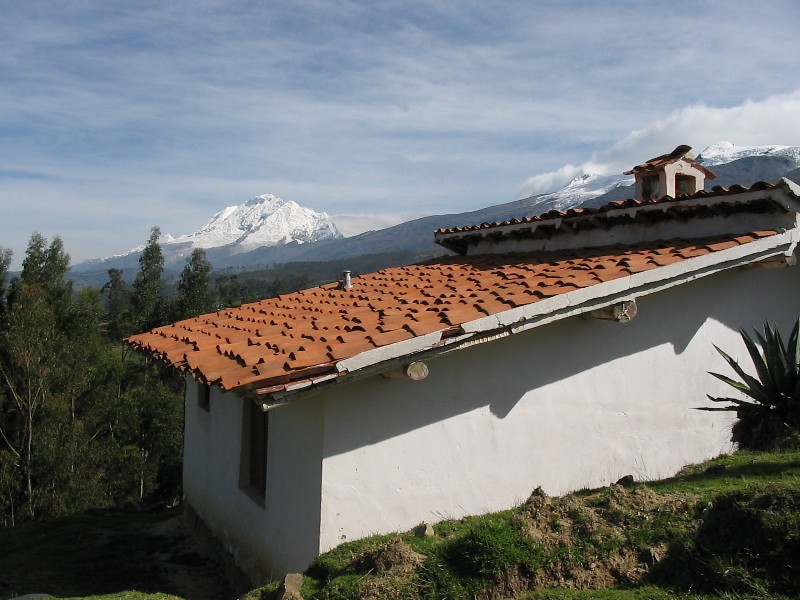
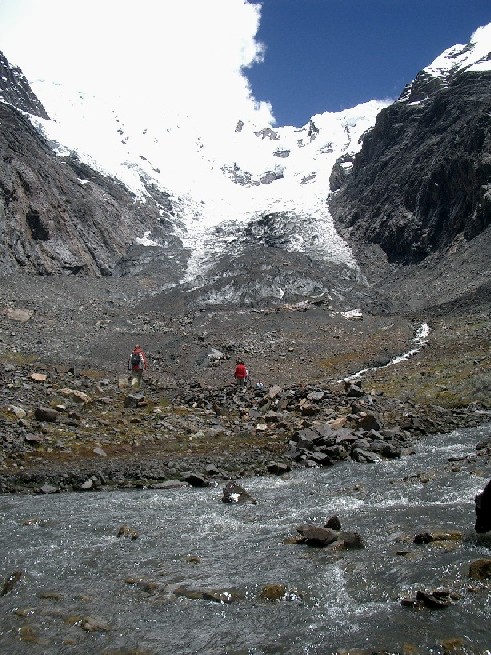
| The village is located at an altitude of about 3,100 - 3,400 metres above sea level. It is surrounded by the breathtaking mountain range called the Cordillera Blanca, famous amongst mountaineers because of the Alpamayo (world's most beautiful mountain, 5.965 m.) and the Huascar�n (Peru's highest mountain, 6,768 m.), which is shown on the photograph at the right. The white house is one of the tourist lodges of the project. |
| History: |
| Since human beings have lived in Vicos, their way of life has developed slowly. They have always led an agricultural life, living on the natural resources around them and using them in all kinds of ways. This is still the case in the present Vicos' society, though of course they have learned how to cultivate the land in a more efficient way and modern facilities have slowly started to introduce themselves in the everyday life of Vicosinos. |
| But the history of Vicos has not been without complications. One era with a great deal of impact on Vicos was from 1594 until 1962, when the community was a Spanish hacienda with a (Spanish) landlord being the leader of the whole place, treating the Vicosinos very badly. They were the landlords' slaves forced to pay extraordinary taxes (in alimentation goods) leaving little food for themselves and their families. For centuries the Vicosinos (and elsewhere in Peru many other indigenous community members) have been oppressed and it was practically impossible to do anything against it. |
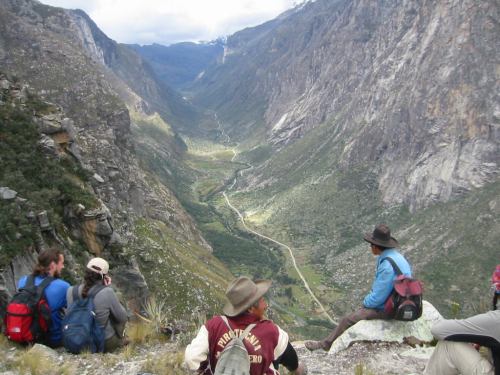 |
| However, in 1952 Vicos reached national and international publicity because of the starting of a project, executed by the Ministry of Labour and Indian Affairs in co-operation with the Cornell University in Ithaca, New York, to demonstrate that community development and land reform can be done. It was Peru's first such development program and received extensive publicity around the country. This situation provoked consternation amongst landlords and elite interests, who purposefully delayed the conclusion of the project. Vicos became an independent community in 1962, when they were finally permitted to purchase the estate that they and their ancestors had cultivated for others for 368 years. With this project Vicos made several hundreds of similar hacienda communities to set the same objective for their communities. After many developments in changes of presidents etc this all lead to the great land reforms in 1963 and 1969. |
| After these land reforms normal life could start over again. People had a good life, enough land to provide food for their family, and many foreign NGO's started development projects in the community, like the construction of drinking water systems, school buildings, and others. A mining company sponsored the construction of a road down from the main valley (Callej�n de Huaylas) passing by Vicos and then all the way up into the Quebrada Honda, a remote valley where Vicosinos mostly cultivate native potatoes and where the mining company extracts different kinds of minerals, among which are gold and silver. |
| Culture: |
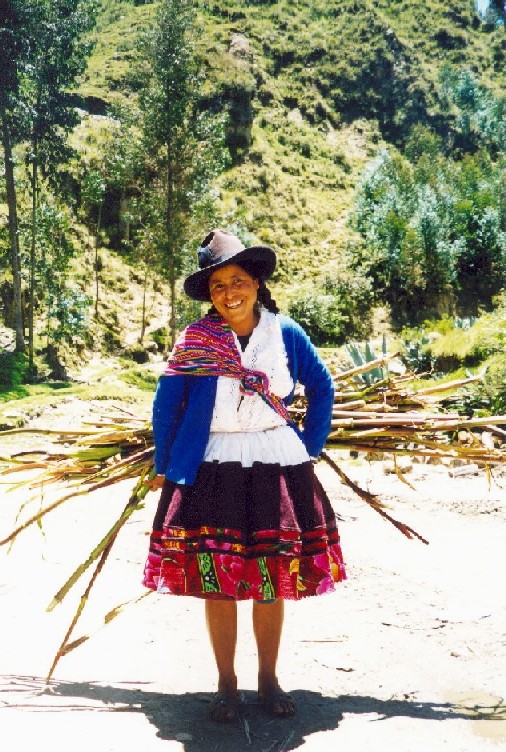
| The people who live in Vicos are all so-called campesinos, which means "peasants" or "people from the field". They are sometimes called native Americans or Quechua Indians. The campesinos speak their own native language called Quechua, which, for your interest, was also the official language of the Inca Empire. Many of the beliefs of the Inca's can still be witnessed in the everyday life of the campesinos. Though the Spaniards brought Catholicism into campesinos' lives, many of the traditional Quechua rituals still exist, as well as many of the beliefs that campesinos have in spiritual aspects and their bond with nature. |
| One of these beliefs for example, is related to a hill nearby the village. It is surrounded by thorn bushes and people believe that there are spirits living on top of the hill. "At midnight you can hear the bells ringing", they all say. And they fully believe in it, you will never see one of them trying to get to the top of that hill. |
| Another interesting phenomenon is that of the "bad winds", the "malos vientos". These are air currents which bring bad luck or diseases to the village. Sometimes they stop at once, during a hike, saying that there are "bad winds" at that spot and that you have to look out for it. |
 |
| A ritual connected with the people's close relationship with Mother Earth (Pacha Mama in Quechua) is that when they drink something, they first have to spill a little bit of the liquid on the ground, as an offer to Pacha Mama. |
| During your stay in Vicos you will experience these rituals and beliefs, as well as many others. |
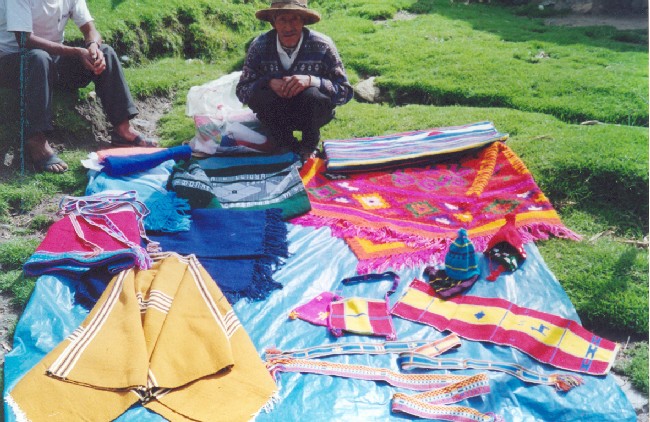
| A visible aspect of the Quechua Indian culture is the handicraft. There are many artisans in Vicos, and each and every one of them has his/her own specialisation. There is a man specialised in making wooden spoons, as another woman is known for her high quality skirts. Others manufacture wooden tools, all sorts of weavings with natural ink, pottery, musical instruments, and so on. |
| Nature: |
| The natural environment of Vicos is characterised by its surrounding mountains. Therefore, the landscape is different depending on the altitude. At the altitude of the village agriculture dominates the scenery with potatoe, wheat and corn |
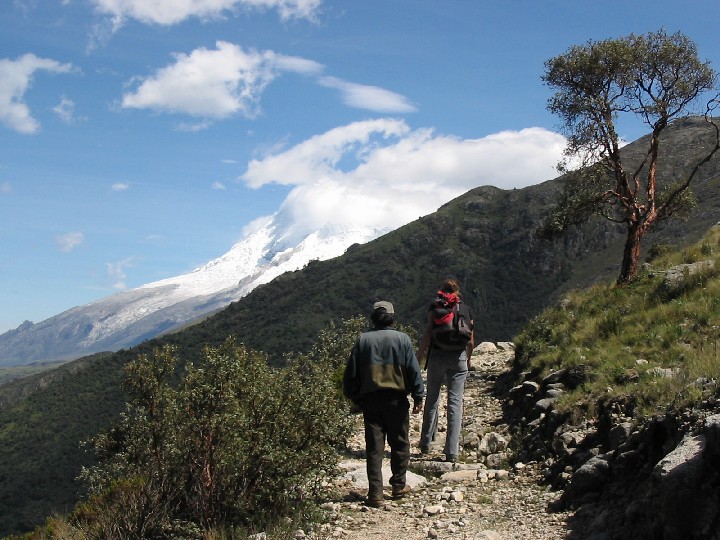 |
| fields. In between those fields eucalyptus forests are found, which are not original to this landscape. |
| On higher altitudes (between 3,500 and 3,800 m) there are many grasslands that are used for cattlebreeding with sheep, goats and cows. Bigger eucalyptus forests and quenual forests are also found on these heights. Quenuales are native trees and as opposed to the eucalyptus trees they are not harmful to the soil. |
| Even higher than this (around 3,800 up to 4,500 m) we find huge grasslands with another type of grass (the type you find at tundra's) and more quenual forests. The only crops that grow here are different sorts of native potatoes. |
| Climate: |
| There are two seasons in the area of Vicos. The rainy season starts around September and lasts until April. At night the temperature is soft, around 8�C. In the mornings the weather is sunny with 20-25�C, however in the afternoon it starts to rain and temperatures drop to 12 or 13�C. |
| Between April and September the sun shines almost the whole day and temperatures range from 6 degrees at night up to 30�C degrees during the day. Late in the afternoon strong winds start to blow and bring cold air into the valleys which makes the evenings and night really cold again. |
| During the rainy season it is not recommendable to visit the Andes because it rains the whole afternoon and there is a high risk of earthslides. |
 |
|
|
|
|
|
|
| QUICK MENU |
| Guestbook |
| What to see and do |
| Your stay in Vicos |
| How to book |
| About the project |
| Photo Albums |
| Home |
|
|
|
|
|
|
|
| QUICK MENU |
| General information |
| What to see and do |
| Your stay in Vicos |
| How to book |
| About the project |
| Photo Albums |
| Guestbook |
|
| HOME |
 |
 |
 |
| General information |