| On this page you will find information about the Tourism Development Project "Cullaquihuayi" in Vicos, and of the tourism product it offers. |
 |
| About the organization |
|
| The Tourism Product |
| About the organization "Cullaquihuayi" and its Tourism Development Project: |
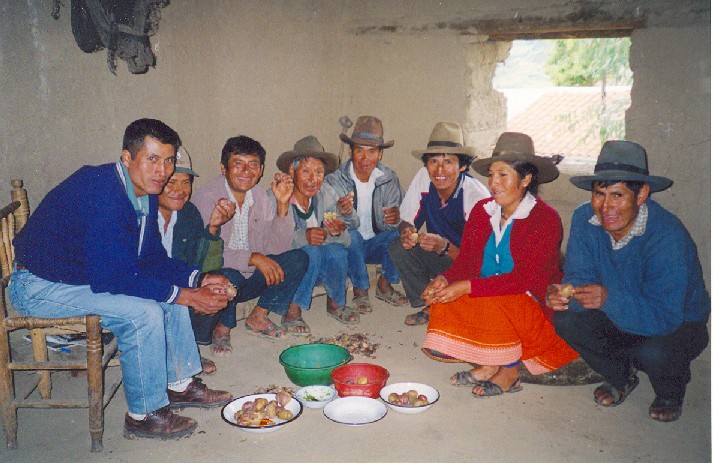
| The organization Cullaquihuayi is a very small and young tourism organization in the village of Vicos in the Andes of Peru, run by local Indians, from now on called the "campesinos". The organization has been started in co-operation with a Peruvian NGO called The Mountain Institute, who started a tourism development project in the village of Vicos, and wanted the locals to have the ownership of the project. After having trained them in all organizational, cultural, environmental and social aspects of a tourism project, the Mountain Institute plans to let the campesinos run the project individually by making their own, well-thought decisions. |
| The organization's main goal is to develop the region, especially the village of Vicos. People who live in Vicos have always been very poor but they had their own lands where they could crop their own food. Medicines could be found all around the village in the form of plants, flowers or other natural things known to cure several diseases or other problems. For centuries the campesinos of Vicos have been living and surviving like this, but lately problems have arisen. Overpopulation is probably the biggest problem, as good agricultural lands are getting scarce and inadequate to provide food for all inhabitants. |
| Tourism development in the rest of the region has brought financial growth in many places, especially because of the beautiful natural environment. Unfortunately Vicos has always been left out of this development. |
| This is the main reason why The Mountain Institute chose the mountain community of Vicos to develop a tourism project on a very sustainable way in which locals participate in the decisions that are made. This has been called Participative Tourism (Turismo Participativo). From the first decisions on, the campesinos have decided what would happen, in co-operation with employees of the Mountain Institute. |
| The Mountain Institute executes this program on a non-profit basis, and profit has to go to communal projects and not to personal financial satisfaction of the eight project members. The project members, all campesinos from Vicos, have all agreed on this. One of the most important objectives is to preserve the natural and cultural environment of Vicos. |
| The tourism product consists of seven lodges with a capacity of two up to four guests. The lodges have basic commodities such as a small bathroom with running water (only cold) and a compost toilet, beds and a fireplace. Of course the simple fact of having an own lodge and some privacy is a nice thought. During their stay, tourists eat together with their host family (each lodge is built close to the house of the family of one of the project members) and make small or large hikes to discover the natural beauty of the environment and / or learn about the way of life of the campesinos. The campesinos (all project members are now trained guides) will tell their guests all about the crops that can be seen, when they grow and how they grow, the animals that live in and around the village, show medicinal plants and explain the way they work and what disease they are for, etc. Furthermore guests will learn all about the life in the village, the way the politics are structures, when kids go to school, when they marry, when they have babies and how many, etc. After one week in Vicos tourists will have the feeling that they know very well what goes on in an Indian village, quite a unique experience. |
 |
|
|
|
|
|
|
| QUICK MENU |
| Guestbook |
| What to see and do |
| General information |
| Your stay in Vicos |
| How to book |
| Photo Albums |
| Home |
|
|
|
|
|
|
|
| QUICK MENU |
| General information |
| What to see and do |
| Your stay in Vicos |
| How to book |
| About the project |
| Photo Albums |
| Guestbook |
|
| HOME |
| About the project |
 |
| The Tourism Product |