|
|
|
|
|
|
|
|
|
|
|
|
|
|
|
|
|
|
|
FAQ
|
|
What previous clients have
said
|
|
|
|
|
|
|
|
|

Breathtaking, Stunning, Spectacular, Unique.
These are just some of the words used to describe Mongolia. From
the vastness of the Gobi desert to the pristine waters at Lake
Khusvgul. Once the centre of the greatest empire in the world
under the rule of Chinggis Khan, it is now a vast land, where
camels and wild horses road about the plains, eagles soar overhead
above mountains and where half the population still live in traditional
gers. Mongolia is opening its doors and many wonders to everyone
and promises a trip to remember. Come to Mongolia, a place which
has not been discovered to a large extent by the international
tourist, by has so much to explore.
|
|
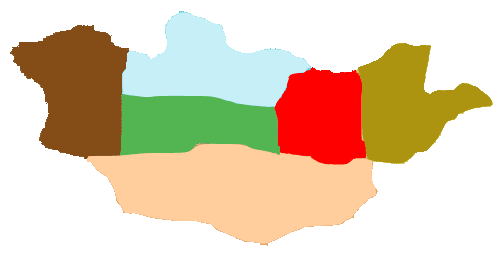
Ulaanbaatar is the capital city of Mongolia
and by far its largest city with over one quarter of the population
living here (around 700,000 people). Built along the Tuul river
and surrounded by mountains, It boasts many monasteries and museums.
Terelj
Located not far from Ulaanbaatar, Gorkhi-Terelj national park is
the most visited natural tourist sight. The national park is a popular
place for trekking, horse-back riding and rafting tours. There are
also many children's summer camps and tourist ger-camps in Terelj.
Bogd Khan's Palace-museum
This palace museum has different religious objects and clothes
used by the last Mongolian Jebtzundamba 8 Bogd Gegen and a rich
collection of masterpieces in Mongolian art. The ensemble of the
winter and summer palaces is an amazing monument of traditional
Mongolian architecture.
Natural History Museum
The skeleton of a giant dinosaur tarbosaurus which lived 70 thousand
years ago is the most interesting exposition of the museum. Here
you can get acquainted with the fauna and flora and natural resources
of Mongolia.
Zanabazar's fine art museum
Zanabazar, an excellent sculptor, architecture and the first Bogd
Gegen who lived in the XVII century. In this museum, you can explore
the famous masterpieces by Zanabazar such as Green Tara, Golden
Stupa. Plus, the museum has a rich collection of paintings on silk
and appliqués, thang-kas made in the 17th and 18th centuries
by Mongolian handcrafts.
Gandantegchilen Khiid
This is the biggest centre of Buddhism, which contain around 200
monks who provide plenty of colour with their chanting and ceremonialising.
The most exciting temple to visit in the Megjid Janraisig temple
which contains a 26 metre high statute.
Choijin Lama's temple-museum
Choijin Lama's temple was dedicated to the brother of 8 Bogd Gegen.
This ensemble of temples has preserved a lot of religious artefacts.
The highlight of the museum is the tsam religious dance masks. Begze
Darmapala's tsam mask made of coral is the main attraction.
|
|
Kharkhorin
Kharakhorum (now known as Kharkhorin) is the ancient capital of
Mongolia where the Mongol Empire was governed for 40 years, until
Kublai Khan moved the capital to Beijing. Following this and after
the collapse of the Mongolian empire, Kharakhorum was abandoned.
Erdene Zuu
Abtai Sain Khaan of Mongolia built the monastery on the ruins of
Kharakhorum, the old capital of the Mongolian Empire in 1586. Mongolian
architects headed by master Manzshir built Erdene Zuu using old
Kharakhorum building foundations, stones and blue bricks. Erdene
Zuu walls, stupas, temples, statutes and sculptures in the temples
exemplify high skills of Mongolian masters.
17640 square metres of land walls up the Erdene Zuu compound. The
walls have four big gates symbolising the four directions and eight
points. The walls consist of 108 stupas, 25 on each side and 2 on
every corner. In the middle of the compound is a big ger 20 metres
in diameter called Bat-Ulzii. It was built in 1658. In front f the
ger there was a hand-made lake. Water pipes were laid from the Orkhon
River to supply the lake with water.
The temples of Erdene Zuu contain an excellent collection of thangkas,
tsam masks, wooden and bronze statutes, appliqués and papiermache
of various gods made by Mongolian masters in the 16th and 18th centuries.
Orkhon Valley
The cradle of Mongolian history - the Orkhon River Valley - is the
most popular and largest tourist centre. The Orkhon river basin
is rich in historical and natural monument, like the Orkhon river
waterfall not far from Bat-Ulziit soum, Ovorkhangai aimag. Horseback
riding and trekking tours have become popular in the area. There
are many ger-amps and tourist centres around this place.
Khorgo
A natural monument located in Tariat soum of Arkhangai aimag, Khorgo-Terkhiin
Tsaagan Nuur national park was established to protect the spectacular
mountain scenery and endangered species of fauna and flora. The
unique natural complex of Horgo mountain (2240 m) and Terhiin Tsagaan
lake (28 square m) appeared as a result of volcanic eruptions many
thousands of years ago. The area has extinct volcanoes, many beautiful
lakes, great numbers of animals and birds and is definitely one
of the best natural tourist attractions
Khar Balgas
Orkhon or the Uighur capital ruins are located on the bank of the
Orkhon River in the territory of Khoton soum, Arkhangai aimag. The
ruins clearly depict that the capital city of the Uighurs was expanding,
and more and more constructions were built outside the city walls.
There are also remains of a water drainage system there. Khar Balgas
is an important place connected with the ancient history of the
Mongolians.
Khushuu Tsaidam
These monuments devoted to the Orkhon Turkic Khaan and his brother
general Kultegen are in the Khashaat Soum, Arkhangai aimag. 6-7th
Century AD was a time for glorious victories of the Turkic states.
The 3.3 metre high and 1.3 metre wide stone monument known as the
Orkhon Bichig (letter) is a letter with 68 lines. There used to
be a whole monument complex, but now only Gerelt Khushuu is left.
Monument of Tonyukuk
Monument of Tonyukuk is located in the Tuul river basin near the
small town of Nalaikh. It was made in 744 and devoted to the wise
minister Tonyuyuk of the Orkhon Turkic state that was prospering
in the 4th-7th century A.D. The ancient Turkic state had been fighting
with the others and aiding the Tang rulers of China. In war and
peace, great was the deed of general Tonyuyuk who devoted all his
life to the well being of his state. The monument is built to commemorate
him.
|
|
Near the Siberian border lies Bulgan, Khuvsgul,
Selenge and Zavkhan aimags. These area are populated by steppe of
mountains & forests and taiga. There are plenty of elk, raindeer
and bears, and rives and lakes filled with an abundance of fish.
The highlight of Northern Mongolia is lake Khuvsgul.
Khuvsgul Lake
Khuvsgul Lake and Siberian Taiga in Khuvsgul have become one of
the most popular tourist sights in the country. Lake Khuvsgul is
136 km long 36 km wide and 262m deep, and is located at an altitude
of 1645 m above sea level.
It is the second largest fresh water lake in Central Asia. It is
inhabited by nine species of fish including the Siberian grayling
and lenok. Fishing and sport fishing have become popular in the
lake area. Taiga, fauna and flora, taiga forest dwellers, Tsaatan,
practicing raindeer breeding are the main attractions for tourists.
Amarbayasgalant Khiid
The second most important monastery is Amarbayasgalant Khiid, on
the southern slope of Buren khaan in Selenge aimag. The original
palace was built in the 17th Century for the 2nd Bogd Javdandamba
Hutagt Luvsandambiidundmid.
Later the construction was completed with several temples where
regular religious ceremonies were held, so the ground became a real
monastery. The 300 year old khiid buildings have enamel ceilings
and functional pillars with special pipes inside for rain drainage.
Khogno Khaan Uul
Just on the border area of Bulgan, Ovorkhangai and Tuv aimags is
the Khogno Khaan mountain. This is a picturesque area with steppes,
mountains, forests and mineral water sources. Ruins of the 19th
century temples and monasteries are found at the Khogno Khaan Uul.
Trekking and horseback riding are popular in this area.
Uvgun Khiid
Uvgun Khiid is one of the 10 stone monasteries built by the Mongolian
master of those times. The monastery was built in the Khogno Khaan
Uul mountains in the 16th century.
|
|
The southern region of Mongolia contains five aimags (Bayankhongor,
Dornogov, Dungov, Gov-Altai and Omnogov which contain sections of
the Gobi desert. filled with wildlife, you will see camels, hawks
and gazelles in this area. This is also the area where many dinosaurs
have been discovered.
Khongoryn Els
The 800 metre high sand dunes in Sevrei soum, South Gobi aimag,
are called Khongoryn Els. These dunes are 20km wide and 100 km long.
The Khongoryn river flows along the sand dunes and gives birth to
oases. Trekking and camel riding tours are favourites amongst tourists
to this area.
Baga Gazryn Chuluu
The 1751 metre high granite mountain in the territory of Adaatsag
soum, Dungobi aimag is another place with unique scenery that many
tourists compare with lunar scenes. The mountain contains remains
of old temples. They are also rich in minerals, crystals and other
rocks.
|
|
Made up of three Aimags of Dornod, Khentii
and Sukhbaatar which lie between the Chinese and Russian border,
Eastern Mongolia is pure steppe, besides the spectacular Khentii
mountain range which is surrounded by forests. It is home to various
forms of wildlife, including the Steppe Eagle.
Dornodyn steppe
Dornodyn steppe which occupies a vast area in the territories
of Dornod and Sukhbaatar aimags, is one of the last undisturbed
plain ecosystems in the world. The vast Mongolian steppes of Dornod
are the habitat for a million gazelles and few other mammals. The
area is home to many species of birds.
Khentii Nuruu
Believed to be the birthplace of Chinggis Khan, it is part of
the giant 1.2 million hetare Khan Khentii strictly protected area.
It contains lakes, an abundance of wildlife and beautiful wildflowers.
|
|
Made up of three aimags (Bayan-Olgii, Uvs and Khovd), Western Mongolia
is dominated by the Altai mountain Nuruu range. It contains many
mountain treks, popular to climbers and possess many river. This
region is home to many Kazak nomads, who used trained eagles to
catch their food.
Tsambagarav
The 4195 meter high mountain with a snow covered peak is called
Tsambagarav. The mountains are located in the Altai highlands, which
are quite rich in wildlife. The rivers and lakes are full of various
fish. The Altai mountains are a good spot for mountain climbing
and trekking.
|
|