Fox Sites in Ireland new Fox History new Fox Genealogy and links Fox Events Fox Lines The Fox Septs Pictures from September 2000 Fox News
Foxsites in Ireland
Pictures and history
-MJ Fox
New pictures ! Fox family cemetary on the remain of the old Foxhall estate in Legan, County Longford. For more info on that site visit www.longfordtourism.com/areas/legan.html
Patrick Fox headstone
click to see a larger image click on the picture (you should be able to read some of the inscription)
Nathaniel Fox Headstone
click to see a larger image click on the picture (you should be able to read some of the inscription)
Headless Knight
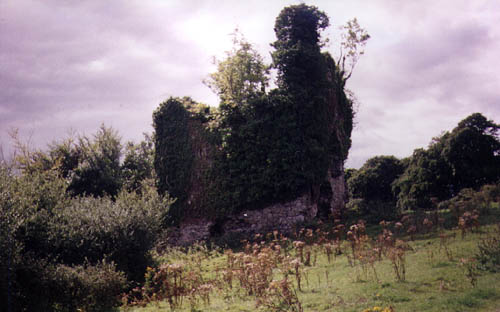
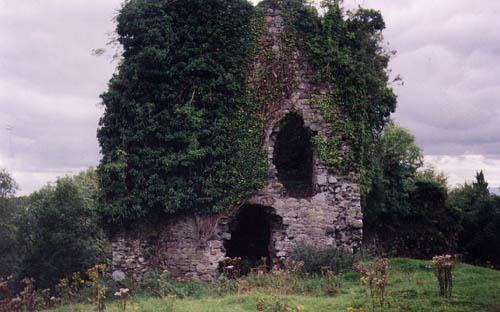
Kilcoursey Castle Ruins
Ivy-covered Kilcoursey Castle ruin
Front view Kilcoursey Castle ruin
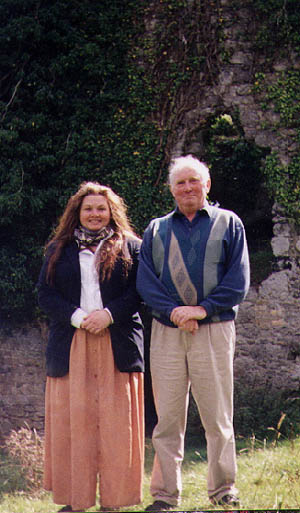
MJ Fox & Michael Fox at Kilcoursey Castle Ruins
to see a line drawing of the castle click here
The Fox Clan Chief Inaugural Stone
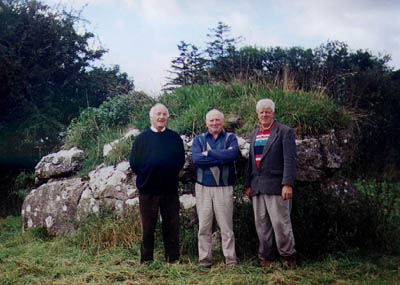
Jim Kenny, Michael Fox, and fred Geoghegan at
'Clogha tanny' (the rock of the Foxes) near Ballycumber & Clara
The Fox Clan Chief Inaugural Stone
Yes, this sounds like a hoax, doesn't it? But it really does exist. While sitting in the Offaly Historical and Archealogical Society's reading room, John Kearney, one of the working members, approached me and told me there was another man who had done some research on local families, and perhaps I would like to speak with him. Jim Kenny proved to be an excellent source of information. He told me some general knowledge he had of the Foxes in the area, most of which I already knew, but he then commented that he had seen in another local author's work some information about a site called Cloghatanny in Ballycumber. The word Cloghatanny, like many Irish words, is an anglicized distortion of the Irish phrase "Cloch an t-sionnaigh", meaning "stone of the Fox". After some time he was able to find the book he mentioned, Down the Great Road by Joe Devine. There was a photo of the rock, perhaps 2 meters high and 3+ meters around (6' x10'), flat on top, with the author standing on top waving. There was also a photo of him standing next to the elderly woman whose property the rock stood on, Mrs. Keena.
Durrow and the Foxes

Church and Cemetery, Durrow (M. Anderson)
(1999) One of the day trips was to the Offaly Historical and Archaeological Society in Tullamore, where John Kearney, and Jim Kenny extended themselves to help me in my searches, and Helen and Jim Bracken proved to be the epitome of Irish hospitality! Helen and Jim offered to drive me to the site of what had once been Durrow monastery, a place long associatated with the Fox Clan. Durrow village is about 4 miles or perhaps 8 kilometers outside of Tullamore. Although the monastery is long gone, there remains an impressive high cross, some very early Fox family graveslabs, and other remnants full of meaning. There is some evidence, from the air, of the original monastery grounds and buildings, however.
In Fox History you might have already read about the murder of Hugh de Lacy at Durrow in 1186, a deed which was organized by the head of Fox Clan at that time. De Lacy, then assigned as vice-roy of Ireland by Henry II of England, was building a castle for himself on the grounds of what had once been Saint Columkille's Durrow monastery, where the Foxes and their ancestors had served as "erenach" (hereditary stewards of church lands) of Durrow. The history of Durrow is still very much alive in that area, and there is even a fairly extensive book called Durrow in History , edited by Michael Byrne, which was published in 1994. The little bit of history which follows will help to shed a lot of light on the link between Durrow and the Foxes, and much of it was gained from Byrne's book.
Saint Columkille and Durrow
Saint Columkille ( in old Irish, Colum meant dove and cille meant church) who after Saint Patrick and alongside Saint Bridget, ranks as one of Ireland's greatest native saints. He was born in Donegal in 521 AD, and died on June 9, 597, the anniversary of his death still observed by the people in the Durrow area today. Curiously, his given name was Cremthann, which also means "fox", though the name Colum was adopted when he entered the religious life.
The land for the monastery had been granted to Columkille by a Fox ancestor, a grandson or great grandson of Maine, one of Niall of the Nine Hostages' sons. This contributor's name was Brannan or Aogh mac Brannan (also Aed mac Brenainn), the donation was reportedly made some time in the 550s. The lineages of this father and son can be found in several sources, among them, O'Hart's Irish Pedigrees, Stokvis, The Annals of Ireland by the Four Masters, and the Ogygia. One peculiarity mentioned about Aogh is that he had a brother, Cremthann, who was ancestor of the Breens. It seems the "fox" applellation was not unusual, or perhaps it was more than coincidental. Another interesting coincidence or link is that when The Fox was reported to have arranged the murder of de Lacy in 1186, his co-conspirator was the chief of the O'Breen Clan.
Durrow in Irish is Dair Magh or Dermaig and can be understood as meaning a plain of oaks; oak groves were not unknown for being the site of pagan worship, and a later abbot who wrote Columkille's biography claims Durrow had indeed been a pagan site. At Durrow the monks engaged in producing manuscripts, and it was here that the famous Book of Durrow, which can be seen at Trinity College alongside the Book of Kells, was created. Durrow at one point in time ranked high among the other famous early religious sites, such as Armagh, Kells, and Clonmacnoise. As such, it was often under attack and raided for its resources. Some sources claim that it was Hugh de Lacy who actually demolished Durrow before he began building his castle; some evidence which supports this comes in the form of references to Durrow up until at least 1149 as a religious and burial site. De Lacy would have probably begun building his castle in the 1170s, but by the 1600s was reported to be in ruins.
What Durrow Looks Like Today
The site of the former monastery is presently located on a private estate, although visitors are entitled to walk down the estate's rather long and overgrown driveway and come upon the abandoned church and very derelict graveyard before gaining full sight of the main house. There is also, across the field to the right, a small marshy wooded area referred to as "Saint Columkille's Island"; it is here you can find a holy well which can be traced as far back as the monastery's foundations, and perhaps even further. Due to the heavy mud I did not go to that site and instead spent about an hour at the church and graveyard, which is surrounded by a high stone wall.
The present church is apparently built on the site of a much older church, and only dates from the early 1700s. The medieval stone church was torn down in 1710 by a Mrs. Fox, whose husband, Major Patrick Fox, was from Foxhall in County Longford. Patrick Fox's possible ancestral ties to the location are not mentioned anywhere in the literature. This is/was a Church of Ireland church, but curiously, if you look carefully at the top of the church, you can see that someone bothered to hang a clearly medieval carved stone face there. It cannot be seen in the summer, when the ivy which is slowly covering the church is in full growth. The church was no longer used after the 1880s, and it is not possible to see inside. It is in very sorry condition.
The graveyard, which was closed in 1913, is teeming with half-fallen enormous gravestones, most of which are from the 1500s and onwards, though there are a few umarked and curious-looking stones there as well which look much older. Both Catholics and Protestants were permitted to be buried there over the years, and its 1913 closing caused an enormous amount of controversy, and prompted the attention of the famous Irish nationalist historian, Mrs. Stopford Green. It is unfortunate that her description of the grounds in 1914 still apply today:
"...we passed into a wilderness of nettles, set around with lofty trees. In the centre of the wilderness was the bare desolate Church built apparently about 1710. It showed every sign of neglect. The round-headed windows were closed outside wiht large wooden shutters....The nettles grow thick to the walls of the church, and thick to the fence on every side....All worship has ceased on the site of Durrow Monastery. But the Catholic Irish had still the right - nearly 1400 years old - to bury in their ancient graveyard; their dead could still pass through the defences of the Tolers (current owners). A priest's grave lies close to the west door. Tombstones, sunken, fallen, thick with ivy, press among the nettles. Fragments of the oldest form of inscribed cross slabs were there...it will be advisable and very necessary for the Celts who revere St. Columcille to watch with care his sacred memorials. No place in Ireland is better worth religious keeping than the site of Durrow." (from Durrow in History )
Read on, and you will understand why I offered to return in September and spend some days just cleaning up the graveyard. Any Foxes who want to join me then are more than welcome, just send an email.
Fox Ancestors at Durrow
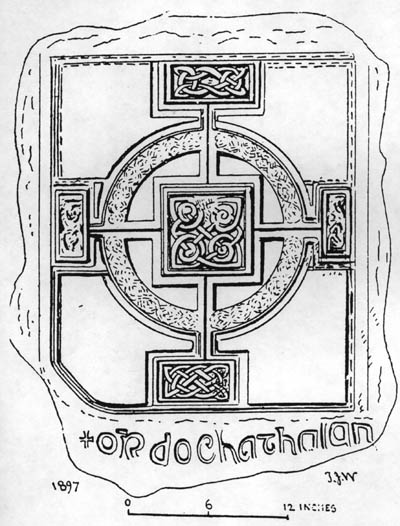
But among the gravesites there were indeed traces of Foxes at Durrow. As mentioned above, there are several large stone burial slabs at Durrow, some of which are unreadable, and others which can be deciphered. For the Foxes, perhaps the best stone slab was a rather large one ( 2'6" x 2'9" or 76cm x 84cm) is one dating from around 900 AD, and to my complete amazement, had the letters
or do chathalan
written across the bottom of it (see picture below). I immediately remembered seeing a Cathalan on the Fox genealogical line, and knew the time period was right. Cathalan (or Chathlan) was the great, great grandfather of Tadhg Sinnaigh O'Catharnaigh from the 11th century. The four letters in front of his name, ordo, mean "pray for" in Irish.
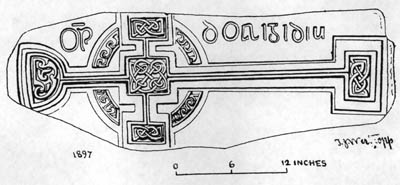
Another very old stone slab is one which is also attributed to the Fox line, though I cannot yet find a direct Fox connection in my sources. This concerns a slab (3'6"x1'4" or 107cm x 41cm) with the inscription
or do aigidiu
also from the tenth century. The Annals of the Four Masters and some other annals do, with some spelling variations, refer to a person who was king of Teathbha at that time who seems a likely candidate. However, in the Fox line genealogies I have, there is no one mentioned with that name in any time period. Perhaps Aigidiu (also spelled aicidi and aichtide ) was a brother to Chathalan, or a son who died before he could assume the chieftainship.
The High Cross
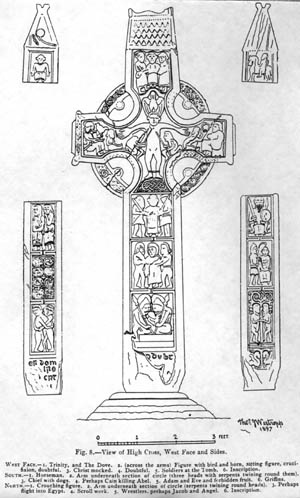
The enormous and impressive sandstone High Cross at Durrow is more than 3 meters high, and has been standing outside for more than 1000 years, and is in relatively good condition. Many of the motifs and scenes are worn off, and some frames are completely blank, as if there was more to be added. The front, back, and sides are all decorated. One of the more unusual scenes is that of David playing an Irish harp, something I was told does not occur on any other high crosses in Ireland.
Brother Kinahan and MJ Fox near the High Cross, Durrow (M.Anderson)
(NOTE: these line-drawings are from a 19th century article on the site, found in Bryne's book, it should be added here that this article also mentions a similar grave slab at Clonmacnoise, not far from Durrow, with the inscription "or do Tadgan". The author seems certain this is a Fox ancestor. Given the approximate date of the slab and the time period for the Fox ancestor mentioned in Fox History Part I (Tagan or Tagain), as well as the Foxes historical links to Clonmacnoise, it is not unlikely that the 19th centruy author is correct.)
General Comments
The Foxes are one of the few Irish families who actually have some of their ancient ancestral connections or links intact. As such, we are privileged, and with that perhaps comes the admonition that we should not take this for granted. Durrow is one of the sites being considered for restoration by the Irish authorities, and perhaps we can encourage them by sending in emails or letters. Also, perhaps there is a way to make sure Cloch an t-sionnaigh remains intact. Foxes are encouraged here to write in with suggestions on how this might be done.