Fox Sites in Ireland updated Fox History updated Fox Genealogy and links Fox Events updated Fox Lines The Fox Septs Pictures from September 2000 Fox News
updated January 2004
Make sure and get involved in planning the next Fox gathering 2005, your input is needed, visit the Fox Event's page !
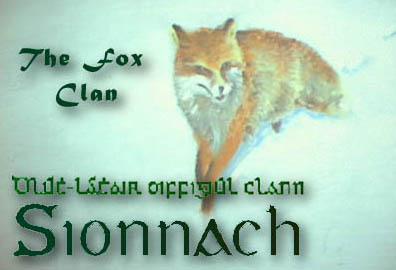
The Regathering of the Fox Clan
If you are of Irish ancestry and one of your parents was a Fox, there is a good chance you are descended from an ancient Celtic line which historical literature places as far back as the time of Saint Patrick, or perhaps an Cambro-Norman line which entered the stage in the 1100s. Our ancestors were dynamic and active participants in the history of Ireland, and perhaps we have been too unaware for too long. In recent centuries we have become scattered throughout the globe, and in our new lives and new homelands we often forget the very soil whence we came.
It is time to regather the Fox Clan from all the corners of the earth and acknowledge our common hertiage, chronicle our recent and distant history, encounter our kith and kin, meet familiar faces we have never seen, and to know our name in the language it was first spoken.
It is the purpose of this website, first appearing in November 1998, to undertake this regathering.
You are invited, as a living Fox descendant, to visit our website, rejoin with your clan, and thus stretch your hand across the centuries and begin to know those who came before you.
Convenor : Moire-Sinead níc an Sionnach
(MJ Fox)
Contact: [email protected]
A Brief Summary of the Sionnach Foxes
The history of the Sionnach Foxes is a long and complicated story. Some sources will trace Fox ancestors back to the time of Christ and even before, but this brief overview begins with Niall of the Nine Hostages in the early fifth century. Niall, who ruled Ireland from 387-405 AD, had at least twelve sons, many of whom founded various Irish family lines. One of these sons was Maine, to whom several families can trace their lineage, and these families became known as the Hy Many. They were also considered to belong to the southern branch of the O'Neills (Ua Niall). Two of the clans of the Hy Many were the Foxes and the O'Breens. As will be seen, the O'Breens figured into Fox history later on.
The land which Maine and his descedants controlled was called Teathbha, or Teffia, though the territory slowly became smaller over time as land was divided among families and competition for land between and among clans also took place (see the list of related websites for a map). Over the centuries, the ancestors of the Fox and other local clans competed for the position of "King of Teathbha". In 550 AD, a great grandson of Maine's by the name of Brennan or Brendan granted a large plot of land to a monk who was in fact from the northern branch of the Ua Nialls, and was born with the name Crimthann, or Fox. The land, since it was covered in oak trees, was called Dur Magh, or oak plain, and eventually became to known as Durrow. The monk from the northern Ua Neill eventually became more well-known as Saint Columkille. A manuscript which is believed to have been made at Durrow in the 8th century, the Book of Durrow, can be seen alongside the Book of Kells at Trinity College Library Museum in Dublin. Thereafter many of Brennan's descendants served as "erenach" (protector-supporters) of Durrow, and this also figures later on in Fox history along with the O'Breens.
Several generations later, around the year 900, there was a Tadhgan in the Fox ancestral line. Although Tadhgan was never a king of Teathbha himself, at least twenty Teathbha kings can trace their roots back to this common ancestor. He became the founder of a line referred to even centuries later as Muintir Tadhgan (clan or people of Tadhgan). A burial stone from the great monastic settlement, Clonmacnoise, bears his name, and it is believed this is does belong to Tadhgan of the Fox line. At Durrow there are 2 burial stones which bear the names of two of his grandsons (or perhaps a grandson and a later descendant), Cathalan and Aghda or Aigidiu. It is from Catharnach, the son of this very Cathalan, that the descendants began to be known as O'Catharnaigh, and only 2 generations later, O'Catharnaigh Fox, or in Irish, Ua Catharnaigh Sionnaigh.
The people are first referred to as the "Sinnacha" in the Annals of the Four Masters for the year 1050.....they raided Clonmacnoise twice in three months! Intersting here is that both O'Catharnaigh and Fox seem to be attempts at assuming some sort of surname, which in turn might have been influenced by Brian Boru's attempts 50 years earlier to introduce a surname system into Ireland. In the 11th centruy there are several other references to Foxes, particularly in terns of kidnapping, fighting and killing, but by the early 12th century they seemed to have become a quieter group, and there is little mention of them on lists of participants in battles from that period. Instead, they seem to be more associated with the Church, and even with mediating conflict: in 1133 it is reported that at the Hill of Uisneach in Westmeath, which is the legendary center or womb of Ireland, a one year truce was arranged between two warring parties on the neutral ground of "Abhall Chethernaigh", or Catharnaigh's Orchard.
Things heated up with the Anglo-Norman invasion in 1171, and Hugh De Lacy, who quickly became Viceroy of Ireland, was granted by the English King, Henry II, a large portion of the eastern half of Ireland. A bishop from Rome was sent to Ireland to issue the threat that anyone opposed to the King of England's right to Ireland would be excommunicated. The O'Breens and Durrow now figure back into the picture, when, in 1186, De Lacy had built a castle for himself (one of many) on the grounds of the Durrow monastic site. The chief of the Foxes, the chief of the O'Breens, and a stepson of the Fox chief conspired to rid themselves of De Lacy, who was recorded as being "destroyer and dissolver of the churches and sanctuaries of Ireland", and had clearly committed a sacrilege by building his own castle on holy ground....and what's more, ground which Fox ancestors had granted to one of Ireland's greatest saints, and which had been under the protection of the Foxes over the centuries. De Lacy had gone too far, and a ruse was created to divert De Lacy's attention and have the Fox's stepson deliver a fatal blow - a blow so great, in fact, that De Lacy was decapitated, and his body and head initially buried in two separate locations.
Not surprisingly, in the 1200s the Foxes and De Lacy's met each other in battle, particularly in 1233. The Foxes generally continued to take part in battles against the English throughout the 1300s as well. The line almost died out completely in 1393 due to an epidemic, and only a few male children survived. In the following centuries the Foxes continued to take part in opposing the English presence, though some did ally themselves with the English crown in order to avoid land confiscation. This remained the case well into the 1600s. In 1641 Hubert Fox, who was at that time still chief of the Fox Clan. took part in various efforts against the English, and eventually a price was put on his head of 400 pounds and permanent pardon for anyone turning him in. However, no one did, and it is not clear what happened to him, though his descendants can be directly traced to Foxes alive today, at the end of the 20th century. The turn of this century into the 21st will mark the beginning of 1000 years of a particular family line from Ireland referring to themselves as Clan Fox.
NOTE: For a more detailed history, go to Fox History
Contact: [email protected]
Picture: Detail of painting by M. Engqwist (used with owner's permission )
Webmaster Michele Anderson [email protected]