
Listen to The Swanee River
See the lyrics
Listen
to The Swanee River
See
the lyrics
The Time
Machine | Regionally Speaking | The
Works in FL | Civics in the Sunshine
Lending a Hand | Book List | Field
Trips | Members | Time
Line
Bible Verses |
Games and Quizzes | Thanks
| Home

Explorers | Natives
of Florida | Military Moves | The
Time Line | Famous Floridians | |
|||||||||||||||||||
|
|
Florida - outline map with cities FL - Blank outline map US - blank outline Printable blank World map Quick Maps of the World World COLORING map "Do It Yourself" Color-Coded State Maps Map of FL with long. and lat. lines The Floridians |
||||||||||||||||||
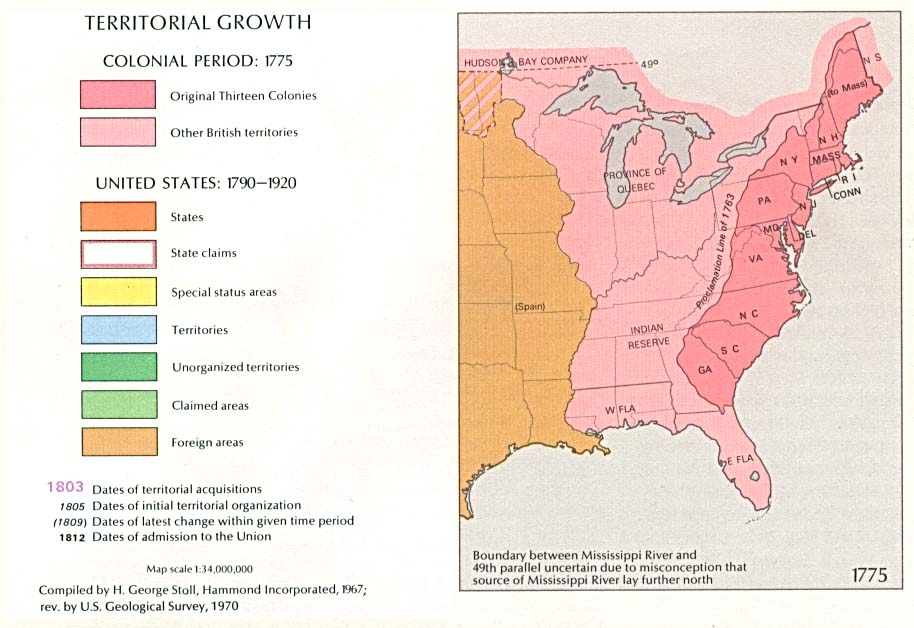
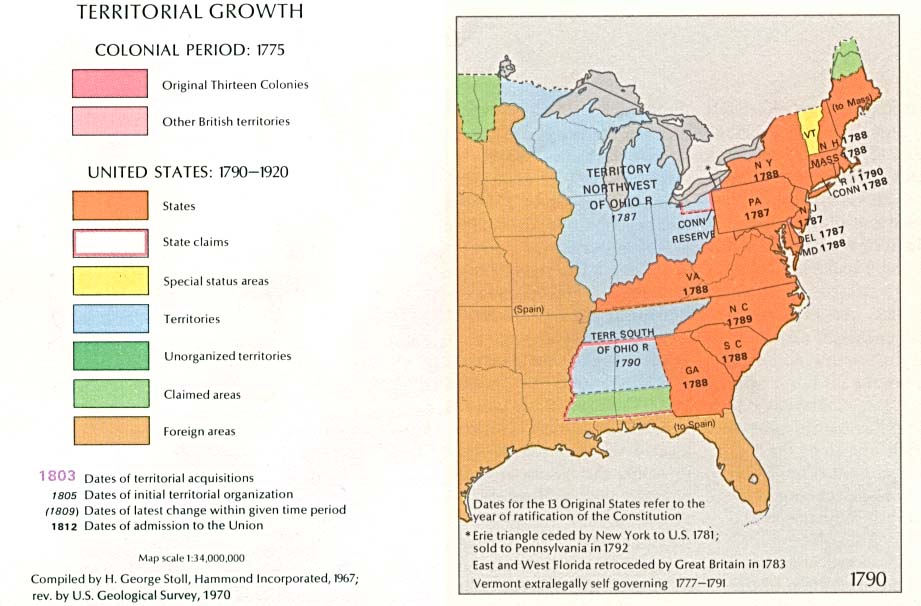
Explain why Juan Ponce de Leon should be identified as the "official discoverer" of La Florida in 1513, and not the "first" European to discover the peninsula. Describe Juan Ponce de Leon’s voyage in 1513. Include details such as: where it started, what his contract was for, where did the voyage take him, and what did he encounter on his voyage. Create a time line for the explorers and their expeditions to Florida. Include what countries they represented, and what they hoped to find. Describe who Pedro Menendez Marquez was and his importance to Florida’s history. Draw maps of Florida that represents the following claims of property from the Spanish, French, and British:
What were the events that caused the maps of Florida to change over the years? Why do you think that the European countries were so interested in claiming Florida as their property? What were the advantages to having Florida under their countries control? Choose five explorers from the list and write a story about their explorations. Set up your story as if you are a newspaper reporter, and you are reporting first hand. Include "interviews" with the explorers and those on the voyage with them. You can even have your story include the "competition" between the explorers. Use your imagination and historical fact to write a article that would be entertaining and informative. Draw a map of each explorer’s voyage. If possible, take pictures of the areas in Florida that the explorers visited and include them with your article. Describe in detail Hernando de Soto’s voyage that began in 1539. Visit the De Soto National Memorial. Take pictures of the demonstration that is presented by the park rangers, and write an article about the demonstration. If you are unable to visit the De Soto
National Park in person, go to the following website and take a virtual
tour of the park and it’s history: Read about Panfilo de Narvaez and Cabeza
de Vaca explorations at the following websites: Read about Alonzo Alvarez de Pineda at
this web site: Write about their exploration of Florida, and draw a map of where they went while they were exploring Florida. Many researchers and historians claim that Florida contains more buried and sunken treasures than any other state. They have also put a price tag on these treasures which amounts to a cool $165 million. Florida, like all other states, has a fascinating and romantic history. Seven different flags have flown over her, not to mention the black flag of the pirates. Florida became the haven of many notorious pirates, including Blackbeard, Lafitte, Gasparilla, Kidd, Rackham, Bowlegs, Bonnett, and possibly even Morgan himself. They roamed the waters of the Caribbean Sea, and captured every ship in sight. Often, they brought their loot back to Florida, and buried it on some lonely shore. When they finally died, the location of their hidden wealth died with them. The majority of all buried treasure in Florida is the work of pirates. Read about the pirates of Florida’s
history: Websites for reference about
explorers: Maps of Early America and Explorers: |
|||||||||||||||||||
 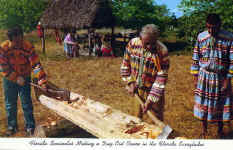 Seminoles carving a dugout canoe in the Everglades. More post cards
|
The
Seminole Tribe of Florida |
||||||||||||||||||
|
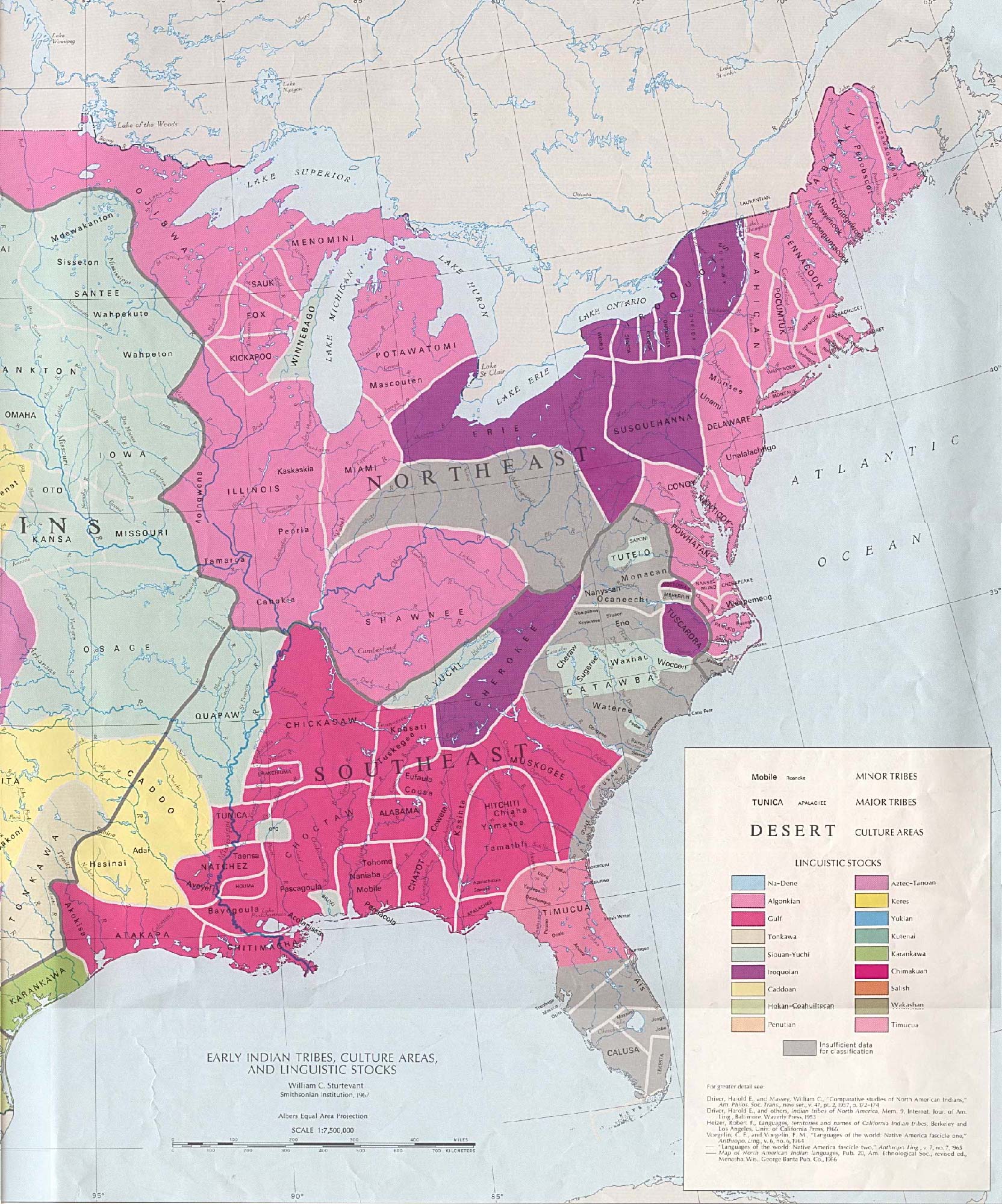
Natives of Florida - Indians Identify the seven major Native American groups and their locations within Florida when the first explorers landed. Describe where they lived, and draw a map of Florida that illustrates where each tribe lived. Florida. Explain why the writings of Domingo Escalante de Fontaneda are so important to understanding the lives of the Native Americans during the first years of European exploration and settlement in Florida. How was he able to describe the lives of the Native Americans? Check out a book from the library that details the writings of Domingo Escalante de Fontaneda. Read the book and write a report on the things that you learned about the lives of the Native Americans in Florida. List the four main reasons for the disappearance of the early Indian tribes in Florida. Draw a map of Florida that represents the Indian Land Grants to the British in 1765. Pre-contact native people had to rely on natural resources for food, tools, housing and decorations. Which of the workers skilled in those areas - pottery maker, fisherman, hunter, gatherer, stone tool maker, shell tool maker, basket maker, woodworker, builder - would you like to be? Why? Write about your work in one or two paragraphs. Include a picture of you at work. Define the following terms:
Visit one or more of the following Indian sites. Take pictures and write an article about your visit and what you experienced. CRYSTAL RIVER STATE ARCHAEOLOGICAL SITE - Located off US19 in Crystal River, this massive village site with its fine museum represents a large complex that existed from 300 BC to 1400 AD. A forty foot truncated cone temple mound overlooks the river and several large burial mounds. PHILIPPE PARK TEMPLE MOUND (Tocobago)
- Located off FL 590 at Safety Harbor on Old Tampa Bay, this cleared
park contains a massive temple mound with a top of 49 by 49 feet and a
base of 146 feet by 162 feet. There are also burial mounds at this Safety
Harbor village of 900 AD to 1200 AD. BIG MOUND KEY - (Not open to public) Boat access from Boca Grande to southern tip of Cape Haze peninsula (Charlotte County), will reveal a large temple mound surrounded by a maze of curved canals and dikes. PORTAVANT MOUND (Snead Island) - On the island's north side off 17th Street West near Emerson Point, is a nearly inaccessible monstrous mound with a top of 150 by 80 feet and a unique circular subsidiary mound. SPANISH POINT (Osprey) - Part of Historic Spanish Point, the bayside home of Chicago socialite Mrs Potter Palmer, the complex contains several mounds and shell middens and a fine historical tour of a thousand years of human activity on the site. The Hill Midden north of Webb's Cove is the best site. PINELAND MOUNDS (Pine Island) - Although access to the mounds and middens is on private land, you will be rewarded by driving along the western shore of Pine Island where the Calusa built cross-island canals. PAULSON POINT (Englewood) - Located off FL 775A in a county park, this low, oval mound has a fine interpretative trail, which provides a nice educational experience. Explain John Forbes’ "Plan for the Captaincy – General of West Florida" in 1804. Draw a map of his suggestions for the divisions of Florida lands. And describe the three things that he suggested Spain should do, and their possible impact on the Native Americans of Florida. Did his plans ever take effect? Answer the following questions:
The word "Timucua" is adapted from the word "Thimogona" which means what when translated into English? The Natives that used hunting and gathering as a means of getting their food instead of growing it, lived in which region? Florida Natives built their homes out of what kind of materials? How did Florida natives travel around the state? Read the excerpt from a letter written by Bishop Calderon in 1675 at this website http://www.oah.org/pubs/magazine/spanishfrontier/cowdrey-document.html#Anchor-Excerpt-36387 How did Bishop Calderón describe the Florida Indians? What did they look like, and what kind of clothing did they wear? What kinds of work skills did the mission Indians have, and how quick were they to learn new skills? What foods and beverages did the Native Americans consume? How were Native American dwellings shaped? What material went into their construction? Which animals did the Florida Indians hunt, and how did they hunt them? How did Bishop Calderón describe the farming methods used by the Florida Indians? Which crops were grown and harvested? Who did the farming? Based on what the bishop wrote, describe a typical council house. How many people could it hold? What were its uses? What kinds of interior furnishings were built along its curved wall? How interested were the mission Indians in gold and silver? What kinds of goods did they trade for, and what did they give in exchange for them? How seriously did the newly converted Indians take their new Catholic faith? How often did they go to church, and what kinds of contributions did they make for the support of the church? Who studied at the mission school? Who was the teacher? Read the following essay, and write an opinion on whether you feel the author proved his point about the survival of Indian tribes: http://members.aol.com/althist2/feb00/indiansatoz.htm Visit this website and gather Native American recipes to prepare a full course meal of Native food for your family: www.nativetech.org/food/index.html Visit the following websites
to learn more about the Apalachee Indians: Visit the following website
to learn more about the Jeaga Indians: Visit the following website
to learn more about the Seminole Indians: Visit the following websites
to learn more about the Timucua Indians: Visit the following website
and use the vocabulary to write your own story in the Timucua language: If you do not have web access, please check out "A Grammar and Dictionary of the Timucua Language", by Julian Granberry, The University of Alabama Press. You can find the vocabulary in this book, and write your story. Click on the following links, read the articles and complete the activities: Visit the following website
to learn more about the Tocobago Indians: Visit the following websites
to learn more about the Tekesta Indians: Visit the following websites
to learn more about the Calusa Indians: Southern Florida's native people used many natural resources to make things - seashells, animal bones, plants and stones. Which resource do you think was the most valuable to them? Why? Explain your thinking in one or two paragraphs. Explain why canoes were important to Calusa life. Why would they want different sizes and styles of canoes? You may either write your explanation in one or two paragraphs or have a discussion where everyone states their ideas. Recent surveys in the Everglades and within the Big Cypress Swamp indicate the presence of at least several hundred archeological sites within the interior of South Florida. Some of these sites proved to be substantial, and suggest more than just marginal or short-term use. Based on current data, it also appears that the sawgrass plains region where the Everglades Agricultural Area is now located was a transitional area used for canoe travel and small encampments by many tribes. Read more about it at this
website:
Websites for reference about
Indians: Recommended reading: · FLORIDA’S INDIANS FROM
ANCIENT TIMES TO THE PRESENT · THE TIMUCUA · FLORIDA INDIANS AND THE INVASION
FROM EUROPE · HERNANDO de SOTO AND THE INDIANS OF
FLORIDA · ARCHAEOLOGY OF NORTHERN FLORIDA, A.D.
200-900, THE McKEITHEN WEEDEN ISLAND CULTURE · TACACHALE · FIRST ENCOUNTERS: SPANISH EXPLORATIONS
IN THE CARIBBEAN AND THE UNITED STATES · THE SOUTHEASTERN INDIANS · BLACK DRINK · FLORIDA’S PREHISTORIC STONE TECHNOLOGY · INDIAN ART OF ANCIENT FLORIDA · THE ART AND ARCHAEOLOGY OF FLORIDA’S
WETLANDS · HOW TO DO ARCHAEOLOGY THE RIGHT WAY · A GRAMMER AND DICTIONARY OF THE TIMUCUA
LANGUAGE · THE FLORIDA OF THE INCA · FLORIDA’S FIRST PEOPLE · SIXTEENTH CENTURY ST. AUGUSTINE, THE
PEOPLE AND THEIR HOMES · THE HOUSES OF ST. AUGUSTINE, 1565 - 1821 · ABORIGINAL SUBSISTENCE TECHNOLOGY ON THE
SOUTHEASTERN COASTAL PLAINS DURING THE LATE PREHISTORIC PERIOD · HISTORY, MYTHS AND SACRED FORMULAS OF
THE CHEROKEES · EARLY HISTORY OF THE CREEK INDIANS AND
THEIR NEIGHBORS · KEY MARCO’S BURIED TREASURE:
ARCHAEOLOGY AND ADVENTURE IN THE NINETEENTH CENTURY · THE SOUTHEASTERN CEREMONIAL COMPLEX,
ARTIFACTS AND ANALYSIS · REMEMBER NATIVE AMERICA! THE EARTHWORKS
OF ANCIENT AMERICA · ARCHAEOLOGY OF ABORIGINAL CULTURE CHANGE
IN THE INTERIOR SOUTHEAST, DEPOPULATION DURING THE EARLY HISTORIC PERIOD · JONATHAN DICKINSON’S JOURNAL · INDIANS AND ARTIFACTS IN THE SOUTHEAST · AN ENVIRONMENTAL HISTORY OF NORTHEAST
FLORIDA · ARCHAEOLOGY OF THE FLORIDA GULF COAST · FORT CENTER, AN ARCHAEOLOGICAL SITE IN
THE LAKE OKEECHOBEE BASIN · THE TIMUCUAN CHIEFDOMS OF SPANISH
FLORIDA - VOLUME I: ASSIMILATION, VOLUME II: RESISTANCE AND DESTRUCTION · LOST CITIES OF THE ANCIENT SOUTHEAST · PERSPECTIVES ON GULF COAST PREHISTORY · EXCAVATIONS ON THE FRANCISCAN FRONTIER ,
ARCHAEOLOGY AT THE FIG SPRINGS MISSIONS · FORAGING AND FARMING IN THE EASTERN
WOODLANDS · HERNANDO de SOTO AMOUNG THE APALACHEE,
THE ARCHAEOLOGY OF THE WINTER ENCAMPMENT · MISSIONS TO THE CALUSA · A HISTORY OF THE TIMUCUA INDIANS AND
MISSIONS · APALACHEE: THE LAND BETWEEN THE RIVERS · THE APALACHEE INDIANS AND MISSION SAN
LUIS · THE SPANISH MISSIONS OF La FLORIDA Pioneers of Florida Read the book, The Yearling by Margorie Kinnan Rawlings, and go to the following website and complete the study guide:
Write a journal entry from a day in the life of a Florida Cracker. Research what types of foods were popular in the days of the Florida pioneers. Plan a meal, and prepare it for your family. Websites for reference about Pioneers of Florida: |
|||||||||||||||||||
©2001 FUSE. All rights reserved.
For problems or questions regarding this web contact Kathy
Last updated: March 21, 2002.