Please Note: We do not endorse the sites
behind these links. We offer them for your additional research.
Explorers | Natives
of Florida | Military Moves | The
Time Line
| Famous Floridians |
|
|

|
Florida - outline map with cities
FL
- Blank outline map
US - blank outline
Printable blank World map
Quick Maps of the World
World
COLORING
map
"Do
It Yourself" Color-Coded State Maps
Map
of FL with long. and lat. lines
The
Floridians |
- The European Explorers
- Read the story of Ponce de Leon discovering Florida on these
websites:
Who is Ponce de Leon?
Their Stamp on History - Ponce de Leon
The Discovery of Florida
- Explain why Ponce de Leon named our state Pascua Florida.
- Locate on a map or globe where Ponce de Leon first landed.
- Draw a picture of some flowers Ponce de Leon may have seen
near the shoreline when he first discovered Florida.
- Go on a wildflower hunt. Pick the flowers, take them home and
press them between paper towel in heavy books. After about five
days put them on a poster or in a ‘wildflower booklet’ you
make.
- Do the activity on this website:
Their Stamp on History
- Read the story of the Spanish explorer Panfilo de Narvaez on this
website:
The Narvaez / Vace Expedition
- Locate Tampa Bay on a map or globe.
- Trace the route Narvaez and his ships might have taken from
Spain.
- Do this boat experiment: Get a milk bottle cap, an empty tuna
can, a rock and a flat piece of foil. Put them in a bathtub full
of water. See which ones float without any waves. Why do you
think some of the ‘boats’ floated and some didn’t? What
does buoyant mean? With the remaining floating ‘boats’ make
small waves. Which ones are still afloat? Next, make big waves.
See what it takes to sink even the strongest ‘boat’. Do you
think Narvaez had a strong boat to get all the way from Spain to
Tampa Bay on the Atlantic Ocean? What kind of storm do you think
Narvaez and his crew might have encountered in the Gulf of
Mexico to make their boat sink?
- Write out your experiment steps and the conclusion you
reach.
- Read about the Spanish explorer Hernando de Soto at this website:
Hernando De Soto
- Look on a map of the United States and trace with your finger
a possible route that Hernando de Soto and his crew might have
taken to get them to the Mississippi River. What states might he
have traveled through?
- What two things were the Spanish explorers always seeking that
usually led to their demise? Hint: Both words start with the
letter ‘F’ and the first word rhymes with ‘game’.
- Read about the French explorers Jean Ribault and Rene de
Ladonniere at:
Who is Jean Ribault?
- Locate the St. Johns River on a map of Florida.
- Tell something unique about the St. John’s River.
- Find on the map the location where the French settlers built
Fort Caroline.
- Go to the beach or a sandbox and build a ‘sand fort’.
- Put a moat around your fort like Fort Caroline had. Why do
you think the French settlers thought they would need a moat
if they were friendly with the local Timucua Indians?
- What did Jean Ribault come to Florida for?
- Read about the Spanish explorer Pedro Menendez de Aviles at:
Pedro Menendez de Aviles
- On a United States outline map show the routes of these early
explorers.
- Use a different color/pattern for each one’s route.
- Make sure you include a legend on your map showing which
explorer belongs to each route.
- Paint a picture of an explorer’s ship. Be sure to include the
flag to show which country the ship represents.
- Make stick puppets. Draw pictures of the Spanish and French
explorers. Cut out and glue to a straw or stick. Act out some of
their adventures.
- Find France and Spain on a globe or world map.
- For further information on the early explorers of Florida visit:
A
ShortHistory of Florida
Early
Spanish Exploration map
- Visit this website on Recipes from Spain and have the whole family
help in preparing a meal that is fit for an explorer! Favorite
Food Recipes From Spain
- Visit this website for an English-Spanish Picture Dictionary:
Little Explorers Spanish-English Dictionary
- Find the Spanish words to replace the English words in ( ) and
complete the following story… A long, long time ago many brave
men seeking fortunes of gold sailed in a (boat) halfway across
the (world). The trip was long. At times the sailors were tired
of only having their (ship), the (sea), the (blue) (sky) by day
and the (stars) and (moon) by night. The (sun) was hot. The
(waves) often tossed their mighty ship like a toy. Then, all of
a sudden, a sailor shouted, "Land Ho!" At first the
shipmates thought it might only be a small (island). But as they
sailed closer the vast (beach) lined with (flowers) and (palm
trees) came clearer into view. One (man) told the captain the
land looked a little different than on the (map), but he was
just happy to be there. Together they kneeled in a prayer of
thanks. They dropped (anchor) and boarded rowboats to paddle to
shore. The (water) was a beautiful shade of bright (blue). Once
on shore, with (swords) drawn, they explored the area. The
sailors found (snakes) and many other (animals). Some of them
collected a few of the beautiful (shells) from the shoreline.
- Alphabetize, Define, Spell and use these words in a sentence or
story: explorer, settler, ship, fortune, route, adventure, ship,
compass, moat, river.
|

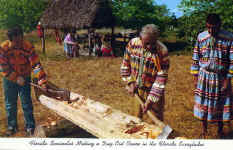
Seminoles carving a dugout canoe in the
Everglades. More
post cards
|
The
Seminole Tribe of Florida
Tour of the Florida
Territory during the Seminole Wars, 1792-1859
Florida
Folklife Program
Native
American coloring pages
|
- Read about the tribes who lived in Florida when the explorers
first arrived.
- Visit this website for a map of their locations:
http://garnet.acns.fsu.edu/~jbm4162/indians.htm
- List the tribes.
- Make a map showing the areas of the state each tribe lived
in.
- Indicate on your map if the tribe was friendly to the
other tribes and the explorers.
- Make up your own symbols for: each tribe, friendly to
tribes, friendly to explorers, unfriendly to tribes,
unfriendly to explorers.
- Be sure to include a legend explaining your symbols.
- Tell what happened to the original tribes.
- To learn more about the Timucua Indians and for fun pages to
color visit these websites: http://pelotes.jea.com/NativeAmerican/Coloring%20Pages/incolor3.htm,
http://pelotes.jea.com/kiwhotim.htm,
http://pelotes.jea.com/NativeAmerican/Coloring%20Pages/incolor2.htm
- Write a story with you as a main character living among the
native Indians at the time the explorers came to Florida.
- Illustrate your story.
- Present your story to a group. This could be your family,
friends or homeschool group.
- Read about the history of the Seminole Tribe.
- Explain why the Seminole Tribe formed and which tribes
made up the Seminoles.
- Show on a map where the Seminole reservations are located
today.
- Tell why Chief Billy Bowlegs and Chief Sam Jones
played a significant role in the Seminole reservation in
the Everglades.
- Tell the main ways the Seminoles earned a living in the
past and today.
- Write a list to compare and contrast these ways.
- Visit the following websites to learn more about the Seminoles
and their way of life: www.gbso.net/skyhawk/seminole.htm
http://reach.ucf.edu/~multiexg/nativeamerican/Arts.html
www.le.liverpool.K12.ny.us/LE/Classwork/Robinson/Wetlands/Malindapage
- Visit this website and play some Native American games:
www.nativetech.org/games/index.php
- Visit this website and gather Native American recipes to prepare
a full course meal of Native food for your family:
www.nativetech.org/food/index.html
- Check out this website of Native American pictures and complete
the crossword puzzle:
www.ancientnative.org/kp.htm
- Dress up for the day like a Native American.
- Carve a miniature canoe, an animal or another object familiar to
the Native Americans out of a piece of wood or bar of soap. *NOTE:
Carving should be done under adult supervision only. Plastic
knives may be used to carve soap.
- Try your canoe out in the tub and see if it floats.
- Give yourself an Indian name.
- Write your name using symbols like the Indians did.
- Make up sign language to tell your name to others.
- Draw a picture of a Seminole Chickee.
- Tell what you think the advantages/disadvantages of this
type of house would be.
- Find the meanings to these Native American words we use for city
and water names: Miami, Ocala, Caloosahatchee, Loxahatchee,
Okeechobee, Apalachicola, Hialeah, Palatka, Homasassa.
- Can you find any other Native American names of cities,
towns, rivers or lakes on a Florida map?
- Tell the meanings of any you find.
- Make an ‘animal’ skin display.
- Materials needed: two 18" sticks or dowels, two
15" sticks or dowels, eight 12" pieces and one
90" piece of twine, one 12" x 15" piece of thin
vinyl.
- Shape the sticks or dowels into a rectangle. Use four of the
12" pieces of twine to wrap the corners together tightly.
Secure with hot glue or strong craft glue.
- Cut the piece of vinyl in the shape of an animal skin. Poke
approximately 10 holes around the skin about 1" from the
edge. Make sure to make one hole in each corner first.
- Tie the four corner holes in place with the four remaining
12" pieces of twine.
- Then lace the 90" piece of twine around the skin
through the remaining holes.
- Make an Indian Bead necklace. Visit this website for directions:
www.easyfunschool.com/article1320.html
- Alphabetize, define, spell and use these words in a sentence or
story: tribe, native, reservation, legend, swamp, tradition,
language, ancient, camp, starvation.
Pioneers
Read about pioneer life in the early days of Florida at: www.pasconews.com/memory.htm
As a family read one (or both) of these classic books about Florida
pioneer life:
- Strawberry Girl
by Lois Lensky
- The Yearling
by Marjorie Kinnan Rawlings
Tell what it would be like growing up in Florida as one of the early
pioneers.
- What would your daily chores be?
- What kind of pets might you have?
- What kind of clothes would you wear?
- What would your house look like?
- Do you think it would be easier or harder to live in the days of
Florida’s pioneers?
Draw pictures of a Florida pioneer family. Color them and cut them
out. Glue sticks or straws to the bottom to make stick puppets.
What’s a Florida Cracker and where did they get their name? Go to
this website for a thorough explanation: http://community-2.webtv.net/galyungin/THEFLORIDACRACKER/
Check the field trip guide to visit a pioneer village or pioneer day
festival near you.
Visit this website to color on-line or print and color a picture of
an early Florida settler, a log cabin and a train: www.leg.state.fl.us/kids/junior/colorbook/index.html
Make some old fashioned ink.
- Start by smashing dark berries (blueberries or raspberries work
well).
- Take a decorative feather with a fairly large quill, dip in the
‘ink’ and write your name, a short Bible verse or another bit
of wisdom on a piece of paper.
- Do you think you’d like to write this way all the time?
Alphabetize, Define, Spell and use these words in a sentence or
story: pioneer, chores, cabin, garden, festival, cattle, barefoot,
hog, vegetables, brave.
|

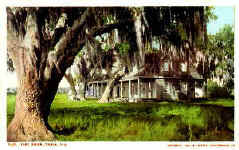
Old Fort Brooke More
post cards |
|
Read about the importance of escaped slaves in the Indian Wars and
Civil War at: www.buffalosoldier.net/SeminoleNegroIndianScouts.htm
Read about Florida’s involvement in the Civil War. Check these
websites: http://dhr.dos.state.fl.us/museum/civwar/,
www.tulane.edu/~latner/CrisisMain.html
http://www2.cr.nps.gov/abpp/battles/bystate.htm,
www.cr.nps.gov/nr/twhp/wwwlps/lessons/38pickens/38pickens.htm
http://extlab7.entnem.ufl.edu/olustee,
http://americancivilwar.com/statepic/fl.html
- Explain why state’s rights caused Florida and the other
Confederate states to secede from the Union. See the thorough
explanation on this website:
www.germantown.k12.il.us/html/sections.html
- Write a song or a poem about the Civil War from a soldier’s
point of view.
- To see some actual songs and poems by Civil War soldiers
visit this website:
http://users.erols.com/kfraser
- Read about Harriett Tubman and her role in the Underground
Railroad.
- Tell why you think she would risk her life to help others to
freedom.
- Visit this site with a map of the Underground Railroad
routes:
www.cr.nps.gov/nr/travel/underground/
Visit a Civil War Battle Reenactment. http://festivals.com/02-February/olustee
Draw pictures of the Civil War uniforms. Visit this website for
details on the uniforms: http://www2.lhric.org/pocantico/civilwar/uniforms.htm.
On a blank outline map of the United States color the northern
or Union states blue, color the southern or Confederate states
gray and color the territories red.
Pretend you are a newspaper editor in 1861.
- Write an editorial piece giving your opinion of slavery.
- Do you think it’s right for people to ‘own’ another
person?
- What could have been a better alternative to slavery for the
Confederates?
Visit this website to view posters of World War II: http://americanhistory.si.edu/victory
- Design and color your own war poster.
Read about Florida’s memorial to the WWII Veterans at: www.floridavets.org/memorials/wwii.htm
Read about Florida’s memorial to the Korean War Veterans at: www.floridavets.org/memorials/korea.htm
Read about Florida’s memorial to the Vietnam War Veterans at:
www.floridavets.org/memorials/viet.htm
- Why do you think we have memorials?
- Do you think they’re important?
- Forts
- Visit this website for a complete listing with descriptions of
Florida’s forts since the 1500’s: www.geocities.com/naforts/fl.htm
- Make a model of a fort using the following ingredients: large
pretzel sticks and peanut butter OR small twigs, sticks or dowels
and mud or plaster of paris.
- Make sure to name your fort and take a picture.
- Alphabetize, Define, Spell and use in a sentence or story:
involve, battle, government, history, escape, secede, captive,
territory, memorial, slavery, rights.
- Military Bases
- Florida has several military bases. Explain why you think this
is. You may want to look at a map of the world to help you answer
this one.
- Write a marching chant like the soldiers sing at boot camp.
(example: I don’t know but I hear tell, Florida’s coast is
full of shells).
- Dress up like a soldier and march around your house singing
the marching chant you made up.
- Make a list of pro’s and con’s of having a strong military.
- At the bottom write a sentence indicating whether you are
for or against supporting a strong military.
- Make a Military Family Tree page.
- List the name of everyone in your family tree who has served
our country in the military.
- Make sure to list their rank, branch of service, years
served, metals and awards received and if they were wounded or
killed in the line of duty.
- Add pictures to your Military Family Tree if you have them.
- If they are still alive send them a Thank You note for their
service to our country and a copy of your Military Family
Tree.
- Interview a Veteran.
- Record your interview on a tape recorder or video tape.
- Visit your nearest Veteran’s Hospital.
- Make Thank You notes or draw pictures beforehand to give to
the veterans.
- Visit a Veteran’s Cemetery. Check this website for locations: www.floridavets.org/benefits/vacemeteries.htm
- Visit these websites of Florida’s military bases:
www.geocities.com/capitolhill/senate/7264/military.html
www.angelfire.com/fl/joe6111/military2.html
- Alphabetize, define, spell and use in a sentence or story:
soldier, service, base, rank, veteran, march, military, weapon,
award, treaty.
|