 |
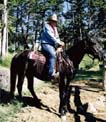
Hi. I’m Ben Benton from Flagstaff, Arizona. I believe that you will enjoy my daily journal from Yellowstone National Park during the summer of 1999. I left downtown Flagstaff with my saddle and duffel in early July and lighted in the horse corral at Mammoth Hot Springs. My journal will continue through September 20th, unless the weather shuts us down earlier. You’ll read about adventures on the back country trails, Yellowstone history, people I meet, and anything else I can think of to write about. I’m the author of “National Park Employment Data,” a guide to working in national parks, which is available for purchase on my web site at www.gorp.com/nped/. I’ve been working in national parks and ski areas off and on for over twenty years. Because I want the data in my book to always be fresh, I continually test the concepts, employers, and tips that I provide. Right now, I’m working for Amfac Parks and Resorts. They are a top notch concession company because they place employee training, morale, and amenities first. |
 |
|
Previous 7/16 |
Wednesday, 8-4-99I drove to Norris Junction today and toured the Museum of the National Park Ranger. It is in a six room log building built in 1908 along the Gibbon River. The facility was the Norris Soldier Station when the U. S. Army ran Yellowstone. Photos of it in the early days show it to be nearly identical today. A VIP (Volunteers in Parks), Bruce Morris, and his wife were hosting visitors today, and it turned out they were retired from the National Park Service. He talked about his first assignment in Glacier National Park. In the winter he and another ranger had to hike and ski up to the Continental Divide to check the snow depth and moisture content. He had pictures from 1951 of the two of them crossing bridges with 14 feet of snow on them. When they got to the back country ranger cabin, there was a 20-foot ladder and shovel tied high in a tree. At least it was high in the summer, but that day they were able to walk right up to it, disconnect it, and begin shoveling their way down to the front door of the cabin. His wife then told about her first home after getting married. It was a log cabin in Glacier with no plumbing or central heat, but there was a party line phone shared with other rangers and the international border patrol. She said that each user of the line had a distinct ring, but when a call came in it didn’t matter who it was for. They all picked up the phone and talked to the caller and to each other. It was the only entertainment they had all day. The Park Service organization is similar to the military because the military ran the world’s first national park until 1918. The National Park Service was created in 1916 and many of the soldiers became park rangers. Park rangers have military-style uniforms, live in government housing, and get reassigned every two to four years. The distinctive NPS ranger hat evolved from the military hat in use at Fort Yellowstone. The divisions in a national park, as best as I can figure out, go something like this: Under the superintendent and assistant superintendent are Interpretation and Resource Management, Administration, and Engineering. The I&RM includes law enforcement, interpretation (like rangers who staff the visitor centers), and resource management (like my friend Tom Sperry who eradicates exotic plants, builds fences to protect the thermal areas, and fishes Lake Yellowstone with nets to remove the unwelcomed lake trout). All personnel in the I&RM division wear badges because they have authority to protect the park’s resources. The chief ranger and chief naturalist are in this division. The Admin Division consists of clerks, accountants, secretaries, budget analysts, and human resource professionals much like any other business. And the Engineering Division includes infrastructure, maintenance, roads, trails, grounds, and utilities — pretty much like the public works department of a city. The budget for the National Park Service is infinitesimal compared to most other agencies of the federal government. Since Yellowstone is the size of Connecticut, it speaks well for the National Park Service that they do so much with so little.  |
Previous |
|