 |
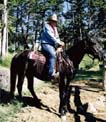
Hi. I’m Ben Benton from Flagstaff, Arizona. I believe that you will enjoy my daily journal from Yellowstone National Park during the summer of 1999. I left downtown Flagstaff with my saddle and duffel in early July and lighted in the horse corral at Mammoth Hot Springs. My journal will continue through September 20th, unless the weather shuts us down earlier. You’ll read about adventures on the back country trails, Yellowstone history, people I meet, and anything else I can think of to write about. I’m the author of “National Park Employment Data,” a guide to working in national parks, which is available for purchase on my web site at www.gorp.com. I’ve been working in national parks and ski areas off and on for over twenty years. Because I want the data in my book to always be fresh, I continually test the concepts, employers, and tips that I provide. Right now, I’m working for Amfac Parks and Resorts. They are a top notch concession company because they place employee training, morale, and amenities first. |
 |
|
Previous |
Monday, 7-19-99Today was my first day off so I got caught up on necessities, like getting an entrance sticker for my truck and finding Internet access. The first was easy but the second is more difficult. The Mammoth Hot Springs Hotel will let me use a line at the bellman’s desk, of all places, if I have an 800 access number. So I’m working on getting that. The rest of the day, I studied “The Wranglers’ Handbook,” a 167 page in-depth guide to the commentary required of a wrangler. It was prepared by Leslie J. Quinn of Amfac Parks and Resorts Transportation Department. As if that weren’t enough, “shotgunners [on the stage coaches], wranglers, and others may also call Amfac Parks and Resorts Information Specialist with questions at extension 4665.” Wow. They sure want their employees well informed. Did you know that ravens can live to be 70? On the trail rides I refer to them as black eagles to give them a little dignity (and to get dad to whip out the camera before he realizes he got fooled). The other guides refer to them as flying rats so its all in the eye of the beholder, I guess. One of the favorite stories on the Mammoth one-hour trail ride is that of Truman Everts, an accountant from Maine. The story goes that he was in his late 60s when he joined the Washburn expedition exploring Yellowstone. The group encountered thick lodge pole pine and agreed to split up and regroup near Yellowstone Lake, but on the first day out, Truman got lost. On the second day, his horse ran away. On the third day he lost his spectacles. I’m going to interrupt the Everts story for a moment because a family of elk, three cows and three spotted calves, just sauntered across the parking lot outside my window. They walked over to the bed of my pickup and looked in as if they expected to find something. Right now they are on the lawn, some munching and the others lying there posing — literally posing — for photos by tourists. Sometimes I wonder if the Park Service pays the bison, elk, and bighorn sheep $10 a day extra to pose by the side of the road in the evenings. All day today, big horn sheep were on a ledge high above the entrance road from Gardiner to Mammoth causing a traffic jam. I can just imagine Joe Bighorn in the morning saying to his wife, Jane Bighorn, “Let’s go down to the ledge over the entrance road today and watch the traffic jam below.” Anyway, back to Truman Everts. He learned before entering Yellowstone that native Americans in the area survived on a particular thistle (in a remarkable coincidence, it's called the Everts Thistle), which grows throughout Yellowstone. Truman, now desperate, ate the thistle for 37 days and made his way to the Old Faithful area where he slept near active geysers. One night he rolled into one and severely burned his leg. The Washburn party, now back in Montana, felt guilty about leaving old Truman behind, so they offered a trapper, Jack Baronet, $200 to return with the body of Truman Everts. The trapper took the challenge and went looking for Truman. He spotted what he thought was a bear crawling on all fours near what is now Roosevelt Junction, but soon discovered it was Truman, alive but near death. Now one problem of surviving on thistle is that is really stops you up. Big time. Truman was alive but constipated. The trapper took him to a local trapper’s cabin and they poured two pints of bear grease down him to open him up. He returned Truman to the Washburn expedition who were happy to get him back, but refused to pay the reward because it was for the BODY of Truman, not Truman himself. Truman later married, at age 72, a 14 year old girl and had two children. So, along our trail we point out the Everts Thistle and Everts
Mountain, which is named because the trapper thought he was here
when he found Truman, when actually he was way over at Roosevelt
Junction. |
|
|