 |
|
Who was Lao Tzu?
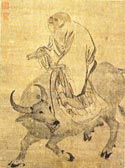
Lao-tzu lived twenty-five centuries ago in ancient China. Even though the details of his existence are shrouded in the mist of time, we know with a fair degree of certainty that his name was Li Er.
Legend has it that King Wu of Zhou appointed him head librarian of the imperial archives at Luoyang. In this capacity Lao-tzu was able to immerse himself in the study of history, philosophy and literature, gaining wisdom and insights along the way.
According to another well known legend, Confucius visited with Lao-tzu and came away in awe of Lao-tzu's intellect. Confucius recognized in Lao-tzu a deep understanding about the world that was above his own, and went so far as to liken Lao-tzu to the mysterious dragon.
Lao-tzu decided to leave civilization behind when the House of Zhao began its decline. He departed Luoyang and headed through the Hangu Pass to some destination beyond the Great Wall.
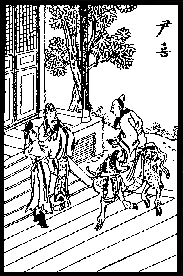
Before leaving the gate at the Great Wall, a guard at the gate asked him to write down his thoughts on the Tao for posterity. Lao-tzu agreed, and wrote a small book in two parts, expressing his accumulated learnings in brief, concise yet profound language. This book survived over 2,500 years and came to be known as the Tao Te Ching. And all the logics of Chinese astrologies (including Feng Shui, astrology, Chinese prediction and phrenology) were from this book and Yi Jing.
Name Translation Notes
The name Lao-tzu ("Old Master") is sometimes written as Lao-tse. In the more modern Pinyin system, it is written as Laozi. All are equally correct.
"Tzu" is sometimes mistranslated as "son" or "boy." To compound this error, people talk about how meaningful it is that Lao-tzu was literally an "old boy" in the sense of being old and wise and yet young at heart. This is hilariously incorrect. In other contexts "tzu" can mean "son" or "boy," but in this context the only valid meaning is "master." or the men who was venerable.
According to the above, Taoism is not a religion, but a philosophy. It is a "Way" of life. It is a River. The Tao is the natural order of things. It is a force that flows through every living and sentient object, as well as through the entire universe.
The primary religious figures in Taoism are Lao Tzu and Chuang Tzu, two scholars who dedicated their lives two balancing their inner spirits. Infact, Taoism and Confucianism are very similar to each other. So, Taoism and Confucianism are one family.
The most common graphic representation of Taoist theology is the circular Yin Yang figure. It represents the balance of opposites in the universe. When they are equally present, all is calm. When one is outweighed by the other, there is confusion and disarray. The Yin and Yang are a model that the faithful follow, an aid that allows each person to contemplate the state of his or her lives.
The Detail History of Xuan Kong Da Gua
How to Measure and Luo Pan(Compass) Reading
&http://www.energybalancingservices.com/
�@