The Torah (Law, Pentateuch, or Five Books of Moses)
Deuteronomy: The Lawbook and the Conclusion
The Lawbook
The Laws are the core and purport of the book of Deuteronomy. They are couched in hortatory,sermonic style that has led to their being categorized as preached law. Emphatic statements of what must or must not be done are connected with exhortations to fulfill these injunctions , pointing to the motivations and spirit in which they should be carried out. There is a wide variety of laws here__ritual, criminal, social__but they are all set within this preaching context
and aimed at the service of God. This is no dry legal code but, rather, a book written in fluent and moving prose. Scholars have seen duplications and parallels between the laws presented here and those in the Covenant Code in Chapters 21-23 of Exodus; but to this a common source may be ascribed, and Deutoronomy may considered a work in its own right and not a mere expansion of Covenant Code.
The lawbook comprises chapters 12-26, Supplemented by chapters 27-28. After an initial order to destroy the pagan cultic places and idols, the lawbook goes to its injunction : to set up a single central sanctuary in Canaan, where all Israel is to make their offerings, as distinct from the present
unregulated practice,"every man doing whatever is right in his own eyes." The spot is designated only "the place which the Lord your God will choose," which some interpreters, following King Josiah, have understood to be Jerusalem and which others understand to be Shechem.(Theblessing
and curse, respectively; and an even more elaborate ritual is prescribed for the same locality in chapter 27.)
Instructions are given for proper killing of animals for food, previously connected with the sacrificial cult, and the people are admonished when they settle in canaan not to inquire about how other nations serve their gods, possibly to follow their abominable practices. Inserted at this point
is the striking exhortation, "Everything that I command you : you shall be careful to do; you shall
not add to it or take from it."
Chapter 13 warns the people to beware of the temptations to apostasy arising from the urging or example of prophet-diviners, kinfolk or friends, or a whole town; they are to kill the tempters and destroy the towns.Chapter 14 is devoted mainly to a list of living things that may or may not be eaten, the "clean" and "unclean" similar list in Leviticus, chapter 11; and to laws for tithes and first fruits to be brought annually to the central Sanctuary and triennially to the Levites in towns ,who
are specified as having no "portion" of their own (Two years to the centre, the third year to the towns Levites..) Chapter 15 deals mainly with the releases to be granted every seventh year to debtors of their debts and Hebrew slaves in the sabbatical release. The first section of chapter 16, verses 1-17,
gives the rules for celebrating the three main festivals of the religious year; unleavened Bread, Weeks
and Boots, which are to be observed at the central sanctuary (hence later called the pilgrim festivals).
Beginning with verses 18 of chapter 16 there is a discussion of the appointment and character of judges, and judicial procedures and punishments for apostasy, homocide, and other crimes; similarly, beginning with verse 14 of chapter 17 there are rules on the selection of a king and conduct, and the injunction that he read from"a copy of this law," so that he may be edified and
chastened. The first portion of chapter 18 deals with the office and support of priests, referred to here as "the Levitical priests...all the tribe of Levi," not distinguishing the Aaronic priests from the
lesser Levites .This is followed __after a passage inveighing against abominable cultic and divinatory practices of the nations of the land __by a promise that God will raise up prophets among the people and instructions on how to tell true from false prophets. Thus the offices of Judge, king, priest, and prophet are considered in chapters 16-18.
Chapter 19 deals again with crime and punishment . It distinguishes between unintentional manslaughter and murder, setting up cities of refuge for the manslayer and ordering the murderer to
be killed by the blood avengers. It also lays down the rules for witnesses and the punishment for perjury. It closes with famous lex talionis :"Life for life, eye for eye, tooth for tooth, hand ,for hand, foot for foot, " which in context may spell out what is to happen to the false witness and even could be interpreted as a moderating , rather than an inhumane , precept (No more than an eye for an eye
etc.). Chapter 20 gives the rules for holy war, listing the situations that exempt men from military service (e.g.,a newly married man) and distinguishing the treatment of non-Canaanite and Canaanite cities; the latter are to be utterly destroyed , yet it is forbidden to destroy fruit-bearing trees. There
are also rules on ho;y war in 21:10-14; 23:9-14; 24:5; and 25:17-19. Chapters 20-25 contain a great
variety of laws; the just treatment of women captives, sexual offenses, exclusions from the religious
community , public hygiene in campgrounds, and many other things.
The last of the laws are set forth in chapter 26, dealing with the first fruits offering and tithes. At the annual offering (or soon after entering Canaan), in the central sanctuary, the worshipper is to recite a piece beginning, "A wandering Aramaean was my father," affirming his link with the patriarchs and extolling God's wondrous deeds on behalf of Israel. And every third year he is to set aside his tithe "to the Levite, the sojourner, the fatherless, and the widow" and affirmation " before
the Lord."that he has complied and avoided any ritual stain.
The final passage in chapter 26 proclaims that "This day" God has proclaimed his law , Israel has affirmed its commitment to God and his law, and God has affirmed his choice of Israel as his special, holy people , to be set up high above all the nations. This is the hortary conclusion to chapters 12-26 and to the "second law," or Covenant , contained therein.
The emphasis on the laws given on "this day" Is continued in the supplementary chapters 27-28, which deal with covenant ratification and renewal ceremonies, apparently a reference to an original ceremony in Moab, one in Canaan on the first day in the land, and subsequent, possibly annual, renewal ceremonies. Blessing and curses are to be pronounced from Mts. Gerizim and Ebal for respectively fulfilling or disobeying the Covenant: all good things or all bad things will befall the people, as they keep or fail to keep the Covenat.
Some of the curse consequences in chapter28, referring to seige, subjugation, and exile, are believed
by some scholars to reflect late pre-exilic or exilic situations. The curse consequences fill up the bulk of these chapters and are recounted in powerful, moving language, ending with a threat to return the people to Egypt.
Concluding exhortation and traditions about last days of Moses
Chapter 29-31 comprise the third and last address of Moses to the people of Israel. They are preceded by an introductory verse referring to " these words" as a covenant made in Moab, in addition to the one made at Horeb (Sinai). After reminding them of all that God has done for them,
Moses calls on the whole people to enter into the sworn Covenant made this day that they may be his people and he may be their God, warning the secret apostate of the calamities that will befall
him.Yet the possibility of a return to God and the land is held out to those who will suffer exile
and persecution as punishment for their apostasy, again presumably a reflectioin of the exilic situation (chapter 30 verses1-10 seems clearly to be an interpolation inspired by the actual experience of exile).This law , it is emphasized, is no recondite, remote thing up in the sky but is,
rather very close to men,"in your mouth and in your heart "; what is revealed is made plain, it is not the secret things of God. Moses sets before them the classic Deuteronomic choice:"life and good"
over"death and evil" .The people are given that choice and told the consequences of loving the Lord and keeping the Covenant or of going the other way.
The final chapters are concerned with the last words and acts of Moses: directing Joshua to lead
Israel after death, writing down "this law," calling for a sabbatical renewal ceremony of it on the Feast of Booths, ordering that it be put beside the ark of the Covenant, and uttering two poems.
The first,"The Song of Moses"(Chapter32) , Praises the faithfulness and power of the Lord, decries the faithfulness and wickedness of Israel, and predicts the consequent divine punishment ; it adds however, that in the end the Lord will relent and will vindicate his people .The second poem, "The Blessing of Moses "( Chapter 33), blesses each of the tribes of Israel, one by one, and the blessings are associated with God's love, the law commanded by Moses, and kingship of God over his people .There are indications in both poems of a considerably later date (after Joshua's time ,perhaps in the period of the Judges); Moses is spoken of in the third person in "The Blessing"poem.
The narrative of Deuteronomy, and thus of the Pentateuch , ends with Moses'ascent to the top Mt.
Pisgah, his being shown the Promised Land by God ,and his death there in the land of Moab, buried
by God in an unknown grave. It is emphasized in the closing words that Moses was a unique prophet" whom the Lord knew face to face" and through whom the Lord wrought unique "Signs
and wonders" and "great and terrible deeds." Thus end the Five Books of Moses.
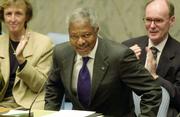
Annan Nobel Peace Price 2001
Blessed are the peace-
makers, for they will
be called sons of God.
-Matthew 5:9
================
Renewing Your Soul
Miracles of Faith
Invitation to the thirsty
Nobel Peace Price 2001
Photo Galleries
Baptism
Bible (NIV)
Bible Study
HealingII
Poetry
Jesus healing Power
===============
Free The Children
Footprints
Resources
Discipleship
Meditation
Prayer
The Lord's Prayer
Prayer Listings
Heavenly Prayer
Unconditional Love
Contact Us

Life's Adventure Prayer Prayer Lists Faith Healing Uncond Love Success