INSTRUCTIONS, EXPERIMENTS, AND PROCESS
It is the commonest of mistakes to consider that the limit of our power of perception is also the limit of all there is to perceive.
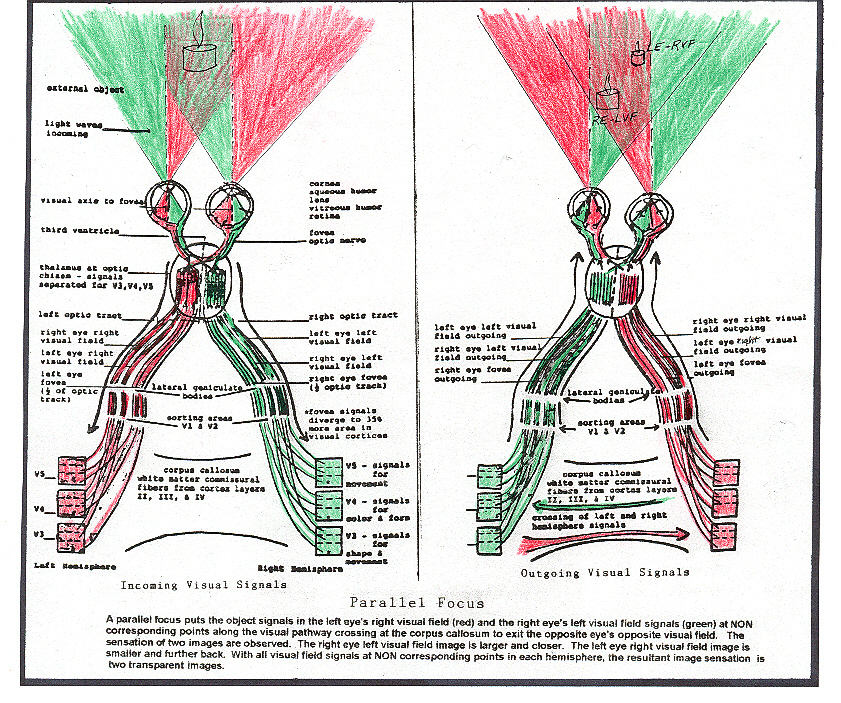
Opposite normal vision's converging the eye's focus point together on an object, a parallel focus allows the left eye to drift to the left, and the right eye drifts to the right. Each eye's focus point will be straight ahead never converging together at one point. Place your thumb or object one to two feet in front of you. Do not focus your eyes on the object but straight ahead. Using only your awareness on the object, a parallel focus produces double images.
Will power, time, and nightly practice is needed to retrain and condition the eye muscles to maintain a parallel focus. When the eye muscles are conditioned to parallel focus then a thought or a blink of the eyes will signal the muscles into a parallel focus with ease.
A parallel focus on an object directly in front of you puts the object signals in the left eye right visual field (red) and the right eye left visual field (green). The LE-RVF and RE-LVF signals are at NONcorresponding points along the visual pathway because the parallel visual axis changes the signal locations along the visual tract.
The LE-RVF signals refract at the cornea and lens to the left retina side, follow the left optic track to the left hemisphere, cross the corpus callosum into the right hemisphere, follow the right optic track to the right eye right retina side, and then reverse refract into the RE-LVF. The sensation of the larger, closer and transparent image is observed on the left side.
The RE-LVF signals refract at the cornea and lens to the right retina side, follow the right optic track to the right hemisphere, cross the corpus callosum into the left hemisphere, follow the left optic track to the left eye left retina side, and then reverse refract into the LE-RVF. The sensation of a smaller, further back, transparent image is observed on the right side.
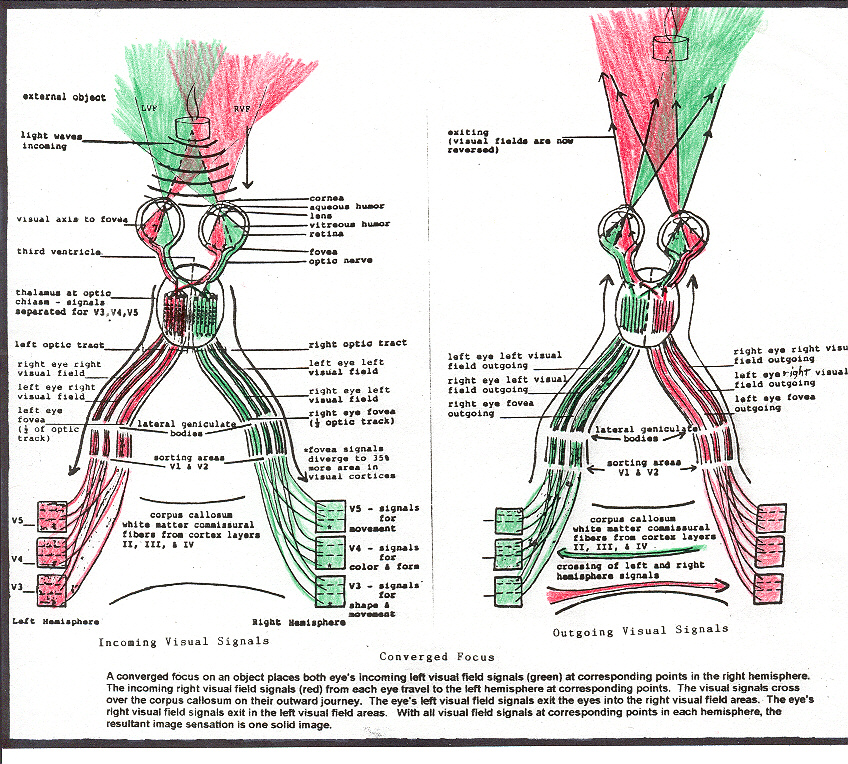
See Converged Focus Resultant.
Difficulty in training the eyes to parallel focus depends, I believe, on past experience to parallel focus or using a cross-eyed focus. Whichever focus your prone to use in the past will be the easiest to do and more difficult to do the opposite focus other than normal converged focus. If group experiments are done, I would suggest to chose prior to experimenting whether to do a parallel or cross-eyed focus.
Looking at the object of focus/attention with your eyes will cause you to use a converged focu instead of a parallel focus.
Understanding the visual field where each image originated came with practice and experimentation with all types of focuses (converged, parallel, cross-eyed, stereogram focuses). The missing link of how the visual signals are layered in a flow-through energy system will become apparent as the different focuses are explored.
Transparent double images are observed because the noncorresponding object signals fall only into the left eye right visual field and right eye left visual field. The lack of corresponding signals from the RE-RVF, LE-Fovea, RE-Fovea, and LE-LVF gives each image only 1/6 of the necessary energy signals needed for an image to appear solid. The illusion of solidity increases as more electrical impulses overlap each other at corresponding points.
The double images will appear as solid if the background is a solid color. Change the background behind the object or finger. An object with color or shape will then be observed through an object or fingers as long as the double images are not overlapping. Objects will appear partially solid where signals overlap at corresponding points along the visual field pathways.
Parallel focus double images are positive afterimages because they are derived from the interference pattern using the original object as the backdrop; therefore, the images are observed in the objects primary colors and not the complementary colors.
Don't forget, a parallel focus creates the double images, one from each eye at different angles at noncorresponding points along the visual field pathways. Also remember negative afterimage experiments showed that vision is a multi-layered sequence. The visual field the image signals falls in determines the size and distance.
Frithof Capra's conclusion is that ...forces inherent in every living organism can work in two different direction...The organism may also undergo a process of self-transformation and self-transcendence, involving states of crises and transition resulting in an entire new state of balance (Capra, Uncommon Wisdom, P 203-4). Normal and microscopic vision clearly proves that organisms can work in two different directions. Karl Pribram states that 8% of the visual signals travel the optic nerve BACK to the retina.
How the visual neurons acquire a new state of balance in order for the incoming and outgoing impulses to travel within the same medium will have to be studied by the experts. Whether the incoming energy waves change to its particle-like characteristics and whether the major energy transformations occur at the corpus callosum will have to be studied, analyzed, and determined by the experts. Light energy with properties of electromagnetic forces that can work in mysterious ways with organisms have yet to be unraveled.