Vision is similar, but not the same for all people. Vision is an individual experience. Some visual differences lie in physical eye defects, color blindness, sensitive or receptive to light, iris color, as well as individual realities affect one's visual perception. For example is a Grizzly a cuddly bundle of joy or a monster to be feared.
A person's inner screen is the blackness one sees when the eyelids are closed.
A positive afterimage in the colors we know the external object to be forms only when the backdrop used is the same external object. The negative afterimage forms only when the eyes are shifted away from the external object using a wall or eyelids as the backdrop.
A negative afterimage although mainly undetected, can be the "first" sight sensation an individual experiences which is the retina's negative conversion of incoming electromagnetic energy (light). This first seeable sight sensation occurs at the eyelid backdrop as a negative in the complementary colors of the original external object.
Albinos will probably not be able to see negative afterimages due to their sensitiveness to high intensity light. Studies will be needed to determine if blue colored iris individuals have too little melanin which allows too much light to flood the retinas due to decreased light absorption in order to see a negative afterimage. Darker colored iris individuals should have no problem seeing vivid, dominant, controlled negative afterimages with a specific feedback process.
The majority of people are unaware of negative afterimages until they are told of their existence. The persons aware of negative afterimages have probably detected merely fleeting glympses such as a bolt of lightening seen at night in which the original image lasts only afew seconds followed quickly by its negative afterimage. Other people may be see vague indistinct negative afterimages that quickly disappear. My research suggests the entire process to view vivid negative afterimages is unknown.
Afterimage unfamiliarity is an advantage because not knowing vigorously pushes forth the desire to know and understand the mysterious visual phenomena and opens the door for creativity. Otherwise, relenting to scientific knowledge would decrease the stamina to push forth into the unknown. "Not knowing" causes the creative imagination to use deductive reasoning and apply the missing links to form the whole explanation to explain vision.
An external object with excellent light reflecting abilities such as a glossy vinyl with a colorful design is best to experiment with in order to create vivid, dominant negative afterimages.
An absolute steady gaze on the external object is necessary to create vivid negative afterimages for a steady flow of unchanging visual signals. Scanning the object causes the visual signals to shift locations on the visual system's path and occurs at a very rapid speed causing the negative afterimage to be unseen.
Normal vision mainly consists of constant eye movement and/or blinking and to maintain an absolute steady gaze is merely a matter of practice, concentration, and feedback training the muscles to the eyes to remain stationary. Practice makes perfect.
The candle exercise practiced in a room with the light on blends the candle flame and room light and decreases the ability to see the flame negative afterimages. The candle flame in a dark room creates the color contrast and allows a person to better observe the flame negative afteimage.
100W light is necessary to create seeable dominant, vivid negative afterimages because stronger intensity light easily breaks away the vitamin A molecule from the cone's opsin. Plus, the magnitude of light striking the retina is increased and will not alter the amount and the speed of travel of an impulse. But the frequency of the impulses, measured in number of impulses per second, increases as the intensity of light is increased. Higher energized photons helps to create a dominant seeable negative afterimage.
Ten minutes nightly practice with an absolute steady gaze is necessary to give the visual neurons time to adapt in order to see negative afterimages. Gaining the ability to see negative afterimages will vary with each individual. Miss one night will set you back two nights.
Time to report a "seeable" negative flame afterimage will vary with individuals according to their eye's sensitivity to light and the ability to maintain and absolutely steady gaze on the external object. When I began a concentration candle exercise, it took 22 days before the flame afterimage appeared which equaled a 60W light. But, it was not my purpose then to create negative afterimages. My purpose was to regain my concentration abilities. My determination to maintain my focus on the flame caused me to eventually maintain an absolutely steady gaze resulting in the flame's negative afterimage of multi-colors. But knowing your goal is to maintain an absolutely steady gaze to create negative afterimages and using a 100 W light bulb will take only a few days.
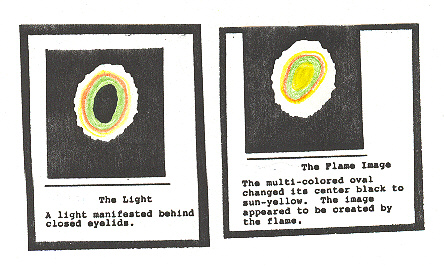
The flame's negative afterimage was a bright, multi-colored oval. The middle of the oval was black, surrounded with a thick circle of light green, then a narrow circle of reddish-orange and a third, smaller circle of yellow, all of which were surrounded by white light. See Flame Afterimage.
Energy's wavelength creates the colors. But remember negative afterimages are the external color wavelengths in their complementary color or negative form.
After several nights of practice, the flame's negative afterimage middle black changed back and forth from white to yellow then finally stayed a brilliant yellow. The outer color rings always stayed the same. I speculate the color change was due to the neurons and cells final transformation or final adaptation to the specific wavelengths and the complementary colors for those wavelengths to its new state of balance. Studies will need to be done on this matter for the experts to analyze.
Color to our sight is caused by different wavelengths of light. In my opinion, the color flow in the flame/bulb afterimage was due to the changing wavelengths of light as the energy moved outward from the flame or bulb and created the effect of movement.
My experience indicated a moving negative afterimage is never seen because the visual signals for movement occur so rapidly that it does not allow enough time for the negative signals to form in order to be observed. A minimum of five seconds was needed (after many hours of feedback had already occurred) with an absolute steady gaze at an external object before a vivid dominant negative afterimage would form. If there was eye movement or external object movement, no afterimage would form. But as energy radiated out away from the flame or lightbulb created the sensation of movement.
I believe the flickering flame had no affect when creating the negative afterimage because the normal flickering was so minute that it did not affect the original flame body. Studies need to be done for the expert's opinion.
Only the flame negative afterimage formed in the beginning due to the lower 60-70 watt light used. Once the eyes have adapted to 100W light, then the negative afterimage of the flame, candle and suroundings will form as a whole.
Due to my visualization/concentration experience with the exploding burned out light bulb, I have to answer a resounding YES, which is probably similar to how singing a high pitch will break glass. After an hour of concentrated visualization exercises, my 60 or 70W light bulb exploded. I replaced it unknowning with the only bulb I had - a 100W Soft white light bulb. Studies need to be done on degrees of concentration and its effects on light bulbs.
A 60 or 70 W light is not strong enough but a 100 W soft white lightbulb creates the process of the neurons self-transormation needed to create vivid negative afterimage. Plus, from the onset of using a 100 W light nightly, it took one week for the visual pathway to adapt to the higher intensity light before the negative afterimage began to appear.
Cell shock from an absolute steady gaze nightly on a 100W light while the transformation into a different state of balance occurred, I imagine. One student began seeing a green color spot after only three nights of practice from a red candle. It is not my purpose to explain what occurrs within the neurons. It will be interesting to hear the expert's opinions after experimentation studies.
I speculate that the 100W light which created higher frequency waves triggered a huge outpouring of coherence in all photons within the frame's square and left this new configuration (yellow square) quivering in a coherent vibrational state of crisis and transition until the cells (possibly the horziontal and amacrine cells) new state of balance settled and became acquired. An increase in area copies the affects of an increase in intensity.
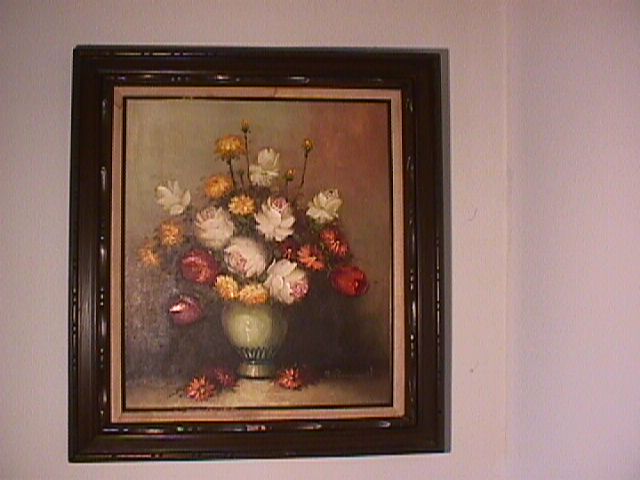
The oil painting negative afterimage nightly experiments brought about gradual changes within the solid yellow square. First the dark wood frame created the brilliant yellow square and the frame's white border brought forth the inner black border behind closed eyelids. A blurred image was the vase of flowers which never would clearly form.
The complementary colors are more fluorescent and pearlescent than external world colors.
Upon interviewing each individual as my knowledge expanded, I found that they:
Continued nightly practice and experimentation using a colorful footstool mouse image, brought forth a "seeable" eight foot negative afterimage when a distance wall was used as the backdrop with open eyes. The image was transparent and every item on the wall could be seen through the mouse image in their normal external colors.
Yes, the wall or eyelid negative afterimage size can be altered by changing the ratio of the object distance to image distance.
Vision is an individual sensation. I had asked my husband to tell me what he saw as I went through the steps to create the wall negative afterimage. He saw NOTHING and rolled over with laughter. I speculate that he was not sensitive to the interference pattern created by my visual signals. There are reports of some individuals acutely sensitive to another person's external negative afterimage who have reported seeing that person's precise image. More experiments need to be done with this.
The ratio of the object distance to image distance creates the size. The wall image increases in size as the wall backdrop gets further away. This is because the visual energy signals began to spread outward as they exit the eyes increasing the micro image signals to its macro image size.
The wall negative afterimage is transparent because as the visual energy exits the eye, the energy begans spreading outward and the signals become thinner as they spread to the greater distance taking away the appearance of solidity.
The wall backdrop image portion was in its negative form because the interference pattern was between the wall and the exiting visual negative signals, thus a negative afterimage. But the wall objects interference pattern was between the original external wall object and its exiting visual negative signals, thus a positive afterimage.
The next negative afterimage occurrance that became noticable was the multistage integration of visual fragments. For example, the outer white bead of the footstool formed in the complementary black, then came the reddish-orange circle in bluegreen. Then in succession formed the ears, head, eyes, then nose, and last the mouth. This clearly proves that vision is a multistage integration of visual signals.
The multistage integration of visual signals were apparent only when observing the negative afterimage behind closed eyelids and could not be detected within the wall image.
The multistage integration of visual signals go unobserved in the wall negative afterimage due to the eyes being open. Open-eyes provide continuous electromagnetic waves entering the eyes pushing the nerve impulses 3 1/4 to 395 feet per second through the visual pathway. The movement is so fast that the multistage integration of visual signals remain unobservable to the conscious mind. But when the eyes are closed nerve cells rely only on their own electro-chemical changes and electrical impulse firing to supply the energy for the transmission of the nerve impulses. Energy's journey through the aqueous humor, lens, and vitreous humor first greatly slow the incoming waves which are further slowed from the slower cell's nerve impulses transmission, thus allowing the multistage intregration of visual signals to be observed.
A final and interesting negative afterimage phase occurred on the 17th night of practice and experimentation using the 100W light bulb. Negative afterimage observation began to include not only the bulb but also the shade, lamp, and curtains, or the external object and items surrounding the object. Simultaneously began the leap to "whole scene" complementary images without the need for the 100W light shining on objects. An early morning scene with normal vision was a small black dog sitting on top of the beige couch in front of the black framed window. The outside scene included the snow-covered ground, dark brown four-car garage with its white doors and snow-covered roof. Whole scene complementary colored inner images could now be created from the light of dawn. Ever see black snow!
The nightly visual experiments caused the visual system to undergo a process of self-transformation which resulted in a new state of balance resulting in the ability to see vivid negative afterimages. But when the nightly experiments ceased, the visual system gradually returned to its normal state of balance.
In my opinion, the five seconds to began forming the negative afterimage will vary for everyone according to the individual's receptiveness to high intensity light, if an absolute steady gaze was maintained, and when enough visual feedback was given.
The negative afterimage fades away after fifteen seconds because it takes 15 seconds for the visual incoming energy to travel the visual path after closing the eyes to dissipate with the interference pattern created when the negative visual energy flow strikes the eyelid backdrop.
Afterimages appear when the interference patterns occur with exiting negative energy striking a backdrop.
Positive and negative afterimages are simply HOLOGRAMS - a sensation detected by the mind.
The first clue for vision's multistage integration of visual signals show up when observing negative afterimages and the multistage integration of the negative signals. The major clue will appear when doing cross-eyed vision experiments. The final resting place all visual signals merge is as electrical impulses exit the two eyes meeting at the backdrop where the interference pattern creates the sensation of sight. The multistage integration of all visual signals and fragments occurs by the alternating right then left eye impulses exiting the eyes.
My speculation worthy of consideration is the change of the wave-like to particle-like characteristics of energy. The medium energy travels in changes light's velocity, therefore the wavelength. The refractive index, and the aqueous and vitreous humors, and lens mass also reduces light's speed and therefore wavelength. Energy's incoming wavelengths have encoded signals for color, size, shape, visual fragments for the ears, nose, mouth, etc. etc. Logic suggests that the incoming wavelengths all vary the wavelength changes due to the curvature of cornea, lens, and entry into the different mediums. Plus the refractive index and humors will vary the wavelengths speeds. Therefore, it is energy's wavelength that determines the impulse sequences for the visual signals and fragments.
Apparent unknown afterimage information includes:
NEXT: Microscopic Vision Instructions, Experiments, & Process
Man's perceptions change as centuries go by.
Teaching Man, he has a holographic Eye --M. J. 2004
Afterimage experimentation had already triggered an interest of light effects on the eye. The next phase was entertainment with the effects of oncoming car headlights by decreasing the pupil aperture to a pin point size. The car headlights disappeared and was replaced by a "large" circle of brilliant light with something floating within the circle. This was followed by experiments at home using a 100 W light backdrop. I continued to research for clues of how and what I was seeing.
No scientific data surfaced amongst my research regarding man's microscopic vision abilities with the naked eye. Scientific data ends with the information that one cannot see clearly an object placed two inches or closer to the eye. At two inches from the eye accommodation fails and the blur point is reached. This fact is true when using normal vision. But using the eye opposite normal vision brings forth the ability of microscopic sight with the specimens two inches or closer to the eye.
Physicist Frithof Capra's conclusion affirms man's microscopic vision abilities when he states: "Self-organizing systems...show the opposite, yet complementary, tendency to transcend themselves to reach out creatively beyond their boundaries and generate new structures and new forms of organization.... Forces inherent in every living organism can work in two different directions" (Capra, Uncommon Wisdom, p. 203-4). Thus, the human eye can work as "normal vision" or the opposite direction for "microscopic vision."
As with negative afterimages, albinos probably will be unable to use their eyes as a microscope due to their sensitivity to high intensity light. All other indivuduals should have no problem acquiring microscopic vision abilities.
Microscopic vision needs higher intensity light for four reasons:
Visual signals for microscopic vision follow the optic/visual axis through the exact cornea center (stroma), and lens center. The minute pupil aperature causes the energy signals to diverge onto a larger fovea area.
The eyelid is nonpermeable to light although if it is a sunny day outside and you close your eyes, you will experience a reddish tint on your inner screen because of the light coming through the blood flow in the capillaries of your eyelids.
Squinting the eyelid for microscopic vision decreases the amount of high intensity incoherent light from flooding the eye and creates small wavelengths (coherence) needed for microscopic vision.
Light coherence is a decisive factor in creating microscopic vision. Energy squeezing through the tiny eyelid and pupil aperture creates small wavelengths and coherent energy has only one wavelength. The eye's natural polarizing filters keeping light coherent are:
Normal vision's focus of attention whose signals fall along the visual axis where the stroma allows waves that vibrate in only one direction to pass through. The lens center, lens mass, and vitreous humor continues to keeps light coherence on its journey to the retina for the most acute vision.
Coherent energy begins to diverge after squeezing through the eyelid opening and enters the aqueous humor as a plane wave coding the image signals of whatever speciman lies in its path. Coherent waves enhance the proton's ability to carry with it piggyback information about the size and three-dimensional shape of the transparent microscopic aqueous specimens.
The aqueous humor slightly slows the coherent energy waves, but the greatest energy slowing agent is the lens mass.
The iris's melanin pigment absorbs stray energy surrounding the pupil. Darker colored irises have more melanin; therefore, the most stray energy absorption.
Microscopic vision energy squeezing through the stroma reaches a focus point at the tiny pupil opening.
Energy entering the eye along the optic/visual axis has a greater luminance than energy entering the eye obliquely.
Four opposing aspects between microscopic and normal vision are:
Incoming visual energy affects the retina by energy absorption, which then produces chemical changes and electrical impulses.
One theory for the inversion of the retina layers is that rods and cones must maintain contact with the densely pigmented epithelium for their growth and for visual pigment regeneration.
Rods still play a role in microscopic vision. When the observer places the attention in the darkness outside the bright illuminated circle, the external peripheral visual images from the right and left visual fields will be seen like walking into a darken movie theatre and detecting form.
The rod's external peripheral visual signals from the eye's right and left visual fields clearly show that all peripheral and visual axis signals converge through the minute eyelid opening, diverge through the aqueous, and then converge through the minute pupil aperature. Incoming visual energy has stored all peripheral and visual axis signals as well as the "whole" of the aqueous specimens, a part of the whole, and the signals to view a specific magnified detailed section of the whole.
Only cones occupy the fovea/macula area. Cones contain three pigments or opsins, which vary in molecular structure and absorb only certain wavelengths and reflect all others. The pigments are:
Incoming microscopic vision energy is coherent after passing through the tiny eyelid and pupil aperature, and coherent energy has only one wavelength. The aqueous microscopic specimens yellow tones within the brilliant circle of light suggest the "one" wavelength is a "long" wavelength. But brighter luminance gives everything yellow hues and energy squeezing through a tiny eyelid and pupil aperture creates "small" wavelengths. Therefore, assumption is made that the action is placed upon the red-sensitive pigment erythrolade, which reacts only to short wavelengths.
Microscope slide colors can be observed because the eyelid and pupil aperature are not decreased to the specific minute size that creates the perfect circle of light as when viewing the aqueous specimens. Therefore the larger pupil size has not created small wavelengths and the various wavelengths for color can be observed.
Chemical and electrical aspects are related to energy's intensity striking the retina. Higher energy intensity striking the retina does not alter the impulse amount and speed, but the frequency increases as energy's intensity is increased.
Monocular microscopic vision's incoming energy does not refract as with normal vision. The right eye right visual field signals go to the right retina side, and the left visual field signals go to the left retina side, which is opposite to normal vision with refraction. Energy signals along the visual axis do not refract as it passes through the stroma and lens center. Plus, the tiny eyelid and pupil apertures cause energy to diverge outward keeping the visual field signals on their corresponding sides.
The major aspect of the fovea/macula cones is that they all have single line pathways (one cone, one bipolar cell, and one ganglion cell) making up one-half the optic nerve. All other cones, rods, and bipolar cells "converge" into one million ganglion cell axons.
Some nerve fibers leave the optic tract at the optic chiasm where they connect with muscle nerves controlling the pupil energy response. Energy's main path continues through the six-layered thalamus onto the lateral geniculate body where energy reorganization takes place. "Association" cells make connections, integrate, and reorder different parts and information, which is believed to be connected to the phenomenon of attention.
After leaving the LGB, single line fovea/macula pathways diverge 35% in the visual cortex area. This coherent energy divergence gives the fovea/macula area signals the most acute visual acuity than any other area. An increase in area copies the effects of an intensity increase, since the quantity of energy increases as the visual cortex area is enlarged.
Negative afterimage experimentation showed using monocular vision triggers an "off" response for signals to cross at the corpus callosum. Therefore, the microscopic visual signals are reflected back along its incoming path to exit the same eye. Neuroscience will have to study, analyze, and explain how this occurs.
Microscopic vision is observed on a single place without depth perception. Using monocular right eye vision has no left eye visual input, thus the multilayered sequence of the left and right eye visual field signals different angles do not occur to create depth perception.
When a different view grabs ones undivided attention and using a high degree of concentration, a magnified, vivid, and closer view of that specific point of attention is observed. Speculation for this occurrence is that the machinery (concentration) used shifts the vibratory level of consciousness into a higher vibration and also possibly increases that visual energy's wavelength and gives the observer the ability to view the image closer from a different perspective (an aspect of holography).
Yes, undivided attention, focus and concentration brought forth by an extremely strong element of surprise is needed to experience this holography aspect and observe dominant, colored, greatly enlarged cornea cells.
I can't explain this. One speculation is the possiblility that the undivided high degree of attention/focus somehow changes within our consciousness the small wavelength to a long wavelength in order to increase the specimen size and for the colors to be seen?
Another holography aspect may be acquired by decreasing the vibratory level of consciousness to a concentrated and relaxed state. Then the opposite perspective of the "whole" specimen within the aqueous humor comes into view.
Dhavid Cooper measured energy reflected back out of his wife's eye. I have no doubts you will be able prove this theoretical model.
Furthermore, two Soviet psychologists, Dr. Alexander P. Dubrove and Dr. Veniamin N. Pushkin, have written extensively that the frequency processing brain capabilities do not in and of themselves prove the holographic nature of images and thoughts in the human mind. They have suggested what might constitute such proof would be an example where the brain projected an image outside of itself, then the holographic nature of the mind would be convincingly demonstrated. Or, to use their own words, "Records of ejection of psychophysical structures outside the brain would provide direct evidence of brain holograms" 65 (Quoted in Talbot, Holographic Universe, P. 110).
NEXT: Parallel Focus Instruction, Experiments, & Process
Difficulty in training the eyes to parallel focus depends, I believe, on past experience to parallel focus or using a cross-eyed focus. Whichever focus your prone to use in the past will be the easiest to do and more difficult to do the opposite focus other than normal converged focus. If group experiments are done, I would suggest to chose prior to experimenting whether to do a parallel or cross-eyed focus.
Looking at the object of focus/attention with your eyes will cause you to use a converged focu instead of a parallel focus.
Understanding the visual field where each image originated came with practice and experimentation with all types of focuses (converged, parallel, cross-eyed, stereogram focuses). The missing link of how the visual signals are layered in a flow-through energy system will become apparent as the different focuses are explored.
Transparent double images are observed because the noncorresponding object signals fall only into the left eye right visual field and right eye left visual field. The lack of corresponding signals from the RE-RVF, LE-Fovea, RE-Fovea, and LE-LVF gives each image only 1/6 of the necessary energy signals needed for an image to appear solid. The illusion of solidity increases as more electrical impulses overlap each other at corresponding points.
The double images will appear as solid if the background is a solid color. Change the background behind the object or finger. An object with color or shape will then be observed through an object or fingers as long as the double images are not overlapping. Objects will appear partially solid where signals overlap at corresponding points along the visual field pathways.
Parallel focus double images are positive afterimages because they are derived from the interference pattern using the original object as the backdrop; therefore, the images are observed in the objects primary colors and not the complementary colors.
Don't forget, a parallel focus creates the double images, one from each eye at different angles at noncorresponding points along the visual field pathways. Also remember negative afterimage experiments showed that vision is a multi-layered sequence. The visual field the image signals falls in determines the size and distance.
Frithof Capra's conclusion is that ...forces inherent in every living organism can work in two different direction...The organism may also undergo a process of self-transformation and self-transcendence, involving states of crises and transition resulting in an entire new state of balance (Capra, Uncommon Wisdom, P 203-4). Normal and microscopic vision clearly proves that organisms can work in two different directions. Karl Pribram states that 8% of the visual signals travel the optic nerve BACK to the retina.
How the visual neurons acquire a new state of balance in order for the incoming and outgoing impulses to travel within the same medium will have to be studied by the experts. Whether the incoming energy waves change to its particle-like characteristics and whether the major energy transformations occur at the corpus callosum will have to be studied, analyzed, and determined by the experts. Light energy with properties of electromagnetic forces that can work in mysterious ways with organisms have yet to be unraveled.
The eye's natural habit is to move in synch with each other resultig in a converged focus. Cross-eyed focus is unnatural and more difficult to achinve due to life-long habits.
A cross-eyed focus creates double images by placing each eye's visual signals at non-corresponding points along the visual pathways.
The same chain of events occur in all types of vision. But visual variations occur due to the different visual axis focus points which places the visual signals in different visual fields at corresponding or non corresponding points. Image size and distance are changed according to which visual field the signals are in. For example:
Yes! A six-layered visual system becomes apparent.
A cross-eyed focus on two identical objects create a single, closer positive afterimage because the crossing of the visual axises where the two incoming positive visual signals meet with the two outgoing negative visual signals and act as the original backdrop creating the interference pattern needed for the sensation of sight. The image is closer due to the visual axis location, and smaller due to the ratio of the image and visual axis crossing point.
My speculation is that nature's duality allows the sensation of sight to occur either using a backdrop or the crossing of the visual axis.
The visual axis crossing produces a positive afterimage because the two paths of negative visual energy exiting the eyes are also colliding with the incoming positive energy from the external object.
Visual axises crossing could explain why the exiting negative energy does not have to reach the stars in order for the sensation of a star to be observed. Star images may materialize at the point in space where the visual axises meet or when negative energy interacts with a backdrop, perhaps the earth's atmospheric layer or an individuals energy field cocoon.
Babies learned to converge their focus naturally by focus of their attention towards the sound or object which results in the converged focus.
An individual with a dominent cross-eyed focus, for example, would have two identical cars approach side by side but would observe a single car closer inbetween the two real cars. The observer would move to either side to avoid the single car. SPLAT ! He would be struck by one of the real cars he did not see.
A cross-eyed focus on one red and one white candle will produce one single, closer candle image with the red and white colors switching ghostly back and forth. The switching is caused by the on and off right and left hemisphere switching of the left and right visual field impulse signals.
The clue presented by the color switching clearly shows that the left and right visual field pathways always remain separated never merging the signals, otherwise there would be one pink candle. It now becomes apparent that the visual field signals from each hemisphere are alternately layered visual impulses during the sight sensation.
Eidetic imagery patterns when viewed singly reveals no recognizable pattern but when simultaneously presented to each eye using a cross-eyed focus, an identifiable message emerges by combining the images. Eidetic images are most frequently experienced by school age children and diminishes in adolescence as the habit of a converged focus strongly dominates.
Stereogram 2-D binocular converged focus contains a 3-D image attained only by a parallel or cross-eyed focus on the wall paper type design.
A stereogram design is created by putting dots or images in slightly different positions and layers with the same design used in a wall paper affect. The design has to be a repetition of the initial design in order for some visual layers to overlap in the 3-D mode.
A stereogram converged focus produces a 2-D image because two eyes produce different opposite angled views that overlap each other at corresponding points along the visual pathway, thus, a 2-D image.
The only process necessary to gain the 3-D mode is the mental attitude needed to gain a parallel or cross-eyed focus. Once acquired, the neuron and synapse changes become easier with each successful shift.
The eyes are an extension of the brain, but there is "no" puzzle for the brain to solve regarding stereogram 3-D viewing. The solution is relaxation, mental thought to parallel or cross-eye focus, and patience to allow the visual signals to settle separately into each of the seven different visual field layers.
Mr. Q stereogram 2-D viewing has 5 vertical and 7 horizontal rows. The 3-D focus has 6 vertical rows and 7 horizontal rows on four different depth layers.
Before acquiring the 3-D shift, the head must be held stationary with an absolutely steady parallel focus.
A stereogram parallel focus produces a 3-D image by shifting the left eye view to the left and the right eye view to the right at noncorresponding points. Each of the seven visual paths maintain their own individual pathway, angles and depths.
The eyes can scan the 3-D image as long as the head or stereogram angle remains unchanged. Once the stereogram picture or the head is tilted up, down, left, right and takes that particular angle view out of its necessary boundary then the 3-D mode downshifts back to the 2-D mode.
2-D stereogram has five vertical rows. 3-D stereogram observation has six rows due to the eye's parallel focus which moves the left eye's visual field span to the left and the right eye's visual field span to the right at noncorresponding points along the visual pathway. Thus, the parallel shift creates the sixth vertical row.
The Mr. Q 5/6 vertical columns equal the visual field span of each eye which actually are not columns. Vertical columns were used for the diagram. This stereogram happened to have 5 shark rows but it could be 6, 7, or 10.
Stereogram parallel focus using red and white dots placed above the different shark columns, then closing one eye then the other produces the layered visual fields and shows which layer is foreground or background.
Yes, the background or foreground left or right angle visual fields can be reversed by tilting the stereogram angle. The reversal is not apparent to the observer but is known to occur due to experiements with the red/white dots. Instead of the dots being red/white they become white/red layered when the stereogram angle is changed.
The visual field pathways are: RE-RVF, LE-RVF, LE-FOVEA, LE & RE VISUAL AXIS FOVEA, RE-FOVEA, RE-LVF, LE-LVF.
Yes, each visual field pathway contains the entire visual field signals. The only difference between the different pathways are the individual angles of the visual signals.
Information between visual pathways do not appear to be shared with different visual pathways. But all different angled visual signals merge as one at the interference pattern multistage integration of all visual signals when the sensation of sight occurs.
One speculation is that each visual pathway can handle both incoming and outgoing signals simultaneously because the signals are different angled signals and never interfere with each other. A hologram can hold many different pictures never to interfere with each other all due to each different angles.
Refracted fovea signals send each eye's whole left and right angle views converging to that eye's fovea. The left and right visual field signals never separate. Those signals then increase to 35% more area in the visual cortex, cross the corpus callosum into the opposite hemisphere, follow the optic path to exit the opposite eye's opposite visual fields.
The clue microscopic vision set forth regarding the fovea signals was that both left and right visual fields signals converge to a focus point at the optic axis line going through the cornea center and the visual axis line passing through the lens center. The optic axis line makes an angle of about five degrees with the visual axis. This area has no curvature, therefore, no refraction of visual signals. The optic/visual axis signals become coherent as they squeeze through the cornea and lens center then diverge outward to a larger fovea area. These signals remain upright never refracting. The fovea signals continue to increase to 35% in size at the visual cortex. These fovea optic/visual axis signals then cross the corpus callosum into the opposite hemispheres and exit diverging into the opposite eye's optic/visual axis fields.
Awareness focused at a specific object sends those visual signals converging at the optic/visual axis cornea and lens exact centers and become coherent. Those signals then increase in size diverging to the fovea and further increase 35 % in size at the visual cortex for the most acute visual acuity.
Knowing the two different diagram results, deductive reasoning is one direction to forge links.
A cross-eyed stereogram focus alters the quantity of the left and right visual field signals to each eye. The left eye receives a greater span of LE-LVF signals with a decreased span of LE-RVF signals. And the right eye receives more RE-RVF signals with a decreased span of RE-LVF signals. The cross-eyed visual field signals balances are opposite parallel focus visual field signal balances. The parallel focus image observed has the sharks chasing Mr. Q. and cross-eyed focus has Mr. Q chasing the sharks.
The visual field balance reverses the dominant visual field layer but it is the angle of the cross-eyed focus that creates the change.
The right and left stereogram picures placed correctly in the stereoscope, the stereoscope lenses create a parallel focus to the eyes without the need to retrain the eye muscles.
A positive afterimage is observed because both eyes visual signals have gone full circle to exit the opposite eye striking the original external object/backdrop, therefore a positive afterimage is observed.
Vertical row six appears because the stereoscope lenses send the parallel signals to the eyes at NONcorresponding points.
When two right or left angled pictures are used, there is no multi-layered sequence of the right and left angle visual/fovea signals that is required for 3-D depth perception.
Reversed right and left angled pictures create a cross-eyed focus. The right and left visual field signals plus the quantity of visual field signals are altered opposite that for normal vision.
A double exposure image is created by using two eyes (2 cameras) and two separate energy paths (the film). Then the two opposite angled visual field energy signals are married in a multi-layered sequence and produce the double exposure image.
The visual axis crossing single image is smaller and closer. The stereoscope cross-eyed mode single image is the original size and distance as the original stereogram. The eye's functions can work in opposite directions by either the visual axis crossing or the original object backdrop mode.
According to Fritzhof Capra: "Self-organizing systems not only have the tendency to maintain themselves in their state of dynamic balance but also show the opposite, yet complementary, tendency to transcend themselves to reach out creatively beyond their boundaries and generate new structures and new forms of organization. ... Forces inherent in every living organism can work in two different directions. After a disturbance, the organism may return, more or less, to its previous state through various processos of self-maintenance. ...The organism may also undergo a process of self-transformation and self-transcendence, involving states of crises and transition and resulting in an entire new state of balance (Capra, Uncommon Wisdon, p. 203-4.)
Sheldrake speculated, "The conventional scientific assumption is that they [images] are inside the brain. But this theory may be radically wrong. Our images may be outside us. Vision may involve a two-way process, an inward movement of light and an outward projection of mental images" (Sheldrake, Seven Experiments, p. 99). Sheldrake's speculation that vision may involve a two-way process parallels this new theory of vision.
Dr. Jacob Liberman, a pioneer in the therapeutic use of light, states, "The human body is like a sieve; it is built to allow energy to flow through it (Liberman, Light, Pg. 177). He explains his technique of utilizing light to correct a patient's lazy eye condition. Knowing that the eyes are neurologically connected, he flashed a light source into the patient's good eye. This light followed the visual path through the brain, loosened the bad eye's blocked energy, which was released out of the poorer eye and then dissipated (Liberman, Light, P. xix). Liberman's work shows energy as a flow through system.
Cooper measured the light beamed into his wife's eye and again when light reflected back out of his wifes eye (Liberman, Light, PP. 176-177). Cooper's experiment shows that visual energy does indeed flow out the eye and that it can be measured.
Once again Frithof Capra's conclusion surfaces that "Forces inherent in every living organism can work in two different directions." Cooper's wife had one eye closed, therefore the energy was reflected back out the same eye. Liberman's patient had both eyes open creating a flow-through system.
Pribram's theory parallels this new theory of vision in that the retina, lens, pupil, and cornea are the organisms that reverse refracts and uprights the upside down and backward micro signals into the macro images of the external world. The macro image is determined by the ratio of the external object plane to the image plane or backdrop used on energy's diverging path.
Physical sight requires the eye, the mind, and the brain. Without just one of these, there is nothing to see, not even blackness. When a blind from brom birth indivudual gains sight with the help of modern technology, his newly acquired vision is formless, which is how it exists before the mind molds it into light, color and form.
Vibrating electromagnetic energy's increased 100 Watt intensity and daily practice strengthen energy's synaptic crossings to create the mind's first sensation of visible light in the negative form at the eyelid backdrop's interference pattern. A controlled negative afterimage at the eyelid backdrop is the first sight sensation that occurs but remains invisible with normal vision.
Negative afterimage experiments impress the fact that the retina's function is to make the negative form of all incoming visual electromagnetic energy that is needed for the interference pattern to produce a hologram.
The different depths in the various visual field must be created neurologically. This will have to be studied and analyzed by the experts.
Perhaps a mathematical formula will surface that will pull this new direction and order in holography together. Many more experiments need to be done by the dot stereoscope method to determine the various depth layers within both eyes right and left visual fields. And the fovea's reversal of the vertical rows depth affects. Plus, more experiments with negative afterimages will show more ordered sequence of the visual cortex's visual fragments for other different geometric forms and colors.
The complex criss-crossing maze is necessary along the dual holographic process of two eyes to get the signals where they need to go for the proper interference pattern needed to create the awesome hologram which we call sight.
Dogma is defined as "a belief taught or held as true." According to my experience, vision is NOT occurring in the brain. The right and left eye's angled views always remain separated within the visual field and fovea paths through the brain. Vision's incoming signals are then converted into negative electrical impulses. The eyes and brain select abstract qualities from the infinite reservoir of vibrating energy, separate the integral parts, and send the altered attributes along to make a full circle to exit the opposite eye's opposite visual field areas. The fragmented visual signals exit the eyes in a multi-layered sequence of alternating left and right hemisphere electrical visual impulses to the backdrop. An interference pattern occurs at the backdrop and creates the sensation of sight to the mind located in the individual's energy field.
A second clue showing the electrical impulse layering affect goes back to the experiments to create negative afterimages. Using a footstool with a colorful mouse on it, the negative afterimage appears in phases with the outer white bead forming first the negative black bead, then the inner complementary blue-green (for reddish-orange), followed in sequence the ears, then eyes, then nose and mouth. Closing the eyes stops the incoming signals, therefore the impulses are greatly slowed and moved along by the cells own power allowing the multi-layered impulse sequence to be detected.
Furthermore, anatomic evidence shows no single area, no convergence zone in any brain part which summon together all the visual fragments which are scattered throughout the visual cortex of both ehmispheres. Therefore, vision is not occuring in the brain but at the point where all elecrical impulses become one.
Another example that electrical impulses is vision's method for layering the visual signals goes back to the cross-eyed focus experiment using two identical external candles but one candle is red and the other candle is white. A single candle is observed with the image alternating back and forth between red and white - the alternating impulse signals from each eye.
Light, as we know it, is invisible amongst the stars. Photons, units of energy intensity, bounce chaotically through the void, never defining anything and never becoming light. When the photons strike a star, they rebound back on a new path to the individual on earth. This energy remains invisible until its journey through the eyes. It is unlikely that visual energy will travel millions of miles within a second to create the sensation of sight of the star.
Consider the cross-eyed focus experiment using two identical candles which becomes a single smaller candle at the point where the visual axis cross. Using a normal converged focus, there is a point out there in space that the visual axis of the two eyes converge and cross but not the same as cross-eyed focus. This visual axis crossing where the eye's outgoing negative energy traveling up to 395 feet per second interacts with the incoming photons from the stars and create the interference pattern which the mind then senses and only then the star becomes visible.
Visual energy is a holographic projection. Vision is the HOLOGRAM which produces the sight sensation detected by the mind located in an individual's energy field!
Kirlian photographic technique clearly shows energy emitted from the body. The body takes in light and radiates out light in the form of the body's aura. These biophoton particles emmitted from the body range on the electromagnetic spectrum from ultraviolet to infrared. They also vary in intensity depending on the specific biochemical reaction. Changing the way a person uses the mind, according to Kirlian theory, increases, decreases, or alters the aura/energy field vibrations.
Science does not know where the mind is located but proposes that it seems to be located in every cell. An individual's energy field or aura permeates every cell within the body as well as extends great distances outside the body.
UCLA's Professor Valarie Hunt confirms the existence of the human energy field and that the human energy field is holographic. She discovered it responds to stimuli before the brain does. Hunt states: "The mind's not in the brain. It's in that darn field" (Talbot, Holographic Universe, P. 192).
Plato theorized that energy exits the eyes and mingles with light waves emitted by the object to cause sight. Plato alone brought together in harmony the two opposing viewpoints as one whole working together. But Plato was unable to prove his theory because Dennis Gabor did not discover holography until 1947. With the holography knowledge, access to new directions for exploring the visual system became available. And new understanding of the human holographic visual system provides a stepping stone for science to study and analyze a different direction in holography in order to develop a new laser holographic microscope.
See The Eye-Brain Holographic Model.