INSTRUCTIONS, EXPERIMENTS, AND PROCESS
Use an absolutely steady gaze and aim the right eye to the left side of the object placed in front of you and the left eye to the object's right. Both eye's visual axis will cross between you and the object. Do not look at the object with your eyes because that will create a converged focus. Place only your awareness on the external object. PRACTICE, PRACTICE, PRACTICE.
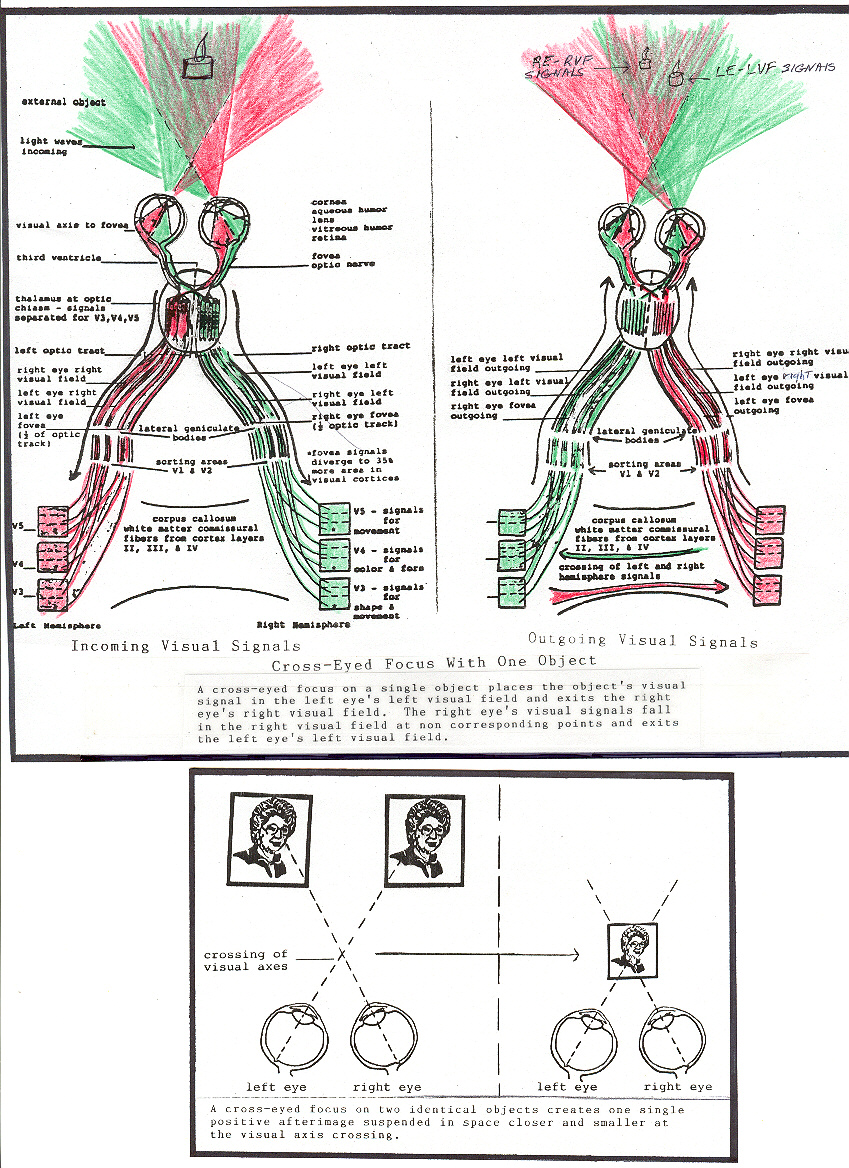
A cross-eyed focus on an external object places the visual signals in the LE-LVF (green) and RE-RVF (red) at NONcorresponding points along the visual pathway.
The LE-LVF (green) signals refract at the cornea and lens to the left eye right retina side, cross the optic chiasm over into the right hemisphere. The LE-LVF signals follow the right optic path to the cerebral cortex, cross the corpus callosum into the left hemisphere, follow the left optic path to the optic chiasm, cross over to the right optic nerve, reach the right eye left retina side and exits into the RE-RVF area. The sensation of a left side, smaller, further back, transparent image is observed.
The RE-RVF (red) signals refract at the cornea and lens to the right eye left retina side, cross the optic chiasm into the left hemisphere. The RE-RVF signals follow the left optic path to the cerebral cortex, cross the corpus callosum into the right hemisphere, follow the right optic path to the optic chiasm, cross over to the left eye right retina side, reverse refracts and exits into the LE-LVF area. The sensation of a right side, larger, closer, transparent image is observed.
A cross-eye focus on two identical pictures/objects put the visual signals at the visual axis of each eye. The visual axis crossing creates the interference pattern resulting in the sensation of sight of a single, closer, smaller and solid positive afterimage. A cross-eyed focus on two identical candles but one is white and the other is red also produces a single, closer, smaller, solid positive afterimage at the visual axis crossing. But the single candle is not a blend of white and red to pink. The single candle image switches back and forth from white to red.
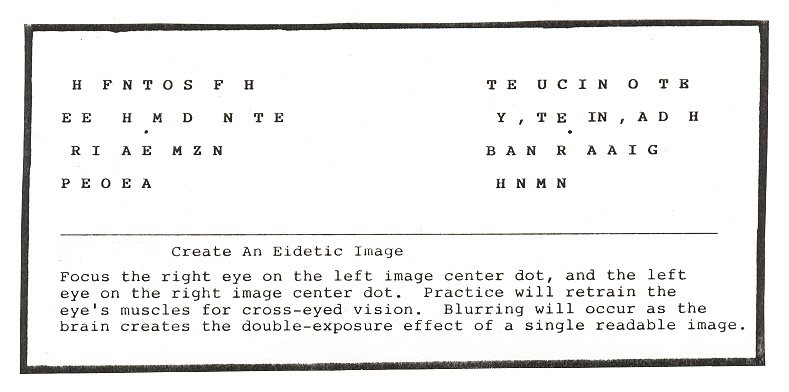
A cross-eyed focus on two groups of random letters will overlap the noncorresponding visual signals into a single readable eidetic image.
See Cross-Eyed Focus Resultant.
The eye's natural habit is to move in synch with each other resultig in a converged focus. Cross-eyed focus is unnatural and more difficult to achinve due to life-long habits.
A cross-eyed focus creates double images by placing each eye's visual signals at non-corresponding points along the visual pathways.
The same chain of events occur in all types of vision. But visual variations occur due to the different visual axis focus points which places the visual signals in different visual fields at corresponding or non corresponding points. Image size and distance are changed according to which visual field the signals are in. For example:
Yes! A six-layered visual system becomes apparent.
A cross-eyed focus on two identical objects create a single, closer positive afterimage because the crossing of the visual axises where the two incoming positive visual signals meet with the two outgoing negative visual signals and act as the original backdrop creating the interference pattern needed for the sensation of sight. The image is closer due to the visual axis location, and smaller due to the ratio of the image and visual axis crossing point.
My speculation is that nature's duality allows the sensation of sight to occur either using a backdrop or the crossing of the visual axis.
The visual axis crossing produces a positive afterimage because the two paths of negative visual energy exiting the eyes are also colliding with the incoming positive energy from the external object.
Visual axises crossing could explain why the exiting negative energy does not have to reach the stars in order for the sensation of a star to be observed. Star images may materialize at the point in space where the visual axises meet or when negative energy interacts with a backdrop, perhaps the earth's atmospheric layer or an individuals energy field cocoon.
Babies learned to converge their focus naturally by focus of their attention towards the sound or object which results in the converged focus.
An individual with a dominent cross-eyed focus, for example, would have two identical cars approach side by side but would observe a single car closer inbetween the two real cars. The observer would move to either side to avoid the single car. SPLAT ! He would be struck by one of the real cars he did not see.
A cross-eyed focus on one red and one white candle will produce one single, closer candle image with the red and white colors switching ghostly back and forth. The switching is caused by the on and off right and left hemisphere switching of the left and right visual field impulse signals.
The clue presented by the color switching clearly shows that the left and right visual field pathways always remain separated never merging the signals, otherwise there would be one pink candle. It now becomes apparent that the visual field signals from each hemisphere are alternately layered visual impulses during the sight sensation.
Eidetic imagery patterns when viewed singly reveals no recognizable pattern but when simultaneously presented to each eye using a cross-eyed focus, an identifiable message emerges by combining the images. Eidetic images are most frequently experienced by school age children and diminishes in adolescence as the habit of a converged focus strongly dominates.