Once the ability to see vivid negative afterimages is gained then experiment with:
A binocular positive afterimage vision uses normal eye movement and electromagnetic lower intensity light which keep the negative signals invisible. The incoming visual waves follow this process. The point of attention, the converged focus point of both eyes, falls along the visual axis to each eye's fovea. The non-fovea part, the peripheral area, of each eye receives signals from all directions. The image-carrying light waves reflect off the external object and pass through both corneas, with a refractive index of 1.376 bending and slowing the light wave as it passes from air into the eye's aqueous humor.
The aqueous humor has a refractive index of 1.336, which bends the waves even more and also changes the speed, slowing the waves to the pupil opening. The lens surface at the pupil refracts the waves still more, with the greatest slowing of waves through the lens mass. More refraction occurs at the posterior portion of the lens. Cornea and lens curvature refracts the image signals to an inverted, upside down, backward, nonpictorial micro signals on the retina. The aqueous humor, lens mass and vitreous humor reduce the speed of light, changing energy's wave-like characteristics to energy's particle-like characteristics as energy travels to the retina.
Energy then travels outside the non-permeable retinal cells (ganglion, bipolar, rods and cones) to the retina's rear to be absorbed by the permeable rod and cone membrane tips containing pigments. Developing the incoming altered energy signals (the film) begins with the chemical and electrical transformation as energy advances through the rods, cones and cross the synapses into the bipolar cells for more changes. The horizontal cells relay signals horizontally to other bipolar cells. Further chemical and electrical altering occurs after the impulses cross the synapses from bipolar cells into ganglion cells. Amacrine cells relay signals horizontally to other ganglion cells. Each ganglion cell has an axon, an unbranched prolongation extending from the cell body of a nerve cell. These axons gather on the inner surface of the retina and exit the eyes as the optic nerves.
The right eye's right visual field signals (red) are refracted to the left side of the right eye retina and then criss-cross at the optic chiasm. The signals next pass through the left thalamus and onto the lateral geniculate body and visual cortex centers V1, V2, V3, V4, and V5 in the left hemisphere. The left eye's right visual field signals (red) are refracted to the left side of the left eye retina. These signals also pass through the left thalamus, the lateral geniculate body, and the visual cortex centers V1, V2, V3, V4, and V5 in the left hemisphere.
The right eye's left visual field signals (green) are refracted to the right side of the right eye retina, and then proceed through the right thalamus, the lateral geniculate body, and the visual cortex centers V1, V2, V3, V4, and V5 in the right hemisphere. The left eye left visual field signals (green) are refracted to the right side of the left eye retina, and then criss-cross at the optic chiasm into the right thalamus, the lateral geniculate body, and visual centers V1, V2, V3, V4, and V5 in the right hemisphere.
Positive Afterimage Vision --Incoming Waves.
Altered incoming energy at each hemisphere's visual cortex centers follow some commissural fibers, the white matter layers, from the left and right hemispheres' visual cortex layers II, III and IV which form the cable-like structure called the corpus callosum. The corpus callosum connects the incoming right visual field signals in the left hemisphere cortex (red) to neurons in the right hemisphere cortex on an outward path to exit the opposite eye. Similarly, the corpus callosum connects the incoming left visual field signals in the right hemisphere cortex (green) to neurons in the left hemisphere cortex on an outward path to exit the opposite eye.
After crossing the corpus callosum, the negative visual impulses follow the optic tract fibers converging into 8% of the optic nerve in route to the opposite visual cortices, lateral geniculate bodies, thalamus and the rear of the opposite retina. The energy's reverse refraction at the lens and corneas have inverted the upside down and backward signals back to the image signal's upright position.
The right visual field signals (red) now exit into the eyes' left visual field areas, and the left visual field signals (green) exit into the eyes' right visual field areas. The exiting negative energy creates an interference pattern with the positive energy at the original external object for the sensation of a positive afterimage - A HOLOGRAM.
The mind, located in the energy field, then receives the sensation of sight of a positive afterimage with the normal external object colors as we know the colors to be. The interference pattern at the external object then cause the energies to dissipate with a continuous flow of sight sensations. The positive afterimage in this case is the size of the object, since both object and image are at the same distance from the eyes.
The negative afterimage visual fragments and visual fields' multilayered sequences producing the background and foreground remain unobserved to human consciousness due to the up to 395 feet per second push from incoming waves.
Positive Afterimage Vision -- Outgoing Energy.
Opposite positive afterimage vision, the complementary colored negative afterimage vision needs an absolutely steady gaze on the external object, which keep the visual signals stationary and unchanging along the visual path. Plus, observing negative afterimages require using a 100W light, which increases light's frequency and easily breaks apart the cones vitamin A and opsin. The stationary visual signals and increased light frequency puts the vivid, dominant, negative signals in the visible spectrum. The entire process of positive or negative afterimage vision follows the same complex visual path.
Negative energy exits the opposite corneas and strikes the closed eyelids creating an interference pattern at the eyelid backdrops for a small negative afterimage sensation to the mind. The negative afterimage size depends on the ratio of the object distant to image distant which in this case keeps the eyelid image sensation small. But changing the eye's focus point to a distant wall, a larger negative wall afterimage will be observed.
The multilayered visual fragments, form, and color sequences will be observed at the eyelid backdrop vivid negative afterimage. The slowing of energy impulses through the visual pathway now rely only on each cell's slower firing rate to push the impulses along its path allowing the negative afterimage to become visible. The generator-like push of open-eyed incoming energy pushes the impulses up to 395 feet per second, therefore the multilayered visual sequences remain invisible. Although each eyelid has a separate negative afterimage, the mind receives the sensation of a single negative afterimage (to be explained by the experts some day, I hope).
Eyelid and Wall Negative Afterimages.
Vision is similar, but not the same for all people. Vision is an individual experience. Some visual differences lie in physical eye defects, color blindness, sensitive or receptive to light, iris color, as well as individual realities affect one's visual perception. For example is a Grizzly a cuddly bundle of joy or a monster to be feared.
A person's inner screen is the blackness one sees when the eyelids are closed.
A positive afterimage in the colors we know the external object to be forms only when the backdrop used is the same external object. The negative afterimage forms only when the eyes are shifted away from the external object using a wall or eyelids as the backdrop.
A negative afterimage although mainly undetected, can be the "first" sight sensation an individual experiences which is the retina's negative conversion of incoming electromagnetic energy (light). This first seeable sight sensation occurs at the eyelid backdrop as a negative in the complementary colors of the original external object.
Albinos will probably not be able to see negative afterimages due to their sensitiveness to high intensity light. Studies will be needed to determine if blue colored iris individuals have too little melanin which allows too much light to flood the retinas due to decreased light absorption in order to see a negative afterimage. Darker colored iris individuals should have no problem seeing vivid, dominant, controlled negative afterimages with a specific feedback process.
The majority of people are unaware of negative afterimages until they are told of their existence. The persons aware of negative afterimages have probably detected merely fleeting glympses such as a bolt of lightening seen at night in which the original image lasts only afew seconds followed quickly by its negative afterimage. Other people may be see vague indistinct negative afterimages that quickly disappear. My research suggests the entire process to view vivid negative afterimages is unknown.
Afterimage unfamiliarity is an advantage because not knowing vigorously pushes forth the desire to know and understand the mysterious visual phenomena and opens the door for creativity. Otherwise, relenting to scientific knowledge would decrease the stamina to push forth into the unknown. "Not knowing" causes the creative imagination to use deductive reasoning and apply the missing links to form the whole explanation to explain vision.
An external object with excellent light reflecting abilities such as a glossy vinyl with a colorful design is best to experiment with in order to create vivid, dominant negative afterimages.
An absolute steady gaze on the external object is necessary to create vivid negative afterimages for a steady flow of unchanging visual signals. Scanning the object causes the visual signals to shift locations on the visual system's path and occurs at a very rapid speed causing the negative afterimage to be unseen.
Normal vision mainly consists of constant eye movement and/or blinking and to maintain an absolute steady gaze is merely a matter of practice, concentration, and feedback training the muscles to the eyes to remain stationary. Practice makes perfect.
The candle exercise practiced in a room with the light on blends the candle flame and room light and decreases the ability to see the flame negative afterimages. The candle flame in a dark room creates the color contrast and allows a person to better observe the flame negative afteimage.
100W light is necessary to create seeable dominant, vivid negative afterimages because stronger intensity light easily breaks away the vitamin A molecule from the cone's opsin. Plus, the magnitude of light striking the retina is increased and will not alter the amount and the speed of travel of an impulse. But the frequency of the impulses, measured in number of impulses per second, increases as the intensity of light is increased. Higher energized photons helps to create a dominant seeable negative afterimage.
Ten minutes nightly practice with an absolute steady gaze is necessary to give the visual neurons time to adapt in order to see negative afterimages. Gaining the ability to see negative afterimages will vary with each individual. Miss one night will set you back two nights.
Time to report a "seeable" negative flame afterimage will vary with individuals according to their eye's sensitivity to light and the ability to maintain and absolutely steady gaze on the external object. When I began a concentration candle exercise, it took 22 days before the flame afterimage appeared which equaled a 60W light. But, it was not my purpose then to create negative afterimages. My purpose was to regain my concentration abilities. My determination to maintain my focus on the flame caused me to eventually maintain an absolutely steady gaze resulting in the flame's negative afterimage of multi-colors. But knowing your goal is to maintain an absolutely steady gaze to create negative afterimages and using a 100 W light bulb will take only a few days.
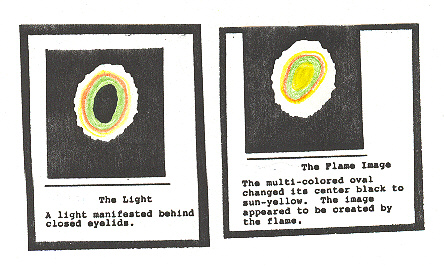
The flame's negative afterimage was a bright, multi-colored oval. The middle of the oval was black, surrounded with a thick circle of light green, then a narrow circle of reddish-orange and a third, smaller circle of yellow, all of which were surrounded by white light. See Flame Afterimage.
Energy's wavelength creates the colors. But remember negative afterimages are the external color wavelengths in their complementary color or negative form.
After several nights of practice, the flame's negative afterimage middle black changed back and forth from white to yellow then finally stayed a brilliant yellow. The outer color rings always stayed the same. I speculate the color change was due to the neurons and cells final transformation or final adaptation to the specific wavelengths and the complementary colors for those wavelengths to its new state of balance. Studies will need to be done on this matter for the experts to analyze.
Color to our sight is caused by different wavelengths of light. In my opinion, the color flow in the flame/bulb afterimage was due to the changing wavelengths of light as the energy moved outward from the flame or bulb and created the effect of movement.
My experience indicated a moving negative afterimage is never seen because the visual signals for movement occur so rapidly that it does not allow enough time for the negative signals to form in order to be observed. A minimum of five seconds was needed (after many hours of feedback had already occurred) with an absolute steady gaze at an external object before a vivid dominant negative afterimage would form. If there was eye movement or external object movement, no afterimage would form. But as energy radiated out away from the flame or lightbulb created the sensation of movement.
I believe the flickering flame had no affect when creating the negative afterimage because the normal flickering was so minute that it did not affect the original flame body. Studies need to be done for the expert's opinion.
Only the flame negative afterimage formed in the beginning due to the lower 60-70 watt light used. Once the eyes have adapted to 100W light, then the negative afterimage of the flame, candle and suroundings will form as a whole.
Due to my visualization/concentration experience with the exploding burned out light bulb, I have to answer a resounding YES, which is probably similar to how singing a high pitch will break glass. After an hour of concentrated visualization exercises, my 60 or 70W light bulb exploded. I replaced it unknowning with the only bulb I had - a 100W Soft white light bulb. Studies need to be done on degrees of concentration and its effects on light bulbs.
A 60 or 70 W light is not strong enough but a 100 W soft white lightbulb creates the process of the neurons self-transormation needed to create vivid negative afterimage. Plus, from the onset of using a 100 W light nightly, it took one week for the visual pathway to adapt to the higher intensity light before the negative afterimage began to appear.
Cell shock from an absolute steady gaze nightly on a 100W light while the transformation into a different state of balance occurred, I imagine. One student began seeing a green color spot after only three nights of practice from a red candle. It is not my purpose to explain what occurrs within the neurons. It will be interesting to hear the expert's opinions after experimentation studies.
I speculate that the 100W light which created higher frequency waves triggered a huge outpouring of coherence in all photons within the frame's square and left this new configuration (yellow square) quivering in a coherent vibrational state of crisis and transition until the cells (possibly the horziontal and amacrine cells) new state of balance settled and became acquired. An increase in area copies the affects of an increase in intensity.
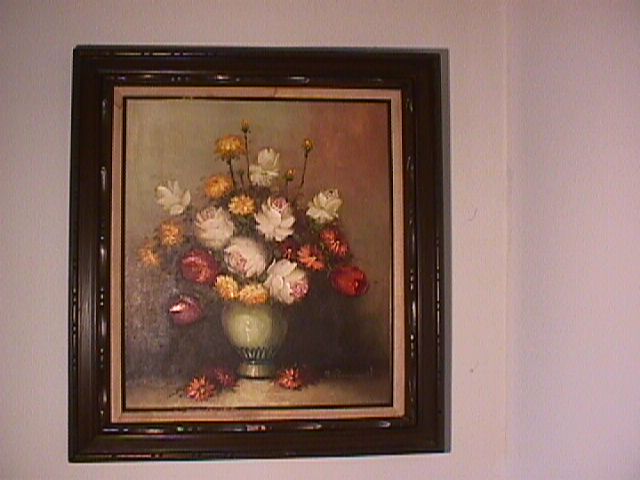
The oil painting negative afterimage nightly experiments brought about gradual changes within the solid yellow square. First the dark wood frame created the brilliant yellow square and the frame's white border brought forth the inner black border behind closed eyelids. A blurred image was the vase of flowers which never would clearly form.
The complementary colors are more fluorescent and pearlescent than external world colors.
Upon interviewing each individual as my knowledge expanded, I found that they:
Continued nightly practice and experimentation using a colorful footstool mouse image, brought forth a "seeable" eight foot negative afterimage when a distance wall was used as the backdrop with open eyes. The image was transparent and every item on the wall could be seen through the mouse image in their normal external colors.
Yes, the wall or eyelid negative afterimage size can be altered by changing the ratio of the object distance to image distance.
Vision is an individual sensation. I had asked my husband to tell me what he saw as I went through the steps to create the wall negative afterimage. He saw NOTHING and rolled over with laughter. I speculate that he was not sensitive to the interference pattern created by my visual signals. There are reports of some individuals acutely sensitive to another person's external negative afterimage who have reported seeing that person's precise image. More experiments need to be done with this.
The ratio of the object distance to image distance creates the size. The wall image increases in size as the wall backdrop gets further away. This is because the visual energy signals began to spread outward as they exit the eyes increasing the micro image signals to its macro image size.
The wall negative afterimage is transparent because as the visual energy exits the eye, the energy begans spreading outward and the signals become thinner as they spread to the greater distance taking away the appearance of solidity.
The wall backdrop image portion was in its negative form because the interference pattern was between the wall and the exiting visual negative signals, thus a negative afterimage. But the wall objects interference pattern was between the original external wall object and its exiting visual negative signals, thus a positive afterimage.
The next negative afterimage occurrance that became noticable was the multistage integration of visual fragments. For example, the outer white bead of the footstool formed in the complementary black, then came the reddish-orange circle in bluegreen. Then in succession formed the ears, head, eyes, then nose, and last the mouth. This clearly proves that vision is a multistage integration of visual signals.
The multistage integration of visual signals were apparent only when observing the negative afterimage behind closed eyelids and could not be detected within the wall image.
The multistage integration of visual signals go unobserved in the wall negative afterimage due to the eyes being open. Open-eyes provide continuous electromagnetic waves entering the eyes pushing the nerve impulses 3 1/4 to 395 feet per second through the visual pathway. The movement is so fast that the multistage integration of visual signals remain unobservable to the conscious mind. But when the eyes are closed nerve cells rely only on their own electro-chemical changes and electrical impulse firing to supply the energy for the transmission of the nerve impulses. Energy's journey through the aqueous humor, lens, and vitreous humor first greatly slow the incoming waves which are further slowed from the slower cell's nerve impulses transmission, thus allowing the multistage intregration of visual signals to be observed.
A final and interesting negative afterimage phase occurred on the 17th night of practice and experimentation using the 100W light bulb. Negative afterimage observation began to include not only the bulb but also the shade, lamp, and curtains, or the external object and items surrounding the object. Simultaneously began the leap to "whole scene" complementary images without the need for the 100W light shining on objects. An early morning scene with normal vision was a small black dog sitting on top of the beige couch in front of the black framed window. The outside scene included the snow-covered ground, dark brown four-car garage with its white doors and snow-covered roof. Whole scene complementary colored inner images could now be created from the light of dawn. Ever see black snow!
The nightly visual experiments caused the visual system to undergo a process of self-transformation which resulted in a new state of balance resulting in the ability to see vivid negative afterimages. But when the nightly experiments ceased, the visual system gradually returned to its normal state of balance.
In my opinion, the five seconds to began forming the negative afterimage will vary for everyone according to the individual's receptiveness to high intensity light, if an absolute steady gaze was maintained, and when enough visual feedback was given.
The negative afterimage fades away after fifteen seconds because it takes 15 seconds for the visual incoming energy to travel the visual path after closing the eyes to dissipate with the interference pattern created when the negative visual energy flow strikes the eyelid backdrop.
Afterimages appear when the interference patterns occur with exiting negative energy striking a backdrop.
Positive and negative afterimages are simply HOLOGRAMS - a sensation detected by the mind.
The first clue for vision's multistage integration of visual signals show up when observing negative afterimages and the multistage integration of the negative signals. The major clue will appear when doing cross-eyed vision experiments. The final resting place all visual signals merge is as electrical impulses exit the two eyes meeting at the backdrop where the interference pattern creates the sensation of sight. The multistage integration of all visual signals and fragments occurs by the alternating right then left eye impulses exiting the eyes.
My speculation worthy of consideration is the change of the wave-like to particle-like characteristics of energy. The medium energy travels in changes light's velocity, therefore the wavelength. The refractive index, and the aqueous and vitreous humors, and lens mass also reduces light's speed and therefore wavelength. Energy's incoming wavelengths have encoded signals for color, size, shape, visual fragments for the ears, nose, mouth, etc. etc. Logic suggests that the incoming wavelengths all vary the wavelength changes due to the curvature of cornea, lens, and entry into the different mediums. Plus the refractive index and humors will vary the wavelengths speeds. Therefore, it is energy's wavelength that determines the impulse sequences for the visual signals and fragments.
Apparent unknown afterimage information includes:
NEXT: Microscopic Vision Instructions, Experiments, & Process