



Second
Act:
Operation Uranus(2)
On November, between 19 and 23, the Russian counter-offensive destroyed 15 German and allied divisions, of which three were armoured, doing 60.000 prisoners; on having ended the fifth day, his more advanced tops in the end of the pliers were to 65 km to the west of Stalingrad, in Kalach. Surrounding the Germans showed itself a ring of approximately 35-60 kilometres that transformed the assailants in assaulted. Paulus, who was thinking in Kalasch's surroundings, got away himself from being accidentally captured; then he realized of that the south flank was discovered, that was lacking fuel and that they had provisions for approximately six days.
(pag 2 of 2)
On November 18, Stalin was despairing of restlessness being afraid for the offensive that was going to be produced on the following day. Zhukov had prepared everything even the most minimal detail; he knew that the advance would have to be very quick to avoid the response of the German armoured troops. The operation key was the weakness of the Germany's allies, principally Rumanian, who they were defending Paulus's flanks.
To 7.30 Russian hour 19th of November, the artillery and the batteries of Soviet mortars began to shoot in Kletscakia's area, to receive the password "Siren". The sign was given for trumpets, which were been heard by the Rumanian divisions. In both principal sectors of the north offensive, more than 3.500 cannons centred and weighed mortars to open a gap for a dozen of infantry divisions, three tanks corps and two of cavalry that were forming a part of the Army Corps of Vatutin and Rokossovsky.
The Rumanian troops managed to repel several Soviet assaults, but the intensity of the offensive and his antitank lack of sufficient weapon was such, that were doomed. To half a day of 19th of November, the Soviet squashed the Rumanians in Kletskaia's area and, little later, they were traversing the same luck the troops of Serafimovich's area (Map, situation b).
The bad weather, which was accompanying on the Soviet assault, was preventing that the Luftwafe's airplanes could to fly. During the evening of 17th, the Soviet armoured vehicles continued advancing towards the south; nevertheless, the visibility was so painful that had to use compasses to not get lost. The headquarters of the Army Group B supervised by Von Weichs order to block the Soviet advance with part of the XI corp and 14th Panzer Division, but already it was late because the Soviet tanks had overcome already the supposed line of defence. In the night, Von Weichs, ordered to interrupt the struggle in Stalingrad with the aim to turn troops aside to cover the rear of the VI Army of Paulus, threatened after the collapse of 3rd Rumanian Army.
Von Paulus ordered to several divisions to move to the rear, near the Don, for defend the area, nevertheless, the lack of fuel and the contradictory orders, slow any possible reaction. It would be necessary to add, that Paulus on having observed that the assaults happened in a zone out of his responsibility area, he decided not to actuate and to wait for orders from the top; something similar was happening to Von Weichs, waiting for the Führer's orders. Hitler, in his desire to control everything what was happening in the front, had built immobility and a slowness of the German troops that increased the disaster.
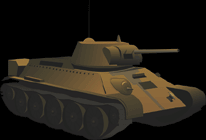
On the 20th in the middle of the morning in the middle of a thick fog, the general Eremenko, commander of Stalingrad's front, was arranging the assault to the south of Stalingrad against 4th Rumanian Army. It produced an identical scene to that of the before day, the Rumanians fought bravely and managed to push the first Soviet assaults back; nevertheless, it was impossible to contain the advance without the sufficient antitank weapon. The T-34 destroyed the weak Rumanian defences in spite of the terrible faults of the assault's organization, on the following day the soviet troops of the zone remained without supplies. While, the Soviet troops of the north were advancing without too many problems towards Kalasch, meeting point of the combined Soviet assault. The remains of the Rumanian and German divisions were fleeing dispersed in the steppe trying to reach the Don and to meet the thickness of the VI Army (Map, situation c).
In the first hours of 22nd of November, the lieutenant colonel G.N. Filippov, commander of 19th Tank Brigade ordered that two German tanks and a vehicle of recognition, captured the previous day, should cross the bridge on the Don in Kalasch. When the German troops that were monitoring the bridge discovered the snare, the Soviet had crossed the bridge and they avoided that it was demolished out.
In the south, 4th Rumanian army was destroyed and 4th Army Panzer of Hoth had to move back in the middle of a hard combat to avoid to be cornered (Map, situation d).
Kalach, the offensive's target, was the most vulnerable point in this moment. It didn't have an organized defence and soon it turned into a hell on having being mixed the disorganized troops that were fleeing in front of the Soviet armoured vehicles. On the following day, the troops of the north and of the south were meeting in Kalasch's surroundings, completing the fence (Map, situation e).
In the following days the different Soviet armies who had taken part in the operation and new others, were reinforcing the new positions to avoid a counter-offensive (Map, situation f).
The German Army looks for the Manstein's genius for a rescue operation: The Winter Storm.

