




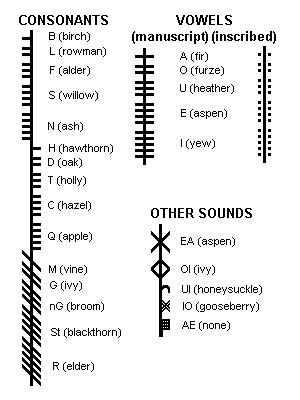
The Ogham Tree Alphabet At first these may look like chicken scratches and seem to have little to do with trees, but in fact they do. These marks actually spell out the word "Forest," and the letters stand for the following trees: Fearn (alder), Onn (furze), Ruis (elder), Edhadh (aspen), Sail (willow), and Tinne (holly). It is in the ancient form of celtic communication called Ogham. Ogham does not appear to have developed from earlier systems. It was supposedly given to man by the the god Oghma, who was skilled in dialects and poetry. Oghma was the "strong man" of the gods, or the celtic version of Hercules. However, strength among the celts referred not to physical prowess, but eloquence of speech. Oghma gave the language as a signing language to be used by the learned. However, it was not intended to be a magical or secret script used only by Druids. Accounts indicate Ogham was often written on lengths of yew (a sacred druidic tree) and sent from one person to another -- possibly as a means of simple communication, or a code that served a magical purpose for all to see. It was also inscribed on standing stones. The language itself was of a ritualistic manner, for non-verbal dialogue. It seems to have been intended to be used to communicate spiritual thoughts and ideas, and the spiritual power it contained was highly regarded.
No evidence of Ogham writing remains from yew branches, of course, but many ogham-inscribed stones have been found -- 332 have been discoverd in Ireland, 40 in Wales, 8 in England, 5 on the Isle of Man, 29 in Scotland (2 in irish and 27 in pictish). In recent years, 2 ogham-inscribed stones have been identified in North America, though the stone inscriptions consist of names only. There are well over 100 differt types of ogham, each with unique names and different shaped notches for the letters. Tree ogham is the most commmon form, though there is river-pool, color, fortress, and bird. In bird ogham, for example, each of the letters is named for a bird. However, the order of the letters always remains the same. The other oghams may have been used in much the same way modern english assigns objects to help as a mnemonic. For example, using objects -- A is for apple, B is for ball; animals -- A is for alligator, B is for bison; or colors -- A is for aqua, B is for black. Celtic Tree Mysteries: Secrets of the Ogham, Steve Blamires, 1997 |
web design by

Sacred Woods • Myths and Legends • Medieval Forestry
Ancient Forests • Forestry Timeline • Evolution of Tools
© Copyright 2004