|
|
The New Forest
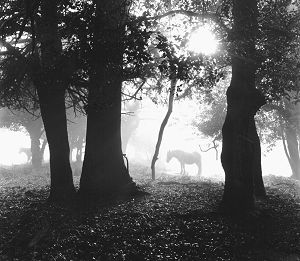
William I (The Conquerer) was a Norman King who invaded England and defeted the anglo-saxons under King Harold at the Battle of Hastings in 1066. Thirteen years later he set up the New Forest in Hampshire, England -- ostensibly to provide a habitat for deer which he hunted for pleasure. A set of laws called the Forest Law were enacted to preserve the deer and their food supply (called mast).
The creation of the New Forest did not set well with the locals, because the New Forest was set aside at their expense. The only concessions they were granted were that they were allowed to gather dead wood for fuel and turn their stock out. Even these were regulated if such activities interfered with the king's "venison," which at the time included four kinds of wildlife: red deer, fallow deer, roe, and wild pig.
|
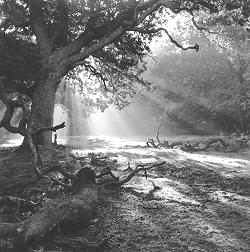
If William the Conquerer was unpopular for comandeering the land to create the New Forest, his son William II became reviled. One common expression we use today possibly resulted from the death of this ruthless king. While hunting in the New Forest, William II was found dead, killed by an arrow, supposedly at Centerdon Glen (right). Presumably he was murdered for imposing harsh punishments. His body was found by a charcol burner named Purkiss who carried the dead king's body to Westminster for proper burial. In exchange, Purkiss was granted the right to collect any firewood for his charcoal burners that he could reach by "hook or by crook," meaning anything he could reach with a reapers billhook (a tool with a curved blade attached to the handle) or shepherds crook. The term has come to mean attaining something by any means possible. The exact etymology of this term may never truly be known, but the decendants of Purkiss, now called Purkess, still reside within the New Forest.
|
To this day, remnants of the legal structure that policed the New Forest for the Crown are still present in some form. However, the 1971 Wild Creatures and Forest Laws Act abolished the prerogative right of the Sovereign to wild animals (except swans and royal fish), formally ending the Forest Law.
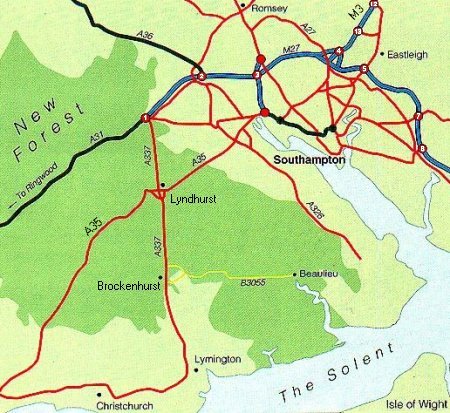
Boundries of the New Forest as it exists today near Southampton, England |
Photos courtesy of Graham Cooper (used by permission). Read more about the New Forest.
|
|