 |
 |
 |
| EMERGENCY ASSESSMENT |
| AND |
| FIRST-AID |
 |
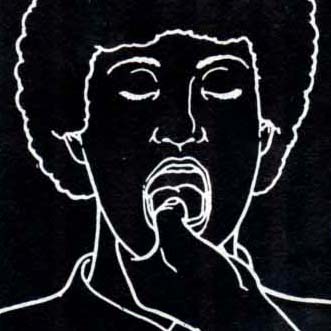
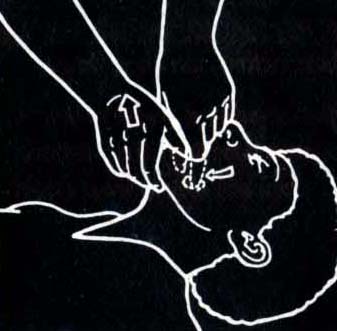
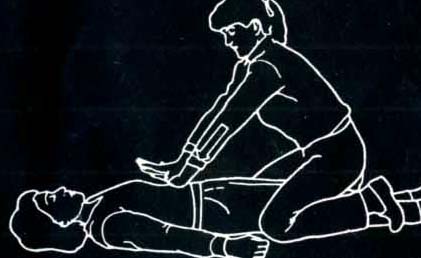
| COMPLETE AIRWAY OBSTRUCTION -----Unconscious Adult -------------------- Call for help Do finger sweep to remove object -Move from straddle position and kneel beside patient's head -With patient's face up, open the mouth and grasp both tongue and lower jaw between thumb and fingers of hand nearest patient's legs; lift jaw -Insert index finger into mouth along inside of cheek and deep into throat to base of tongue -Use "hooking" action to dislodge object and move into mouth for removal *Open airway and try to ventillate; if still obstructed, reposition head and try to ventilate again Perform 5 abdominal thrusts -Straddle patient's thighs -Place heel of one hand against middle of patient's abdomen just above navel and well below lower tip of breastbone -Place other hand directly on top of first hand (fingers of both hands should be pointing toward patient's head) -Press into patient's abdomen 5 times with quick upward thrusts -Each thrust should be a separate and distinct attempt to dislodge the object |
 |
 |
 |
|
|
| CPR must be done with care because compression to the heart can cause repeated flexion/extension of the cervical spine (those bones which are located in the neck). Look also for signs of external bleeding or hemorrhage. When inspecting a bleeding structure, the examiner should note the type of vessel affected. An artery will spurt blood, pulsating flow with bright red color while a vein will provide an even flow. Because arterial bleeding is of greatest concern, the examiner must be aware of the pressure points in the body to apply proper pressure. The examiner must choose the proper pressure point closest to the area of bleeding and applies pressure to the artery to stop or slow the bleeding. Tourniquets should be used only with extreme caution and in selected instances(e.g. accidental amputation of a limb, very severe bleeding from a major artery, or the need to apply CPR with no assistance available. If it is used, the time of the torniquet application should be carefully noted. If signs and symptoms of shock are present (pulse rate is beginning to weaken with restlesness and anxiousness, cold and clammy skin, profuse sweating, pale face, cyanotic[bluish] around the mouth, shallow, laboured, rapid or irregular breathing, dull, lusterless and dilated pupils) but visible bleeding is minimal, the examiner should suspect hidden bleeding within the abdomen, chest or extremities[the arms or the legs]. To prevent or delay the onset of shock, the examiner may cover the patients, elevate the legs or attempt to eliminate the cause of the problem. |
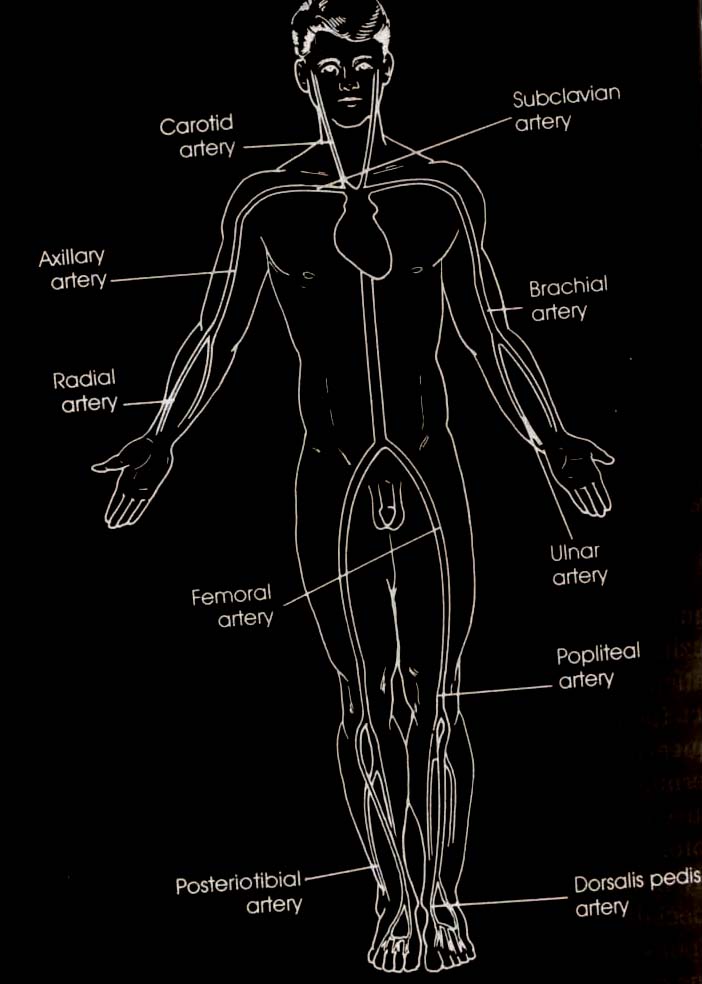 |
| Pressure Points |