 |
 |
 |
| EMERGENCY ASSESSMENT |
| AND |
| FIRST-AID |
 |
|
|
| -Position shoulders over hands with elbows locked and arms straight Give 15 Compressions -Compress breastbone 1 1/2 to 2 inches at a rate of 80 to 100 compressions per minute (15 compressions per minute (15 compressions should take 9 to 11 seconds) -Count aloud "One and two and three and four and five and six and....fifteen and" (Push down as you say the number and come up as you say "and") -Compress down and release pressure smoothly, keeping hand contact with chest at all times ADULT ONE-RESCUER CPR -------------------- Compression/Breathing Cycles -Continue cycles of 15 compressions followed by 2 slow breaths -after 4 cycles of 15:2 (about 1 minute), check pulse -if still with no pulse, continue 15:2 cycles beginning with compression -recheck pulse every few minutes *Lay persons should be taught only one-rescuer CPR. Professional medical rescuers should learn both one-rescuer and two rescuer techniques ADULT TWO RESCUER CPR -------------------- Rescuer One 1. Open airway (head-tilt, chin lift or jaw thrust)Check breathing (look, listen, feel) 2. Give 2 slow breaths (1 1/2 to 2 seconds per breath) Watch chest rise Allow for exhalations between breaths 3. Check for carotid pulse Rescuer Two 1. If no pulse, give cycles of 15 chest compressions (80-100 per minute) followed by one slow breath by rescuer one 2. After one minute of resue support, check pulse. If no pulse, continue 5:1 cycles |
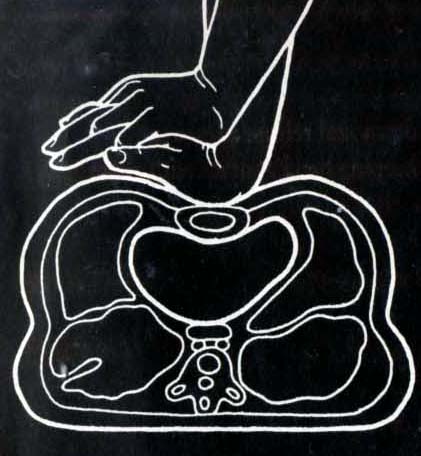
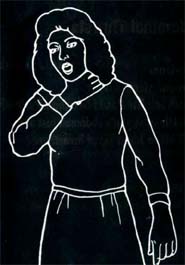
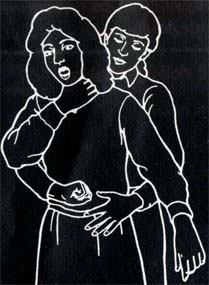
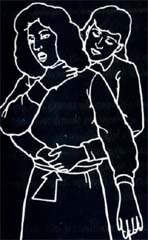
| FOREIGN BODY AIRWAY OBSTRUCTION -----Conscious Adult ------------------- Determine if patient is choking -Ask "Are you choking?" Perform abdominal thrusts -Stand behind patient -Wrap arms around patient's waist - Make a fist with one hand and place thumb side of fist against middle of patient's abdomen just above navel and well below lower tip of breatsbone -Grasp your fist with your other hand -Keeping elbows out, press fist into victim's abdomen with a quick upward thrust -Each thrust should be a separate and distinct attempt to dislodge the object -Repeat thrusts until obstruction is cleared or victim becomes unconscious *For pregnant and obese patients, use chest thrust |
 |
 |
 |
 |