|
|
| Pre High School |
| Home |
| Pre High School |
| High School |
| Fordham Univ. |
| Harrisburg PA |
| White Plains NY |
| Williamsport PA |
| State College |
| Utica NY |
| Wheeling WV |
| Woodsboro Md |
| Current Home |
| My Wife |
| My Kids |
| My Grandkids |
| My Parents |
|
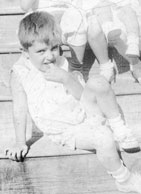
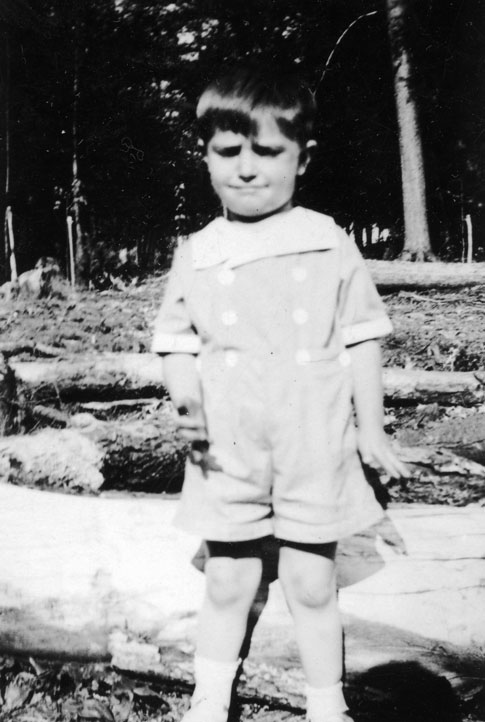
| This photograph is one of the earliest available of me. I always view this picture with wonder because my recollections of the clothing I wore as a kid were that they were soiled and well worn. I cannot recall be dressed in the kind of clothing represented here. |
My home during my entire childhood was in Mount Carmel, Pennsylvania at the northwest corner of 6th and Walnut streets. The precise address was 248 South Walnut Street. The house was owned by my paternal grandparents before my parents owned it. Today it is owned by my oldest sister, Ramona. By Mount Carmel standards it was a large home. Actually, it combined two duplexes. The downstairs 6th Street side was, for most of its existence, used for business purposes. First as a barroom and then by my parents, as a grocery store. The other side, downstairs, contained a kitchen in the back, a center room that we call the dining room, and the room in front, the parlor. French doors, like sentries, separated the dining room and the parlor which was generally off limits except for special occasions. Upstairs, on the side above the grocery store, were three bedrooms. The opposite side had two bedrooms, a bathroom and a smallish room used for sewing and the storage of clothing. The attic was large, was well lighted with windows and was often a rainy day play area. The basement was large with adequate head room for tall family members but with only a crawl space in the back end of the house. The home contained a coal stove in the kitchen for cooking and for heat. The kitchen did not have a refrigerator, instead the cooling resources in the grocery store were used. A coal fired heater, about as big as a refrigerator, called a Heaterola, was in a corner of the dining room to heat the entire home. Heat flowed to the upstairs through a hole in the ceiling. Understandably, the bedrooms were quite cold in winter. Laundry was done in the basement with a wringer washing machine. The wash was hung outside for drying. All rooms had area rugs, usually with a floral design, that extended to within a foot of the walls. The home directly bordered the sidewalk in front as did most homes in Mount Carmel. The 6th Street side contained a narrow strip that was used for planting flowers. A yard in back was mostly grass with flowers around the perimeter. There was also a grapevine near the kitchen. The home directly abutted the home on the north side except for a three foot strip that ran the length of the kitchen and allowed for a window in the kitchen and also the dining room. The back of the home faced a pair of homes, a duplex, with a backyard that adjoined ours without a fence. My parents owned those homes. An outhouse was in the backyard near its center, a two seater. A narrow porch was in the front along with an entry to steps that lead down to a door that entered basement. The streets in Mount Carmel were wide, mostly unpaved, and perpendicular to each other. A trolley line entered the town from Centralia in the east, turned through the business district on Oak Street and then headed for Kulpmont and Shamokin to the west. Most streets were profusely lined with mature trees, mostly maple. The front of our home was adorned with a buckeye tree. The 6th street side had a series of maples. Tree branches almost entered some bedroom windows. It was an absolute delight to be awakened on summer mornings to the songs and chatter of birds. The homes in town were well maintained with the street only moderately littered with small debris. In spring , however, the streets were usually a mess after the winter snows melted and a residue of coal ash that homeowners spread, to free their cars from the clutches of ice and snow, became exposed. Our town was a pleasant place to grow up and, in our community, our home was generously sized for a family with 6 kids. Street sounds began in the darkened early morning hours with the home delivery of milk in clanking glass bottles. Footsteps on the sidewalks clicked by as folks made their way to work in various factories and coal mines around town or to connect with public transportation. Car doors slammed, their engines came to life and then faded away as they proceeded down the street. With the arrival of daylight the deliveries from wholesalers for our grocery store began. Several bakeries, meat packers, dairies, grocery, and produce suppliers all contributed to the continual sounds of activity. In the bedrooms above the store muffled voices and footsteps could be heard from below. As children began to gradually spill out of their homes in the morning they initially tended to form small groups and engaged in subdued activities. It seemed as though the intensity of their activity rose as the sun rose. Several times a week a junk man would pass through with a sizable bell on his truck that rang out in a rhythmical clang-clang. Old newsprint, scrap metal, and rags could be exchanged for a few cents from the junkman. Iceman deliveries occurred on a daily basis to neighborhood homes and the chipping of his ice pick along with the clank of his thongs was a signal for kids to surround his truck to retrieve scattered ice shards. There were no playgrounds in Mount Carmel so streets and sidewalks were the location of choice for games and activities of all kinds. Scooters, wagons, bicycles and tricycles had to be dodged by both pedestrians and cars. Girls, typically, were often occupied with playing jacks or hopscotch, or, skipping rope or bouncing balls in coordination with various rhymes. Pinochle, a somewhat adult card game, was a favorite with most kids and played on front porches. Blackjack, was less favored, and played with chewing gum wrappers substituting for money. Boys fabricated toy guns from broom handles. Old broom handles were the major resource for fashioning the implements of many street games. Nipsy, Taggitty Hoop, Wickitty, Stick Ball, Hit-the-Stick, and Half Ball come immediately to mind. Group games requiring no implements included Surrender, the generally shunned Hide'n Seek, and the most popular, Prisoner's Base. Hide-the-Belt was infrequently played since most did not want to endure the pain inflicted by the belt. Evening was the favored time to play the recall game, Movie Stars. Each morning, Mr. Shemanski made his way back to his home, stooped over with a bucket of coal hanging from the crook of his arm. He would collect the coal on the refuse banks of strip mine operations where coal chunks of various sizes could be found scattered about among the rocks and dirt. There were four volunteer fire companies in Mount Carmel. Fire call boxes were located on many street corners. If an alarm was set off at one of those call boxes it would trigger the sounding of a raucous horn in the center of town that could be heard everywhere. The count of the number blasts from the horn identified the call box from which the alarm originated. The town had a 9:00 PM curfew and everyone was reminded of it, each day, with three blasts from the fire horn. Coal was delivered to homes periodically to replenish their basement supply. A coal chute was attached to the back of the coal delivery truck that then descended through a hole in the home's foundation into an interior coal bin. The coal was then sent down the chute one shovelful at a time. The shovel bit into the coal in the truck with a scrunch and the delivery man then sent the coal on to its destination down the chute. I find that I cannot adequately describe the sound of coal sliding on metal, at consistent intervals, until a ton or two of coal is finally settled into its dark, dusty, basement confines. I always marveled at the strength of the men who did this back breaking work. Much less frequently an organ grinder, or hurdy gurdy, would pass through. The music played by the organ grinder was reminiscent of a carousal. For a few coins the hurdy gurdy's parrot would select a folded paper from a tray which contained your fortune. Another infrequent visitor passing though the neighborhood was the umbrellaman. With his tools carried on his back his services also included sharpening scissors and knives as well as umbrella repair. Periodically, a church bell would slowly peal to let people know of the funeral of one of its residents. Mount Carmel was littered with churches. At noon, each day, seemingly every church bell was rung. This announced the exodus of those who worked in town, back to their homes for the noon meal. As dusk began to settle in, the hokey-pokey ice cream man caught everyone's attention with the consistent ding-ding-ding of the bell on his truck. The cost of a cone was just a few cents and drew people off their porches to the truck as all family members were treated to his goodies. Each Friday morning a seafood vendor wound though the streets and made his presence known with his cry of "Fresh Fish". On Saturdays an elderly egg peddler, on foot, shuffled by making deliveries to his regular customers. Local farmers drove through with their trucks laden with fruits and vegetables. The farmers also provided poultry, which were live and beheaded by the farmer at the time of purchase. At night, once in bed, the automobile traffic on the streets gradually subsided. Once in a while a car door could be heard slamming as people returned home from a night out. Their voices suddenly being severed as they entered their homes. Late at night, on weekends, the silence was usually broken by the sound of high heels on the pavement below as a woman, who lived several doors away, returned from her lengthy attendance at her favorite bar. The lonesome sound of a steam locomotive's whistle could sometimes be heard spreading over the landscape from a distance. Shockingly, sometimes you were jolted awake, in the middle of the night, as the silence was shattered by the screams of a woman across the street who was being beaten by her husband. Police were always called when this occurred but the woman would seldom press charges. Mount Carmel was in the midst of the Pennsylvania anthracite coal fields. Strip coal mines surrounded the town and for almost all my childhood those mines continued to be worked. Summer nights, with our home's windows open, were punctuated with the sounds of the huge shovels tearing open the earth. The strip mines created gaping holes and hills of extracted earth. Most people in town deposited their garbage and refuse in those strip mines at multiple locations. There were no landfills. Old appliances, furniture, newsprint, magazines, foodstuff, you name it, found their way to those "dumps". Invariably, the dumps were set afire. If the fire burned over an exposed coal vein, it sometime caught fire. If the coal vein burned with sufficient intensity, the fire would follow the vein underground were it could not be extinguished. Those underground fires burned for years, required millions of taxpayer dollars to put out and, in one case, the evacuation of an entire small nearby town. The entire area was honeycombed with the underground tunneling of coal mines. Homes and roads were sometimes affected by cave-ins of abandoned mines below. Roads dipped and the shifting foundations of homes would make them lean at odd angles. The refuse from the deep coal mines in the area, called culm, consisted of coal dust, dirt and small particles of coal. The culm was deposited near the mine operations and over time grew immensely into hills that were easily visible from many points. The culm would sometimes catch fire and then burn underground so that it could not easily be extinguished. The fires were then left to smolder. This was normally not a problem except for dreary rainy days. Water seepage coming into contact with the fire would turn to steam. The sulfur content in the coal when heated would produce a rotten egg odor. Low lying clouds and the absence of a breeze would cause the water vapor, laden with its stygian odor, to settle slowly and linger for long periods. The Shamokin Creek ran through the entire length of the north end of town. The raw sewage from every home in town, that had indoor plumbing, emptied into this creek. The sewage was clearly visible, as well as the the many rats for whom it was paradise, and the odor in summer was undeniably offensive. Remarkably, homes lined this creek on both sides for its entire length. It is uncertain what effect this creek had on the health of the nearby residents. Mount Carmel was a friendly place and people intereacted freely, seemingly without inhibitions. The entire area contained people with many different ethnic backgrounds that did not speak English. Nevertheless, communication difficulties were overcome one way or another and everyone got along rather well. Children were influenced by relatives and by many other people in the community. My maternal grandparents lived on 7th street two blocks away from our home. My mother's brothers and sisters all lived in the area all their lives. My father's siblings all moved elsewhere and were seldom seen or heard from. There's little that I can recollect from my years as a toddler. I have very vague memories of being treated very kindly by my paternal grandmother. When she died, her funeral was a very scary event for me. The heavily mystical qualities of the Greek Catholic religious rites were frightening to me. Now that I think about it, most of my pre-school remembrances have an element of fear associated with them. One exception was my exit from my crib, unassisted, over the high railing. My mother's suprise at my accomplishment was a source of gleeful pride. Amazingly, I also recall what were apparently my first attempts at walking and the universal approval of those present at that glorious event. Other remembered events, however, were far less exhilarating. My oldest sister, Ramona, was a huge movie fan. Often, her viewing of movies at the State Or Victoria theaters were often with me in tow. In those days Hollywood was producing a series of monster movies featuring the likes of Frankenstein, The Mummy, The Wolf Man, and various ghost and murder mysteries in gloomy, foreboding settings. I was far too young to experience those things. Sleeping at night became problematical as I awaited my doom at the hands of every monster ever conceived and who had now taken up residence in my bedroom closet. Now, upon reflection, I'm not surprised that I was a bed wetter. By the time I did get to sleep I was too exhausted to respond to the urgent signals from a bladder struggling to retain its contents. As it happens, my bedroom was the room with the door that led to the attic. The door had a broken latch such that it could not be secured. At night, if the attic windows were open and some breezes were blowing, the door would periodically slowly open an inch or so and then gradually close. To me, it was terrifying. I would turn on my side, away from the door, so as not to be menaced by the most frightening creature my vivid imagination could construct. Unfortunately, I was then confronted with the dreaded closet on the opposite side of the room. Sleeping with my head under the covers was then, a nightly ritual. Try that on a hot, humid summer night with no fan and no air conditioning. The exposure to fear during those most formative years was relentless. There was no television, of course, but radio contributed quite a bit to scaring the daylights out of people. Radio, without any visual content, required the listener to mentally conjure up their own visual interpretations. With my solid repertoire of horrendous mental images, I had little trouble imagining the most severe examples of imagery capable of triggering undergarment soiling trickles. Obviously, I was easily the biggest contributor to my mother's laundry load. "The Inner Sanctum", a radio show designed to make you aware of the hairs on the nape of your neck, opened with a slowly opening squeaking door. Ramona, insisted that we listen to that program with all the lights out. Naturally, this made it all the more frightening, at least for me. Why didn't I simply leave the room? Why was Ramona, and others, seemingly not affected to the extent that I was? It wasn't often that my parents would get a baby sitter and go out for the evening. Thank goodness. When they did the sitter would put us kids to bed but I would never go to sleep until my parents got back home. With my parents out of the house my usually low sense of security plunged even further. on one occasion, I recall overhearing our baby sitter, (her last name was Arnold), relating to someone the gruesome details of one of her dreams. She dreamt she was buried alive. I internally shudder, even now, as I type this, over her lengthy detailed account of her dreadful nightmare. Summer nights, on our dark back porch, was often the favored site for the older kids in the neighborhood to hone their capabilities to concoct and tell ghost stories. Their strategic spooky emphasis, in all the right places, was such that I easily could have been crowned the goose bump champion of the county. Naturally, I eventually came to believe that every home within a five block radius was haunted, including my own. Every light reflection off a windowpane was, I was certain, some horrific specter determined to swoop me up and transport me to some unbelievably hellish oblivion. My father owned a neighborhood grocery store. It was the custom, back then, for all retail businesses to close on Wednesday afternoon. My father, an avid fisherman, often used those Wednesday afternoons to do some fishing. The rest of the family tagged along to picnic and to don our bathing suits and splash around in the creek. Yes, I had yet another nasty experience. One day, in the creek, I slipped and went under. I'm sure it was only a moment or so for me to resurface but, it seemed like an eternity. I came up with water streaming from my nostrils and brackish creek water in my stomach. I hightailed it for shore and my swimsuit never got wet again. My fear of water was then insurmountable. As an older boy, on hot summer days, when my pals would spontaneously suggest we head for the nearest pool, I always managed some lame excuse for not tagging along. It wasn't until I was in my mid forties when I finally overcame my fear of water. Talk about having a privileged upbringing. I had my own personalized version of Head Start. It consisted of getting all my psychological demons firmly implanted by the time I was 6 so they could torment me for the rest of my life. Of course it can't be that the youngest years of my life was one continuous stream of unpleasantness. Overall, I still carry with me a deep sense of longing for my childhood. So, my predominate experiences must have been quite satisfying. I just can't remember the details. Kindergarten was some distant concept back then, so first grade was my initiation to the public school system. My first learning experiences assured me that school was a place to be bored, embarrassed, humiliated or most likely, all three. I hated school. Still do. I was easily the dimmest bulb in our first grade. Reading instruction consisted of sitting in a circle of mini chairs and then taking turns reading a page from the primer. I knew, by listening to the kids reading before me that apparently the only words in the book were... run, Spot, Jane, see, and Dick. So when my turn came to read, (I had no idea what the words were), I took my cue from the accompanying picture and made up my own phrase. If the picture depicted a dog running, I would recite, "Run, Spot". My first try was usually wrong but undeterred I would follow-up with "Run, Spot, run" or "See Spot run" or "Run run Spot". I suspect I never got it right because, Mrs. Coyle our teacher, would usually ask the kid next in turn to read the same page. To this day I still maintain that I learned to read from comic books and interaction with other kids and my siblings. School was confining, regimental, inflexible and designed mostly for the benefit of the teacher who usually was obsessed with maintaining discipline. Schools also offer an environment that is far more conducive to the innate learning capabilities of girls. Boys, whose fundamental learning styles encompass exuberance and activity, are straitjacketed with teaching techniques intended to keep their natural drives constrained. As a result the performance of girls tends to exceed that of boys for almost three fourths of their school years. It isn't until girls are introduced to heavy duty math and science do they begin to scholastically falter. But, it is not because girls are genetically crippled. Math and science are introduced at the same time that girls become hell bent on attracting the attention of boys. They begin wearing makeup and clothing that they have learned will maximize the stares and glances of boys. They talk incessantly about boys, particularly celebrities. Their actions at music concerts border on the maniacal. They all, seemingly, aspire to be cheerleaders. They consider becoming models, or actors or entering beauty pageants. I know, I know, they are continuously encouraged by the media to behave this way, However, they adopt current societal customs because they want to. They are free to make rational choices. Too often, they don't. Girls, intellectually, pay a heavy price for succumbing to these ego inflating activities. Girls, however, do sustain their good performance with subject matter that has a strong language component, where their genetic advantage makes learning almost effortless for them. It has been shown, time after time, that girls do much better in all girl schools. Feminists stridently claim it's because in mixed schools teachers favor boys. But, that has never reliably been proven to be generally true. |
I can't remember the names or faces of my first grade classmates. Although one of the girls in the class, Jean Yarnall, was to become my wife 13 years later. We attended first grade in the Stevens grade school at 4th and Walnut streets, just two blocks from my home. Jean began attending the McKinley school in 2nd grade so we were separated then. I never paid attention to Jean and she maintains she had no idea who I was. It wasn't until our early teens that I began noticing her but we never associated with one another. Occasionally, our paths would pass but we never exchanged greetings. Over time I became smitten with her but her attitude towards me remained indifferent. Her family eventually moved into one of the homes my parents owned at the end of our backyard. That proximity tended to heighten my infatuation with Jean but I was always too shy and backward to initiate any kind of contact that may have lead to a meaningful relationship. Then, when Jean was 17 she finally noticed that I existed. I was overwhelmed that I was worthy of her attention and our relationship blossomed. |
|||
| Here is a photograph of Jean as an infant being held by her mother in their backyard | Jean with her brother Clyde with the rear of their home in the background. | A photograph of Jean in her early or mid-teens with her hair in braids. | A picture of Jean when she worked in a garment factory in her latter teens. |
The period prior to my 9th trip around the sun, were the years of the Great Depression and times of turmoil in Europe that preceded World War II. I often wonder now how much those worrisome events contributed to elevating stress levels within individual families. Hollywood eased those strains with an endless succession of upbeat, entertaining movies. The films with nastier content always ended with the bad guys getting their come-uppance. In those days theaters ran their shows continuously, in a loop, there was no intermission. Tickets could be bought at any time and patrons could take their seats at any time. We didn't care if we sat down 5 minutes before the end of a film, we knew there was going to be a happy ending anyway. If we really liked a show we would watch it twice, or more. You left the theater feeling good and often whistling or humming a new tune. The principle medium for music was radio. The music was eclectic and spanned generations and continents. All kinds of music was played on every radio station. I never heard one or another musical genre being denigrated by anyone. You either liked a particular song or didn't. Hit tunes were recorded by multiple performers. Most people listened to the "Hit Parade" on Saturday night to learn the rankings of songs. Radio stations would often broadcast live performances with local musicians, usually in the afternoons. Major hits would sometimes contain a decidedly religious theme. Novelty tunes, written to simply be fun, were widely accepted. To make it as a performer you had to have a rich, full voice that was capable of belting out a tune with gusto when required. Major artists often performed within easy reach of the smallest towns. Great popular music persisted until somewhere in the 1980's when the concept of a melody was seemingly looked upon with disdain. Songs lost their lilt and became almost mono tonal. Record companies gave performers, who thought they could write music, too much leeway. And the listening public eventually lost their capability to discern that what they were hearing was less then mediocre. The listening public today is like children raised in poverty. Poor kids, from their frame of reference, don't know they're poor. They would also, initially, resist being removed from their "comfort zone". Similarly, today's music fans are often oblivious of the depths of their musical deprivation. As the bible says, "forgive them, for they know not what they do". Mostly, my grade school experiences are vague. I did have some interest in geography, but other than that the highlight was art. Having colored construction paper at my disposal along with blunt pointed scissors and that seemingly edible white paste, was the only thing about school that was worth looking forward to. I'm sure my representations of pilgrims, Christmas trees, jack-o-lanterns and Abe Lincoln were clumsy but I sure loved the process of creating them. In school, I became an expert doodler in order to help get through the day without dozing off. My forte was planes, cartoon characters and geometric shapes. I have little artistic talent but always had an irresistible desire to be artistically creative. It wasn't until I was in my early 40's that I seriously tried oils on canvas. The odor of oils and turpentine were more than I could stand so I tried water colors. I was totally inept with water colors and tried pastels. But the matte finish of pastels and the dust left me cold to that medium. So, I settled in on acrylics. I produced a number of credible things that are still hanging around in various places. But, being self taught, I knew little about technique. My stuff was painstakingly created over long time spans. After painting mostly still life and landscapes for about 10 years, my skill improved hardly at all so I gave it up out of frustration. Like most people, I love music. I'll listen to anything. As a kid I did the typical kid singing around the house. My first public singing was in church, on one occasion. It was during Mass when I got emotionally swept up with the communal hymn singing that I, for the first time, joined in with vigor. After just a couple of bars, I attracted the attention of those within earshot who turned toward me with unbelieving looks on their faces. For a fraction of a second I was pleased with the attention I was getting but then, quickly realized that those looks said... "SHUT UP!". Except for my wife, I never voluntarily sang in front of anyone again. Being both tone deaf and rhythmically challenged did not make music a participatory activity for me. A particularly awful 4th grade experience for me was when our teacher decided that the music lesson for the week would not consist of the usual group singing, where I could simply mouth the words, but each student, in turn, would sing a few lines of a song - alone. I was aghast. I would rather have confronted the school bully. The wait for my turn incrementally constricted my throat as each student before me angelically sang their lines. My mouth felt like cotton. When my turn came I could barely stand up. Leaning on the desk, a series of guttural croaks seemed not to be coming from me but from some barnyard animal at my side. I dared not look at the reaction of my fellow students. For days afterward I would recall the occasion and it would evoke yet another kick in the pit of my stomach. Talk about reinforcing one's hatred of school. I've always been a loner. There are many people with whom I am friendly but I can't think of anyone that I would consider a friend. This never bothered me. I never sought popularity and understandably never achieved any. But, in grade school I dreaded Valentine's Day. Several weeks before that unfortunate day, the teacher would place an empty carton, covered with bright paper and a multitude of red hearts, in front of the class. A slit was carved into the top of the box so that students could place valentine cards inside, designated for other students in the class. Then, on Valentine's Day, the cards were individually distributed in an incredibly drawn out process. The teacher would extract the cards, one at a time, call out the recipient's name, wait for the student to march to the front of the class to receive their prize, and then repeat the process until the box was emptied. I was awe struck by the number of cards the other kids received. By 3rd grade I began employing the strategy of placing the few cards I received inside my desk to reduce any awareness, by others, of the paucity of my collection. A card from a girl was really a rarity. Strangely, in that era, there were Valentine "cards" available that ridiculed people. They were color printed, folded in quarters, and depicted grotesque people with accompanying insulting text. If you received such a card you were to assume that you apparently shared characteristics with those freakish caricatures. I felt that Valentine's Day was a resounding success if I had not received one of those disparaging cards. |