
|
| State College, Pennsylvania |
| Home |
| Pre High School |
| High School |
| Fordham Univ. |
| Harrisburg PA |
| White Plains NY |
| Williamsport PA |
| State College |
| Utica NY |
| Wheeling WV |
| Woodsboro Md |
| Current Home |
| My Wife |
| My Kids |
| My Grandkids |
| My Parents |
|
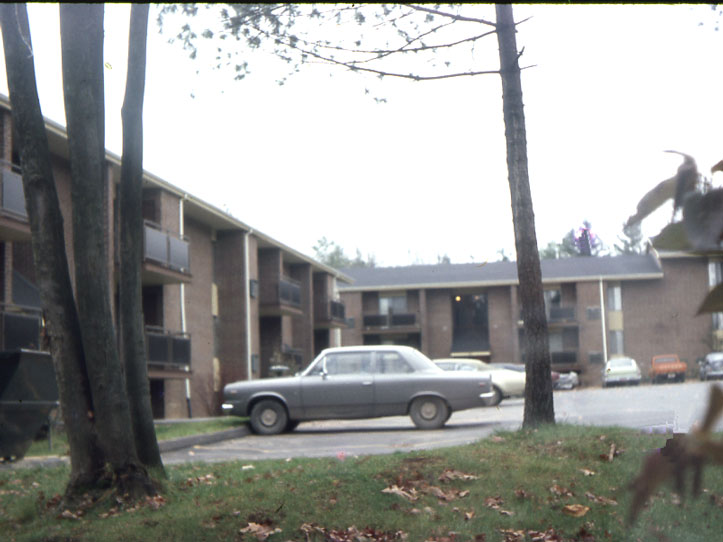
| This photo was taken from our first floor apartment on Cricklewood Drive in State College, Pennsylvania |
 |
|
Even though I had the second highest average in my graduating class at Lycoming College it was difficult for me to get accepted into Penn State's graduate school of Educational Psychology. Their reluctance had a brief negative impact on my morale, which was overcome by my enthusiastic desire to ultimately get into the world of educational research as a profession. However, my enthusiasm caused me to overlook the financial burden it would become. I was assigned to the university's Department of Institutional Studies as a graduate assistant and received a modest stipend for the work. Jean took a job at a nearby factory that manufactured ceramic capacitors, which helped with our income. But, it was not quite enough because we had to periodically dip into our savings from time to time. It also helped financially to have only one child, Nancy, living with us. Moving from a home into an apartment also required a period of adjustment for us. Nancy and Jean seemed to get acclimated better than I did. The apartment was outside of town in Briarcliff Manor on Westgate Drive off Fox Hollow Road. It was necessary to drive by the stadium to get to the apartment so on game days the campus area was avoided altogether. We lived in a complex that was occupied, mostly, by professional people and graduate students which made it considerably less rowdy than the high rise apartments in town that were dominated by undergraduate students who were considerably less civilized. We were in a more or less rural environment, near the Toftrees golf course, which provided space for walking, biking and spots for Nancy, who was still in grade school, to engage in outdoor kid stuff. One negative aspect of the apartment was that the ventilating system allowed cooking odors from our neighbors to seep into our living quarters. Of course, I never speculated about how they regarded the smells we generated. We all seemed to enjoy State College. The public school system was the best of all the many places I've lived. This was, I think, mostly attributable to the quality of the teachers. Nancy has also stated that she liked living in State College better than any of the other towns we subjected her to. Jean was somewhat content except that her job was not high on her list of desirable places to work. As a graduate student I was able to get reduced price tickets for any of the events sponsored by the university and we took advantage of many opportunities. The entire atmosphere of being in a university-dominated area was invigorating. I took one course during the first summer at Penn State, which helped me get acclimated without too much pressure. It was a Statistics course that was only a bit more complex than material I had already been exposed to. My goal was to get into educational research so I took every statistics related course I possibly could. All those Statistics courses emphasized the application of Statistics as a tool to analyze and make sense of research results. Then in the fall I enrolled in a course that presented Statistical methodologies from a strictly mathematically theoretical point of view. For me, it was a nightmare. Hindsight helped me to understand that I should have had a course in Calculus before getting in over my head. That awful experience still dogs me today with periodic dreams about entering a classroom to take a test for which I lacked the necessary comprehension. I got through the course with my sanity intact, I think, but considerably more humble with the realization that I didn't possess the expertise I thought I had. My confidence got a boost when I was required to teach a session of an introductory undergraduate Statistics course. Since it was a rather large auditorium sized class there was some trepidation for me because my teaching style for any session consists of a series of expositions and discussions. Since the size of this class was so large the opportunity for discussion was diminished or would be awkward. Also, my brain has a problem with constructing a single coherent sentence, let alone sufficient sentences to constitute an entire lecture. My concern drove me to expend a lot of prep time with mental visualizations frequently invading my consciousness. I guess it paid off because I experienced little nervousness during the session and I felt things went rather well. My exuberance swelled for days afterward. I hoped I would be able to get more opportunities to repeat the experience. But, there were no more requests for me to teach. Gradually, self-doubt overtook the high marks I gave myself for my performance. Naturally, a normal person would have approached the professor, whose course it was, for an objective evaluation. I never did. Although I later did a fair amount of teaching in other institutions, there were no more chances to lecture in front of very large groups. The more I studied research psychology the greater became my irreverence for the entire field. The other arm of psychology, clinical psychology, long before, earned my scorn. It's not that clinical psychologists and psychiatrists don't perform useful functions, it's just a lot cheaper to talk to a compassionate friend that you regard as trustworthy. Unless, of course, you also want your brain chemically altered, then get a psychiatrist to prescribe a pill for you. The country is also awash with people who are only too happy to take your money and tell you how to live your life via a book or a lecture. All these professionals mean well but their suggestions become momentary fads with not enough profound substance for extended adherence to their advice. I've long ago concluded that people are better able to cope with life's tribulations by embracing a superbly proven resource... religion. Psychological researchers use scientific methodologies developed by the "hard" sciences to concoct their theories and to test them. Scientific research requires that extraneous variables be controlled so that they do not unduly affect outcomes. For psychological research, extraneous variable control is, in my estimation, impossible in most cases. The complexity of the human mind and the influence of life's experiences on anyone's responses is so overwhelming that makes it impossible to precisely determine the cause of one�s reaction in any given situation. It's no wonder that it's difficult for two different psychology researchers, conducting the same experiment, to get the same results. That problem is almost never encountered in physics, or chemistry, or... well you get the picture. But, it is correct for psychologists to use scientific methods for their research, there's nothing better available. What's wrong is the certitude that they attach to their research results. Maybe other psychologists recognize the fluidity of research results but it is evident that both the media that report research results, and the public that the media influence, do not. Anyway, my interest in educational psychology was deep and I staunchly believed that research could be helpful to educators in determining teaching strategies. I pursued this interest knowing full well that public school administrators, (I worked 10 years in a public school system), pretty much ignore psychological research. They tend to adopt, in lemming-like fashion, the current fad sweeping the educational community, make a mess, and then dismantle what they once enthusiastically cherished. They tend to rely heavily on emotional content and anecdotal "evidence" to fashion their teaching strategies. These attitudes are symptomatic of today's public school administrators and teachers. My ever-growing low regard for teachers has reached profound depths. I do not regard them as professionals, but rather union members whose characteristics embody all the detrimental qualities that have severely damaged whole industries in this country. Their major objectives, seems to be, to have more than enough to live on while continuously minimizing their responsibilities. They are experts at taking credit for anything that goes right while deflecting blame elsewhere when things go wrong. Their salaries are raised disproportionately when compared to the salaries of taxpayers who are far less privileged. Their workload is continuously reduced and they complain about making any effort beyond contracted hours. They are provided with teacher aides to do their grunge work, and they still complain. Their class sizes are reduced which results in, not increased student performance, but a continuance of demands for higher salaries and lessened workloads. They contribute less than most other people to their benefit packages but get more out of them. There are Christmas breaks and Spring breaks and other holidays throughout the year that ordinary working people do not have available. They have two months, or more, during the summer to relax, take college courses, (which yields higher salaries), or take on a summer job. On the other hand, normal workers find little or no time to relax, must work a part time job at night to augment their income, and take evening classes to keep pace with the changes that impact their jobs. By and large, teachers are the most pampered group in our society, provide a low level of results, and manifest little gratefulness for the advantages they enjoy. Ah, lambasting teachers always feels good. I only wanted to make one or two comments about teachers and the public education train wreaks, but I got carried away. Naturally, my comments are highly generalized and they do not apply to all teachers, But, generally, I think I'm right. Now, I can't resist continuing with this topic. The continual carping by teachers about class sizes is an outrage. They always claim that it's the students that will benefit when, really, their primary objective a lessened work load. Most of the teaching during the first year or so in colleges is done in auditoriums with huge numbers of students yielding good results. Generations of students in this country were taught in classes of 30 to 35 students with better results than those obtained today. Think about all the self-help lecturers that traverse the country and expound on their beliefs before large, satisfied, audiences. It's clear, that class size has little to do with enhanced learning. Teachers are fond of pointing to all sorts of bogus "studies" that they claim support their contention that class size reductions generate increased student learning. But, make no mistake about it, the chief beneficiary of ridiculously low class sizes, are teachers. If an occasional student benefits from being in a small class, it is not nearly sufficient to merit the exorbitant increases in costs. I suppose it's fairly commonly agreed that too many public school systems in this country are performing abysmally. Even those school systems that are doing well are smug when they could, in fact, be getting even better results. The major problem is the entrenched elitist "professionals" who have sacrificed the future of children in order to continually pad their protected, plush jobs. They have created a remarkable myth about the special nature of their work and the extraordinary empathic characteristics they think they possess. Generally, the public has bought into mythical image. I doubt that anything will change this situation unless the country gets rid of the teacher colleges and the accompanying certification system. It is producing teacher shortages because anyone who is passionate about a scholarly area will not enter a teacher prep program because they know it will restrict the depth of knowledge they hope to gain. It's sad because I firmly believe that an instructor�s enthusiasm and passion for subject matter trumps teaching mechanics every time. There are too many great teachers in this country who are locked out of the public school classrooms by antiquated rules that make it not worth their time to comply with. Getting rid of those obstacles will invigorate the classroom environment. Otherwise, too many public school graduates will continue to struggle making up for what they should have learned as kids. Subject matter expertise does not insure that an instructor can adequately convey that knowledge to others. I was excited in anticipation of being taught in graduate school by professors who had written books that were used as texts in my undergraduate courses. Without exception, each of those professors, whose texts I used, turned out to be incredibly dull as instructors. I felt that they were also as bored as they were making me. None of them appeared to be passionate about the subject matter. Finding teachers, then, that possess both subject knowledge and expositional skills is apparently elusive. For the life of me, I cannot comprehend the actions, or inactions, of school board members. They appear to be no more than bureaucrats with rubber stamps who are oblivious to the educational carnage produced by the school systems they are expected to oversee. I think that if I were a school board member that I would be raising all sorts of issues and demand that changes be made. In the process I think that I would make so many enemies that my re-election would not be possible. But, if the publics' awareness of those issues were sufficiently aroused so that vigorous debate would ensue, it would be worth it. School board members, whose districts receive most of their revenue from real estate taxes, should be ashamed of themselves. If I had my way, each board meeting, by law, would begin with a reading of the stories of every family who lost their homes because of their inability to pay their taxes. Better yet, anyone losing their home should be granted a one-term seat on the school board, which would have no membership size restrictions. School board excesses would soon come to a screeching halt. Maybe school board members do scrutinize school administrators� actions and attempt to eliminate excesses, but I have never seen any evidence of it in any of the communities I've lived in. I'm appalled each time a new school is built. There seems to be almost no attempt to provide architects with appropriate restrictions for their designs. Sprawling schools that devour land and include amenities that go far beyond the need to just satisfy educational requirements are an outrage. An acre, or so, of land is more than enough for any school. Schools need to be built vertically, like a box, not horizontally. Every school district does not need its own athletic facilities. One athletic complex in each county, for example, used by all schools in the county, would probably be more than enough to satisfy the sporting needs of all sports enthusiasts. Such facilities should also be made available to the general public. Sports teams can practice on fields that already exist in most communities for recreational purposes. There is absolutely no need for each school to replicate facilities and to seemingly attempt to outdo their neighboring communities in exorbitance and ostentation. I know, I'm probably over simplifying what is a complex set of circumstances, but at the very least, consolidation considerations in various areas should be an ongoing process. What is it about people who become school board members that make them reluctant to curb the excesses of the systems that they, presumably, control? Are they so overwhelmed by the complexities of their school systems that they are only capable of acquiescing when faced with the systems administrators, lawyers, and instructional experts? It's rare to hear about a board member with the sufficient backbone to fight for fiscal restraint when considering administrative proposals. Or is it that the concept of fiscal restraint eludes them? The threshold for implementing draconian actions was traversed years ago and we are still subjected to irresponsible people who seem to be unmindful of the destructive nature of their inaction. Is there no one with enough grit to overcome their timidity and simply adopt the incantation "we can't afford this"? It seems to me that not too long ago there were more calls for getting back to the basics in our school systems. That seems, now, to have considerably diminished. Most schools are still incorporating into their curriculum courses that need to be regularly evaluated to be sure that they are worthy of offering both in terms of cost and appropriateness. If school boards are truly interested in educating children they should be continuously monitoring the schools' administrators to be certain that teachers are being provided with the tools and time they need to do a first class job. Teachers should not be burdened with clerical type jobs or anything else that is a diversion from the major task of educating. Providing instructors with the teaching materials and tools to enhance presentation of subject matter should be given the highest priority. Every expenditure considered should be made in the context of its impact on satisfying the classroom needs of teachers. School board members should regard themselves, predominantly, as facilators and providers for teachers. School board and administrative originated actions that generate classroom frustrations must be identified and eliminated. I suppose school board members' actions are always influenced by their desire to get re-elected. If that's the case then better results may be obtained by limited terms to, say, just 4 or 6 years. It would seem also, that school employees should not be permitted to vote for school board members. It strikes me as ludicrous that employees are allowed to participate in determining who their bosses are going to be. Especially since the voting turnout of those employees for school board positions is, I'll wager, up around 80 to 90 percent. Aren't their votes going to be determined more by self-serving issues than what's best for the general community? Don't try to convince me otherwise. All right, I've vented far more than I should have about public education, (don't get me started on the fiscal intemperance of colleges). Now, back to Penn State grad school stuff. Gradually, I became a bit disenchanted with the entire graduate school process. I was mostly tipped in that direction by a bad experience with a one Psych course. That course centered on the "nature versus nurture" aspects of human behavior. That is, that there were two sources that impact behavior. One is that behavior is determined at birth and is a product of the genes one inherits. The other is the impact of the accumulated experiences to which one is exposed. The course presented the material as an either/or proposition and each side of the argument was supported by the views of partisan psychology experts. Now, I'm just a dumbbell know-it-all but I felt that it was unquestionably obvious that behavior is the result of both genes and experience. There were 5 students in the course. For an entire semester we sat around a conference table and discussed the either/or paradigm while my annoyance grew. There were no tests. The final grade was based on a paper due on the last day. My paper, based on my overwhelming rejection of the basis of the course, ridiculed a notion that I didn't believe in and castigated those experts that exclusively held one view or other. I cherry picked statements from the writings of noted psychologists to support my views. I received a grade of "C", which is tantamount to failure at the graduate level. I was outraged. I argued my case with the professor of the course in an attempt to get my grade changed. My point was that just because I don�t believe in the either/or dichotomy doesn't mean that I don't comprehend it. The prof's response was that he personally knows many of the experts I cited and that they do not think that way. I claimed that I didn't have the privilege of knowing them, as he did, and I can only go on the basis of what they have written. My arguments were futile. The grade of "C" went into my record. The mix of my desire for independence and my ignorance of graduate school culture conspired to give me big problems with my work toward a Masters degree. After I completed all my course work I was left with only a thesis to be completed. I had a thesis topic in which I was deeply interested but there were no professors who shared my interest. Without that link I was pretty much left to fend for myself. Although I lamented the meager assistance I was getting, I was determined to pursue my own interests rather than someone else�s. But my progress was painfully slow. As I was floundering, Jean was becoming justifiably concerned especially because our financial situation was worsening to the point where we would have to make additional drastic life style changes. We discussed our options extensively and decided that I should find a job and simultaneously work on my thesis. It quickly became apparent that a job in the Penn State area was, at best, an extremely remote possibility. It took a little longer to discern that I would not be accepted at an educational institution where I could use the knowledge that I gained at Penn State. Finally, I had to focus my job search on positions that required those computer related skills used in all my previous jobs. It was then just a short time for me to be accepted by the Mohawk Valley Community College in Utica, New York to direct their computing efforts. |