|
|
| High School |
| Home |
| Pre High School |
| High School |
| Fordham Univ. |
| Harrisburg PA |
| White Plains NY |
| Williamsport PA |
| State College |
| Utica NY |
| Wheeling WV |
| Woodsboro Md |
| Current Home |
| My Wife |
| My Kids |
| My Grandkids |
| My Parents |
|
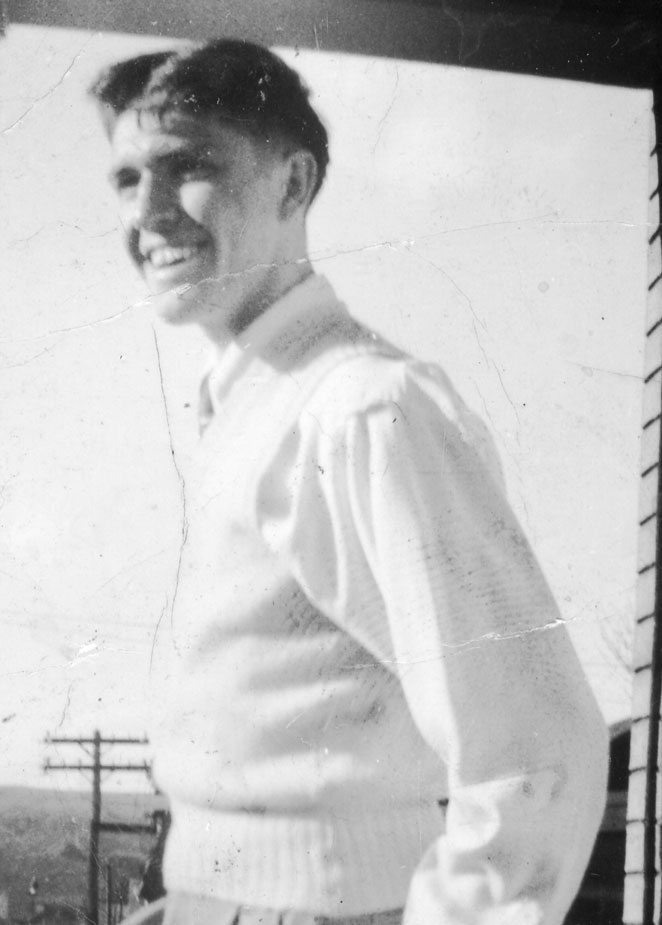
| I always had a fondness for the type of sweater vest shown here. This picture was taken on the front porch of the Yarnall home on Peach Alley in Mount Carmel. |
| Click here for the yearbook site of the 1950 graduating class |
|
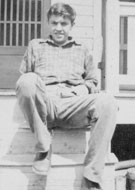
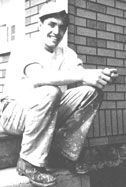
High School is not an experience that I choose to recall when I'm in a nostalgic mood. Ambivalence is also too kind a word to describe my feelings about High School. The students and faculty were fine people and it was a generally pleasant environment but I can say definitively that there was never a day when I wanted to go to school. I was there because I had to be there. The school was located on the northwest corner of Market and Third streets. The town park was across the street to the east. Two blocks to the west was the approximate center of town, which was at 3rd and Oak Streets. Constructed of tan bricks, it was a boxy affair. There were no superficial, inefficient architectural components that too often mar today's Taj Mahals. Two floors of classrooms occupied the perimeter with the auditorium in the center. Restrooms were in the basement area along with the Home Ec classroom, showers, locker rooms and the heating plant. There was no air conditioning; windows were opened on warm days in spring and fall. In a central area, that can best be described as a sub-basement, was the gymnasium. It was notable for the small amount of space surrounding the gymnasium floor. The space between the basketball backboards and the brick wall was no more than a few feet. That wall was padded to protect players who could not stop their momentum on a drive to the basket. The stadium, dubbed the "Silver Bowl", was located on 3rd Street, on the west edge of town, about a mile from the school. The seating capacity of the stadium was large relative to the size of the town. High School football was enthusiastically supported and followed more so than in surrounding communities. Kids were encouraged to develop skills and expectations of being part of the team were nurtured. I didn't particularly consider football to be my favorite sport but I felt that I was obligated to take up the game. Mount Carmel has a history of turning out winning high school football teams and has demonstrated a willingness to support the football program to a greater extent than many towns. It's interesting to observe the superior level of skills and physical conditioning of today's kids. The teams of my day would easily be demolished by the likes of any current team. Most students walked to school. There were no school buses. There was no cafeteria. Most students walked home for lunch at noon and walked back for the resumption of classes at 1:00 PM. Members of various sports teams walked to the stadium for practice and then walked back to the school for showers. I lived about 5 blocks from the school and ambled to school with four other neighborhood kids. Boys usually wore jeans with shirts that buttoned the full length. Plaid flannel shirts were popular in winter. Argyle socks were ubiquitous. Leather shoes, rather than sneakers, were normally the preferred footwear. Boys' hair was usually short on the sides and longer on top. There were some guys with crew cuts. A few boys sported a hairstyle that resembled the backside of a duck and the style was appropriately named. Sweaters were almost always patterned which often depicted winter themes of some sort. Girls wore full skirts and blouses or dresses. Cardigan sweaters were worn with the buttons in the back. Their legs were bare accept for bobby socks. It's unimaginable now that they would willingly endure the coldest temperatures and iciest winds without some sort of protection. Footwear consisted of, primarily, "penny" loafers or two-toned saddle shoes. Hairstyles often consisted of curls or waves. Bangs were seen on many girls with a lot of distance between eyebrows and the end of the bangs. Makeup was minimal and often consisted only of lipstick. Girls' appearance can best be described as neat and prim. Male teachers dressed in suits and ties. Women faculty were neatly adorned in skirts and blouses or dresses. I can't remember if the women wore high heels. I think they did but the heels were hefty. The teachers were usually residents of the community. For the most part they seemed more than competent to teach the courses they were responsible for. The kids were treated respectfully with only rare displays of condescension. The students were respectful of instructors with only a modicum of ridicule aimed at some teacher's idiosyncrasies. Discipline was not a problem. There were few disruptions in the classroom. There were class clowns but their antics were not normally a detriment to the learning environment. The noise levels in the halls during the change of classes is best described as conversational. The "Shop" boys spent half of their time at the Annex, a wooden structure, on Spruce Street, were they learned various trades. Unfortunately, they had an unsubstantiated reputation for being in that program because they could not handle the supposedly more rigorous academic subjects. After graduation most of those boys were expected be employed in manual labor of some sort. There was also a "Commercial" program in which office skills were taught to those who were not expected to attend college. Many girls were in this Commercial program since at that time woman were not expected to aspire to receive high school training for anything other than roles in secretarial type professions. If a girl remained in town after graduation she could expect to find herself employed in the garment industry, in the cigar factory, as a sales clerk, in an office or as a hairdresser. Nursing and teaching were also options for girls with the where-with-all to attend college following high school graduation. Aside from a couple of sports, I did not participate in any extracurricular activities. During the after school hours I did not associate with any of my fellow students except for those who lived in my immediate neighborhood. I think I was friendly, but not enough to want to build bonds with those kids that I only encountered in school. I wasn't asexual but girls generally did not get much of my attention. This was mostly because of my low self-esteem and social backwardness, but also because there was no one for whom I felt even the slightest attraction. There was only one girl, in an upper class that sufficiently got my attention and generated some fantasies. Obviously, I never dated or attended a prom. Both were never remotely considered. I was a prime candidate for geekness but lacked the academic qualifications. My self-perceptions were that of an ordinary kid. Later in life I was labeled as being aloof. I suppose there's some truth in that, but I have much trouble accepting the total validity of that label. In retrospect, could it be that my non-participatory experiences were due to a subtle generalized rejection of me by my fellow students rather than of my own volition? I think I was, at the time, and still am, sufficiently clueless not to recognize the difference. But then, I recall building a collection of classmates' hair snippets. It was surprising how many students permitted me to cut off a lock of their hair. If I was the epitome of freakiness I doubt if anyone would have permitted me to come near them with a pair of scissors. My intent was to maintain those locks because, I thought, their significance would be elevated as more and more time went by. I carefully sealed, named and dated each little packet for storage. They were retained for decades, then, one day, when I wanted to show them to someone, they could not be located. To this day, to my consummate consternation, I have no idea what happened to them. It was early in high school where my self-assurance was severely bruised. It was a modest episode but my super sensitive ego made it have a major impact on my future interactions with the opposite sex. It happened during our community’s welcome home celebration for the veterans of the big war. In addition to the parade and other activities, my father, the caterer, landed the job of feeding the huge number of eligible participants. The food was served in the stadium. I was one of the servers. Two girls, members of an out of town band, with their pompoms and colorful outfits with customarily shortened skirts, approached the server next to me. That server, a much older guy, immediately suggested to the girls that I would be a candidate worthy of their consideration. Their response was immediate uproarious laughter. They quickly departed, without being served, with their laughter continuing, as they moved off into the crowd. The laughter didn't stop; it just mercifully gradually diminished as they moved out of earshot. Since I still remember the event today, it must have been a major contributor to my retarded social skills.
There were three grades in the school, 10th, 11th and 12th. Within a week or two after the school year started, the incoming 10th grade students were subjected to an "initiation". This one day traditional event, endorsed by the school's administration, did not consist of inflicting any physical harm, but did encompass using every other means of humiliation. The worst part to be endured was the garish transformation of one's head with various female makeup products, powders and unidentifiable goop. One's vision soon became impaired such that attending class was of little value. Mercifully, it was common, after a few hours, to permit the abused students to take showers and/or go home for a change of clothing, if necessary. This annual practice was eventually abolished. Another victory for those folks in this country who are relentlessly determined to make life for kids as bland and as possible in order to keep them less subject to harm. Of course they will never achieve a riskless environment for kids, but they'll go to their final reward trying to reach that goal. I was a poor student. My grades were generally average or below. Mostly, I stared out the window, daydreamed, or doodled. I feel badly now for my contributions towards building a cadre of chagrined faculty. If my homework didn't get done in study hall, it didn't get done. There were only one or two courses that sufficiently aroused my interest for me to pull down a rare A or B. I copied homework as often as possible and strained to copy answers from others during examinations. There were some courses that I think I passed only because of the sympathy of the teacher. Algebra, the geometries, physics, biology and chemistry all fascinated me. Still, once the course material moved beyond the fundamentals and some effort was required in order to keep pace, I apparently didn't have enough brains or motivation to assimilate it. The concept of preparing for life after High School eluded me. I had no idea what I wanted to do with my life nor did I ever give it any attention. I was in the college preparatory program because, I assume, my father wanted me to attend college. But, I never gave any consideration to what I would be doing after graduation. The only thing I ever looked forward to was the end of the school day. Naturally, after High School I had to expend considerable energies to make up for my slovenly learning habits. But, remarkably, I have no regrets. When I now examine my behavior, I tend to conclude that I probably would not change if I had to do it over again. If I had the option of doing it over, I would refuse. There is a tremendous chasm between the way I learn and the way teaching takes place in most institutions. When I was 16 my father died. My father loved fishing. September was the month when his business responsibilities eased and Canada was a desirable destination for satisfying his hobby. When my father and his friends were crossing a lake to get to their cabin, a sudden storm came up. Waves swamped a boat they were towing, sinking it, which then pulled their boat down with it. There was only one survivor. I was at football practice when my oldest brother approached me on the field. It struck me as exceedingly odd for him to show up that way, and then, he gave me the news of my father's death. It was incomprehensible. During my trip back to the high school, my shower, dressing, getting back home, was done in a stupor of unbelievability. When I entered our home my sisters and mother were in the kitchen crying. It was really true. My father was dead. I couldn't bear to be there and headed for the seclusion of a bedroom and tried to come to terms with the reality of the situation. I never cried during the ordeal of losing my father. I never really knew him as a father. To me, he was more an authority figure than anything else. But he was also the family's only provider. How would we survive? I knew he did not believe in insurance. But, I also knew there was no mortgage on the house. In a rare optimistic moment for me, I thought, somehow everything would work itself out. I never contemplated the family financial perils again after that. Death, at that time, for me, was not yet viewed as a possibility. And I especially still thought that parents would live forever. Suddenly, I was confronted with the reality of human mortality. Adding to the family agony of dealing with the loss was that it took about a week to recover the bodies. During the search, days seem to be never ending. Relatives drifted in and out of our home providing welcome diversions from the seemingly perpetual gloom. At night, sleep was elusive but exhaustion was eventually overwhelming so that we could get some rest, however fitful. In the morning, during that period when sleep and wakefulness are intertwined, awareness of loss is momentarily not part of one's consciousness. Then, abruptly, the all encompassing despondence ruthlessly assumes its dominance. At 16, I was old enough to have reconciled my fear of dead bodies. But, I didn't. It was customary, in those days when a death occurred, to use the home as the site of the wake. This custom was not to be discarded for my father. Contemplating my father's casket in our parlor further added to the swirling emotions I was dealing with as the search for his body at the lake ensued. After his body was returned it was a significant relief to me when I learned that the casket would always be closed. The few days prior to the funeral were filled with activity. Rarely seen relatives turned up along with those who lived nearby. Friends and acquaintences were a welcome sight. Much food was consumed and alcohol flowed freely. Cigar, cigarette and pipe smoke permeated every room. The funeral was particularly notable, for me, because of the large number of people that turned out. It surprised me. I only nibbled at the food provided following the services. Afterwards, when everyone had left, the tensions finally began to dissipate. But, anything resembling normalcy was a long time coming. Getting back to school helped and having five other siblings around made the transition to a new world a bit easier. Overall, the trauma of my father's death did not have any long-term impact on my personality or my view of life. I'm certain, however, that the trajectory of my life would have considerable different had he lived longer. I doubt that I would have dropped out of college. I'm certain I would not have eloped with Jean when I was 19. It’s highly probable I would not have married Jean at all. The tragedy was brutal, but I am absolutely satisfied with the way the aftermath worked out. Although, some melancholy usually envelopes me when I ponder how my father would have regarded the small successes I have achieved, or how he would have interacted with my kids, or how he might have counseled me as I encountered life’s tribulations. Or, would life have been more tumultuous as we clashed, as two adults, over differences of principles? When I resumed football practice, it was different. My father never indicated to me what his hopes were for me as a player. I simply assumed his expectations were high. I also assumed he was disappointed with my performance. I never had that "killer instinct" to make me a standout. I had the physical stature but not the desire. There was never any attempt on my part to try to live up to what I thought his expectations might be. Nevertheless, it was always a source of internalized discomfort. Now, it was no longer necessary for me to demonstrate competence for my father. In my senior year, our school's traditional rival, Shamokin, was played, as usual, in the afternoon on Thanksgiving Day. Prior to the game, during the normal pep talk, the coach related the story of my father approaching him, the coach, and asking that he "make a man" out of me. Of course, the comments of the coach were meant to inspire the team but I was embarrassed, flustered, uninspired and angry that my father would do that. I've never before related this incident to anyone. It was unusual for me to be in the starting lineup, but for this game I was. On the kickoff I was sent head over heels and landed on the back of my neck. I played the rest of the game in a daze because of it. We won this game with "Kelly" Butts scoring the winning touchdown on a magnificent kickoff return. That nicely capped off what was a rather lackluster season. They say football is a sport that builds character. I'm not so sure about that. For me, however, it taught me the value of being part of a successfully functioning team and significantly contributing to that success. There's nothing more exhilarating than physically or mentally contributing to the defined objective of a group, however large or small. Relative to football, my contributions were rather dismal, but when I surprised myself with a an action that resulted in a positive outcome for the team, it made a deep impression on me that everyone's role can have a major impact in the overall scheme of things. The positions that I've held in my professional life have been dominated with leadership roles that gave me opportunities to build workable teams. Yet I generally did not live up to my own standards of getting others to strive for accomplishing team goals. Still I never encountered anyone that I worked for who had those elusive qualities either. It's tough to get any kind of notoriety when you are a lineman on a football team. I always marveled at the attention that was given to ball carriers whose deeds were largely attributable to others. Would I have been a better player if I were a running back rather than a lineman? Maybe. But then, I would have missed out on the satisfaction that comes from being able to recognize the extent of your contributions, based upon the expertise you steadily acquire, that enables one to make such self evaluations. I know that sounds contrived, but for me, that process has helped me be satisfied with so much that I've done when recognition from outside sources was not forthcoming. Memorable events in high school were rare. It was day after day of routine blandness. All my foregoing high school recollections indicate that my memories do not have an academic basis. For example, "Bobo" Bolinski provided me with a lasting remembrance. Each Friday, the student body was assembled in the auditorium and presented with what apparently was intended to expose us to cultural enrichment. Mostly, those events were highly anticipated because it provided an opportunity to escape the classroom regimentation and not because of the content of the presentations. One Friday, as the curtains closed for a stage change, Bobo came out, off to the side, in front of a microphone, dressed in drag. Up to that time I regarded Bobo as a nice guy, imbued with the ordinariness that was the hallmark of most of us. He began to sing. He sang the classic torch song, "My Man". I couldn't have been more impressed. I'm no judge of musical talent, so maybe it was surprise that mainly colored my opinion. In any event, I left that auditorium feeling that I was entertained. In the ocean of sameness that was high school, that was memorable. Thank you Bobo! There were the customary cliques that populate high schools. Their membership seemed natural, void of snobbishness or malicious behavior, and unchanging throughout the three school years. I, and others acknowledged the existence of these student clusters yet I wonder if the perceived members viewed themselves as part of a cohesive group. Still, every yearbook seemed to contain photographs of certain students repeatedly. Certain students seemed to gravitate to official leadership positions. Some students seemed to strive for belonging to as many clubs as possible and for participating in a broad range of activities. Have I misconstrued some students' common characteristics as constituting a clique? There were spots on Oak Street, Mount Carmel's main street, that were favorite hangouts for many. Dances were a weekend diversion at the Mother of Consolation, (MOC), hall. Knoebels Amusement Park, just a short drive away, was a warm weather destination for almost everyone. I either never, or seldom, found these places as particularly inviting. While my classmates were maturing and adopting grownup behaviors as they progressed through high school, my maturation, on the other hand, failed to keep pace. Before and following graduation, and up to the point when I left town for college, I was still spending much time playing street games. Touch football was only modestly popular. The game of choice, most often, was Half Ball. Half Ball was played with a broom handle as a bat and half a hollow rubber ball. The ball, about two inches in diameter, was carefully cut in half along the seam and, of course, either half could be used as the "ball". A half ball behaved, in flight, very much like a Frisbee. So, the pitcher could throw all sorts of curves and drops. Hitting the ball well required excellent eye-hand coordination rather than power. The distance the ball carried determined the type of hit... single, double, and so on. Base runners were imaginary and advanced according to the type of hit. A big part of the games popularity was that it could be played with as few as two players or as many as could be accommodated. Anyway, preparing for college received little of my attention. Then Jean Yarnall entered my life in a most meaningful kind of way. |
| Jean Yarnall |
|

|
|
|
|---|---|---|---|
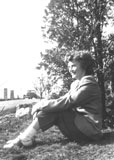
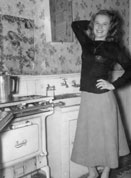
It was astonishing to me when Jean Yarnall gave some indication that I existed. Before that, if some girl had even the slightest interest in me, I was completely unaware of it. Maybe this was due to my disinterest in any other girl in town except Jean. Now, I know that statement seems both vain and disingenuous but I think my disinterest may have had roots in both my shyness and a notion that no one in their right minds would have any interest in me. In my mind, I considered myself completely unworthy of even miniscule attention from any girl. My low self-esteem was not necessarily debilitating, however. I reconciled myself to what I considered to be a condition I had to live with. I suppose my lack of self-confidence was apparent to others and contributed to a less than normal level of charisma or attractiveness. My inadequacy was fully self evident but I consciously chose not to do anything about it. Anyway, the prospect of making the effort was chilling. Consequently, I've always been amazed at those smooth guys who manage to wend their way through life's social impositions with flamboyant self-assurance. From a distance, I was infatuated with Jean for well over a year. Jean has never acknowledged that she had similar feeling for me and I have no reason to doubt that. My infatuation was not an obsession but rather a subdued kind of reaction not unlike the feelings one may have for an actress after viewing a movie. But, we never spoke to each other. When we passed each other on the sidewalk we never exchanged hellos. There were never any events that placed us within close proximity to each other where we may have begun a conversation or otherwise struck up a relationship. It's hard to believe we were neighbors living close to each other. It was as though we were living on different planets. Then, one summer day I was painting the fence that ran between my parent's lot and a neighbor to the south. Eventually my work progressed to within close proximity to the rear of the Yarnall home. Then, Jean appeared on her back porch and smiled at me in an unmistakable way that conveyed an expectation of a similar response from me. I instantly complied with that implied request. I smiled back. She said "Hi". I said "Hi". She commented on the appearance of the fence I was painting. From that point on, I have no recollection what other verbal exchanges took place but within a brief few minutes we were both seated on her back porch swing engaged in earnest conversation. Jean's seemingly non-judgmental acceptance of me vaporized all my inhibitions and I found myself responding to her freely without critically examining my every thought before incorporating it into a sentence. That relatively lengthy encounter was bewildering and exhilarating. Bewildering because I had no idea what had I done to suddenly dissolve the seeming indifference Jean always previously exhibited towards me. But I sure wasn't about to ponder too long about what brought on this wonderful transformational event. Then, when we parted almost all my thoughts were overwhelmed by my predilection to assume it was a one-time fluke. The next day I was constantly on the lookout for Jean to make an appearance outside her home. Finally, there she was on her porch. I wasted no time getting outside, hoping she would look my way. Not only did she instantly look my way, she also waved to me as though we were long time friends. Without any hesitation, I sauntered down to her home and once again we were seated on the swing. There was no doubt in my mind now that this was the beginning of a budding relationship. There's no question I was attracted to Jean by her looks. But our relationship was sustained for many years by Jean's other characteristics. Among them is her boundless optimism. She manages to see the positive aspects of even the direst situation. If it weren’t for her I would have gone through life in a continual deep morass of negativism. Her friendliness, her instant acceptance of people at face value, is exceptional. Some people take pride in being able to instantly size up a new acquaintance. Jean sizes up everyone the same way. With unqualified approval. My periodic warnings that she cannot wholeheartedly trust everyone go unheeded. Jean seems to be perpetually in a good mood. If she is experiencing physical discomfort or mental anguish, she manages to, as they say, put on a happy face. I remind her often that anyone who always gets out of bed every morning in a good mood cannot be normal. She has few vices. But one, smoking, is a nasty habit that she has never had the inclination to shed. To my dismay, none of my psychological ploys has induced her to even slightly consider quitting. Alcohol consumption has always been less than minimal. Other questionable indulgences simply do no exist. She is, however, not above fibbing when she regards it as being appropriate. She steadfastly maintains that it is better to tell a lie if its use manages to avoid confrontation or if someone may be hurt. It's difficult to argue against that stance. I've never heard her use foul language although I suspect, without proof, that she might be prone to occasionally use some mild expletives in stressful situations in the workplace. Jean is just a bit over five feet tall. Her weight seldom varied much from 100 pounds, more or less. I am 6'2" and or height difference has garnered us an expected quota of stares and comments. Her petite stature, easy smile and persistent perkiness are traits that make her readily acceptable to people on a personal level. Outwardly she exudes confidence and independence, which masks her few life-long insecurities that when revealed, seem to enhance her appeal. Attractiveness has many different components that cumulatively define an individual. For Jean, her traits tends to usually bring to mind one word, cute. The garment industry flourished in the Mount Carmel area and Jean, as well as many other women, found employment in the several factories in town. The blouse factory, in what was once a silk mill, located in the northeast corner of town, was lucky to have Jean as an employee. She buttoned and folded blouses all day. During those pre-inflation days Jean earned 65 cents an hour. During non-working hours she contributed much time to chores at home. Jean and I never really dated. We just sort of hung out together. Once in a while we would go to a movie. Visits to her married older sisters occasionally occurred. Walks also were a diversion from time to time. Since there was no TV, radio represented an ever-present form of entertainment. Card games and board games were available for spontaneous, low-key enjoyment. The simplicity of our association was mostly dominated by talk. As I now mull over our association back then, I'm astonished that so much time was devoted to just gabbing. I have no specific remembrance of what we talked about. Our interests are many but few of them coincide. It must have been that we politely listened to what we each had to say and mentally accumulated that information in a process of gradually establishing a thorough representation of each other. But then, maybe not. At that giddy stage of our relationship we probably were simply converting what we heard into something that fit the idealistic image of what we wanted each other to be. Our quaint attachment would probably be viewed as hopelessly naive by today's jarring norms. Obviously huge generational differences exist and I make no attempt to hide my bias. Relative to the customs Jean and I adhered to, we are today, a society bordering on barbaric. It used to be that our animalistic instincts were suppressed or at least obscured. But now, we seem to raucously celebrate the gradual disintegration of what is civilized. I can understand the allure of depravity but why is there such an apparent desire to eschew discretion? While I can work at disregarding the almost undisregardable, I mourn for my grandchildren’s' future. Shame on us all. Jean was exposed to and adopted all the old-fashioned notions about male/female relationships. Girls were expected to marry young and raise a sizable family. Becoming a homemaker was a primary obligation. Sometimes this meant taking care of the home and holding down an outside job. The lines of household responsibilities were clearly delineated. There was no question as to who would do the cooking, cleaning, sewing, child rearing, etc. A man was looked upon as head of the household. If fact, those roles were looked upon as the natural order of things. With that as her background, Jean treated me as though I was royalty. I, in response, treated her as I was expected, chivalrously and with deference. Our elemental expectations were met and we contentedly grew closer and closer. I must add though, that as societal norms in this area evolved, we changed a bit with then. However, residues of those venerable norms remain. Jean still insists that she perform certain functions - and I am more than willing to oblige her. Satisfaction with, and gratefulness for, the simple things in life, has always been a pillar of Jean's existence. It's not that she doesn't appreciate the finer things of life; she just manages to find sufficient contentment without then. Her clothing was obviously not first rate but she managed to be neatly attired day after day. Jewelry was a desirable commodity but invariably received minimal attention in her mix of material considerations. She abstained from using makeup except for lipstick. Her attitude toward home furnishings does not go beyond what is strictly utilitarian. She chose each of our homes on the basis of adequacy, not on an unwarranted need to impress others. Her emphasis is routinely focused on needs rather than wants. She seldom nagged, complained or whined. My lifelong observations of other women confirmed that they all seem to share one or more of those three traits. My exasperation with mean-spirited, nit-picking, capricious, faultfinding women served to continually reemphasize the rarity of Jean's characteristics. I know ladies; you think I fit the classic mold of a "male chauvinist pig". I adore women. My objective here is not to denigrate women. God knows that men are the most deplorable, loutish, childish, slovenly, self-absorbed creatures in the universe. Rather, I want to stress the uniqueness of Jean. I guess I've created here, an image of an extraordinary person. Supposedly, all this suggests that Jean has no faults. Of course she does. But they are so inconsequential that they do not merit attention. Nor should these accolades indicate that our relationship did not have any strains. It did. But those fissures in our bonds were usually the result of my moodiness and temper. Jean's patience with my behavior and her willingness not to harbor resentment kept turbulent situations from deteriorating into irreparable standoffs. I can't say enough about my good fortune to have Jean as a partner. There is no way that I could ever repay her for all she has done for me. |
|
The summer following graduation from high school was long and languorous. I typically reveled in summer, free of the regimentation imposed by school. That summer was no exception. But the nagging, demoralizing realization that at the close of August, I would be headed for the Bronx and Fordham University, cast a ubiquitous pall on my activities. The thought of leaving Jean was difficult to endure. I accepted the prospect of leaving her submissively, and with resignation. It never occurred to me that I had options. Finally on the dreaded day of my departure, my dejection was overwhelming. I said my goodbyes and boarded the bus in a despondent haze. During that ride to New York City my gloomy mood failed to improve and I gave little thought to what was ahead for me. |