Beijing
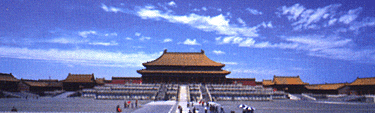
Without Beijing, any tour itinerary to
China is incomplete, especially for first-time
travelers. As the capital of China, Beijing is one
of the world's truly imposing cities, with a
3,000-year history and over 11 million people.
Covering 16,808 square kilometers in area, it is the
political, cultural and economic center of the
People’s Republic of China.
Situated in
northeast
China,
Beijing adjoins the Inner Mongolian Highland to the
northwest and the Great Northern Plain to the south.
Five rivers run through the city, connecting it to
the eastern Bohai Sea. Administratively, the Beijing
municipality equals the status of a Province,
reporting directly to the central government.
(Learn More...)
Chengdu
Chengdu, the capital of Sichuan Province
in the southwest, has been the economic and cultural
center of China's most populous province since 400
BC. (Learn
More...)
Dunhuang
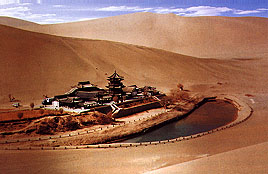
Dunhuang, a small city in
Gansu Province,
is located near the crossroads of the ancient Silk
Road. It is made famous largely by the Buddhist
Grottoes, known as the Mogao Grottoes, which are one
of the world’s most important sites of ancient
Buddhist culture. The grottoes, also known as Caves
of the Thousand Buddhas, preserve nearly a thousand
years of Buddhist cave-temple architecture, clay
sculpture, mural paintings, and manuscripts, dating
from the 5th to the 14th centuries.
(Learn More...)
Guangzhou
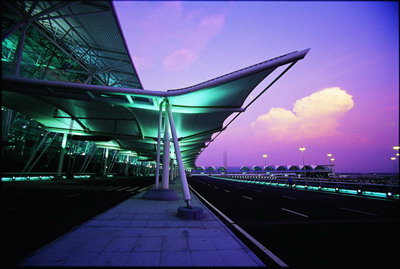
Known as the "City of Five Lambs,"
Guangzhou is the capital of Guangdong Province and
the southern gateway to China. It is a city of
pleasant tropical parks and tree-shaded streets, and
also an important commercial center. Its port,
Huangpu (Whampoa), is southern China's major foreign
trading port and is close to Hong Kong and Macao.
(Learn More...)
Guilin
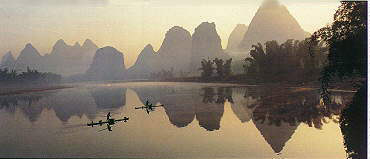
Situated in the northeast corner of the
Guangxi Zhuang Autonomous Region, Guilin is hailed
by many as the most beautiful place in China and is
one of the must-see destinations for most foreign
tourists. According to a popular Chinese saying,
“Guilin’s scenery bests all others in the world.”
Its shapely-rising limestone towers and
crystal-clear waters are often portrayed in Chinese
artworks. Adding to its natural beauty are many
fascinating caves. (Learn
More...)
Hangzhou
Hangzhou, the capital of Zhejiang
Province in east China, lies close to the mouth of
the Qiantang River at the western end of the Gulf of
Hangzhou. The city is best known for its natural
beauty and historical attractions. Many sections of
the city are said to have unchanged for centuries.
The famous West Lake region enjoys the reputation as
one of the most beautiful spots in China, with
landscaped gardens on its banks, tree-shaded walks,
and in the nearby hills, temples, pagodas, and
monasteries. (Learn
More...)
Lhasa
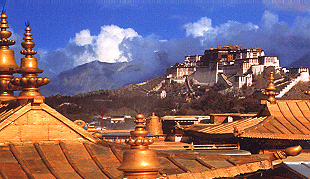
If
Tibet is the "roof of the world," then its capital,
Lhasa, is certainly the “city of the sun.” Standing on a plain
over 13,000 feet above sea level, surrounded by
towering mountains,
Lhasa is a town bathed in sunlight.
(Learn More...)
Shanghai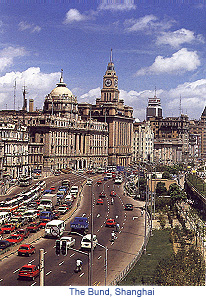
The largest city in
China,
Shanghai contains the most striking blend of
oriental and western cultures and of the past and
present. In this city, European-style buildings can
be seen standing alongside Chinese structures and
ancient temples. Modern ocean-going vessels sail
past junks. (Learn
More...)
Suzhou
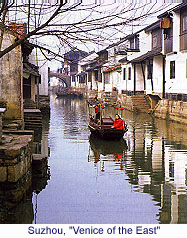
Suzhou is located in the south of
Jiangsu Province, some 50 miles west of Shanghai,
along the old Grand Canal. The city has been famous
for its gardens for many centuries. According to a
Chinese proverb says: “In heaven there is paradise.
On earth there are Suzhou and Hangzhou.” Suzhou has
also long been noted for its beautiful women. (Learn
More...)
Tianjin
Tianjin is China’s third largest city,
an independent municipality with a population of 9.5
million that is a major commercial and industrial
center as well as the biggest port in north China.
137 kilometers (85 miles) southeast of
Beijing,
Tianjin is situated at the confluence of five
tributaries of the Haihe River, 50 km from the Bohai
Sea.
(Learn More...)
Xi'an
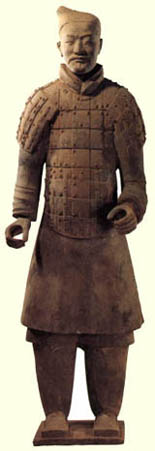
Xi'an was one of the most important
cradles of Chinese civilization. The famous “Silk
Road” that linked China with central Asia and the
Roman Empire starts in Xi’an in the east. The city
served as the first capital of a unified China and
capital of 11 dynasties periodically from the 11th
century BC to the early 10th century AD.
(Learn More...)