|
Major
Chinese Traditional Festivals
This list of major Chinese festivals can hopefully
help you gain a better understanding of the Chinese
people and their unique customs.
Spring Festival
Time:
1st day of the 1st lunar month, which falls on January 24
in 2001.
Venue:
All over
China
Origin:
Spring Festival originated in the sacrificial
ceremony held shortly after the winter solstice
during the early Xia Dynasty (21st-16th century BC),
when
China
was still in the primitive society. The ritual was
designed to repay the blessings of the god and
celebrate bumper harvests. Today, it has become the
foremost of all traditional festivals for the
Chinese people.
Papercuts:
During Spring Festival, many families decorate the
window panes of their houses with pleasant-looking
papercuts portraying Chinese opera characters,
flowers, birds, insects and fish.
New
Year Couplets: New Year couplets, written on strips
of red paper, are a major part of the Chinese Spring
Festival custom. On the lunar New Year’s Eve,
families in urban and rural areas alike make it a
point to grace their gate posts or door panels with
couplets composed of two sentences which match each
other in sound and sense to express their cherished
wishes.
New
Year’s Paintings: New Year’s paintings are a branch
of Chinese folk art which draws inspirations from
such things as bumper harvests, prosperity,
landscape, flowers and birds, buffaloes, and babies.
During the festival, the Chinese love to pin up a
few New Year’s paintings on their living room walls
to bid farewell to the old year and greet the new.
Jiaozi: Jiaozi, or dumplings, is a typical Chinese
food. It is the habit of people living in north
China to celebrate festivals by making and eating
dumplings. On New Year’s Eve entire families would
gather to chat while preparing dumplings. Afterwards
they would stay up late or all night to see the old
year out and the New Year in.
Back
to Top
Lantern Festival
Time:
15th day of the 1st lunar month, which falls on
February 19 in 2000, February 7 in 2001.
Venue:
All over
China.
Origin:
The Lantern Festival has its origin in the Han
Dynasty. King Wen of the Western Han Dynasty
officially designated the 15th day of the 1st lunar
month as Lantern Festival, and during the reign of
King Wu of the Han Dynasty, the Chinese began to
celebrate this festival with lantern shows. During
the Yongping reign of the Eastern Han Dynasty, King
Ming, in an effort to promote Buddhism, ordered that
lanterns be lit up in palaces and monasteries at
night as tribute to the Buddha. Aristocrats and
commoners alike were asked to hang lanterns at the
front gates of their houses. Hence the name, Lantern
Festival. The practice gradually became part of the
Chinese folklore and is celebrated in pomp and
pageantry. During the Song Dynasty, “yuan xiao”, a
kind of dumplings made of glutinous rice flour and
sweet stuffing, were invented. Such dumplings are
boiled in water until they float. They are made
exclusively in celebration of the Lantern Festival,
which is also called “Yuanxiao Festival”.
Back
to Top
Spring
Flower Fair
Time:
28th-30th of the 12th lunar month, which falls on
February 2-4 in 2000.
Venue:
Guangzhou, Guangdong
Province
Origin:
During the Qianlong and Jiaqing reigns of the Qing
Dynasty (1644-1911), tea sales flourished, and the
demand for flowers as ingredients for the making of
flower tea snowballed, thereby providing a great
impetus to flower cultivation in China. During the
Xianfeng and Tongzhi reigns, flower fairs emerged in
some cities. During the fairs the streets were
lined with booths selling such flowers as water lily
and lilac, which bloom in summer; osmanthus and
nandina which come out in autumn and red maple; and
magnolia and winter jasmine which come into full
glory in late winter. Today, all these flowers can
be seen at the Guangzhou Spring Flower Fair, which
takes place on New Year’s Eve. For Guangzhou
residents the Flower Fair is part of Spring Festival
celebrations.
What’s On:
Prior to the Spring Festival, farmers ship flowers
into the city from suburbs, and lay them out in a
number of streets. During the festival, local
residents, old and young, take to the streets to see
the flowers. When they return home they bring some
of the flowers to decorate their houses. A journey
down the flower-bedecked streets is like homecoming
to nature.
Back
to Top
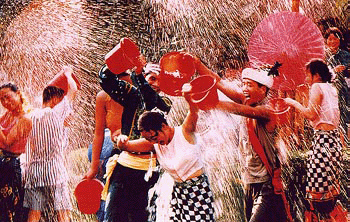
Water Splashing Festival
Time:
April
13-15 every year.
Venue:
Jinghong,
Xishuangbanna Dai Autonomous Prefecture,
Yunnan Province.
Origin:
Legend
has it that there once lived a demon king who was
wreaking havoc in Xishuangbanna by taking seven
young women as his wives against their will. The
women finally rose in rebellion and killed the demon
king, thereby ridding the area of a scourge. However,
the chopped head of the demon king kept rolling,
causing fire in its trail, and the fire could be put
out only when one of the women held it in her arms.
Thus the seven women took turns holding the demon
head once a year. When one woman’s turn was over,
the local people would splash water on her, so as to
rinse her of the blood and expel the evil spirits
out of her; the gesture was also an expression of
gratitude for the women for keeping the local people
from harm’s way. With the passing of time, the demon
king’s head was finally burned to ashes. Splashing
water on each other, however, has gradually evolved
into part of local custom.
What’s On:
Dragon
boat races, the firing of indigenous missiles,
dances to the accompaniment of the beating of drums
on a pedestal shaped like an elephant’s legs,
peacock dances, sightseeing, country fairs, and
water-splashing festivities. During the festival
pouches are tossed between unmarried men and women
as tokens of love.
Back
to Top
Dragon Boat Festival
Time:
5th day of the 5th lunar month
Venue:
All over Chin
Origin:
During the Warring States Period (475-221 BC), Qu
Yuan, a patriotic poet of the state of
Chu, was removed
from office and sent into exile by the duke of Chu.
In sorrow, Qu took a stone in his embrace and
drowned himself in the Miluo River on the 5th day of
the 5th lunar month. The local people wrapped
glutinous rice in mugwort leaves and threw it into
the river to lure the shrimps, fish and crabs away
from the remains of the deceased poet. With the
passing of time the practice of throwing rice into
the river as a sacrifice to Qu Yuan gradually
evolved into a custom.
What’s On:
To
show their respect for the great patriotic poet, the
Chinese make it a point to mark the anniversary of
his death by eat ing zongzi, a pyramid-shaped
dumpling made of glutinous rice wrapped in bamboo or
reed leaves, and holding dragon boat races. Tourist
activities are organized in various parts of the
country, but the celebrations in the city of Miluo
are most fascinating. The International Dragon Boat
Festival held in June 10-14 annually in Yueyang,
Hunan Province, is perhaps the most famous known in
China.
More than 20 dragon boat teams from the
United States,
Canada, Australia, and countries and regions in
Southeast Asia attend the racing and demonstration
shows every year.
Back
to Top
Yunnan Yi Torch
Festival
Time:
The 24th –26th days of the 6th lunar month.
Venue:
Shucun Town
of the Lunan Yi Autonomous County, and the city of
Chuxiong
in the Chuxiong Yi Autonomous Prefecture, Yunnan
Province
Origin:
According to a legend among the Yi people in Lunan, once upon a time
there lived a demon king who terrorized the local
people. During an uprising the local people bound
torches to the horns and hind legs of a herd of
goats and eliminated the demon king by lighting the
torches and driving the goats into its lair. On the
24th day of the 6th lunar month the local people lit
torches for an entire night’s merry-making in
celebration of the victory.
What’s On:
Archery, horse racing, bull fights, and wrestling.
Torch-holding dances around a bonfire at night.
Back
to Top
Mid-Autumn Festival
Time:
15th day of the 8th lunar month
Venue:
All over
China
Origin:
During
the Zhou Dynasty (16th-11th centuries BC), the night
of the full moon was an occasion for the Chinese to
hold rituals to greet the cool weather and sacrifice
to the Goddess of the Moon. By the Tang Dynasty
(618-907) moon-watching and merry-making had become
part of the ritual. During the Northern Song
(960-1127), the 15th day of the 8th lunar month was
designated as Mid-Autumn Festival. When night falls,
the orb of the moon hangs full in the firmament,
shedding a flood of silvery light over the land,
while family members in
China
gather for the happiness of reunion, munching moon
cakes and marveling at the chastened glory of the
Goddess of the Moon. By Chinese custom the 15th day
of the 8th lunar month is a day for family reunion
as symbolized by the full moon and the moon cake.
What’s On:
Ceremonies
to make libation and sacrifices to the moon, and
watching the moon while enjoying moon cakes. There
is always something dream-like and romantic about
Mid-Autumn Festival, on account of its close
association with such Chinese fables as Chang’e
fleeing to the moon, the man Wu Gang performing the
unending servitude to cutting an osmanthus tree, and
the Jade Rabbit pounding medicinal herbs with a
pestle. For men of letters the festival is an
occasion to get together, improvise poems over a cup
of wine and recite them to each other.
Back
to Top
|