|
Beijing
Opera
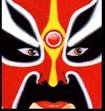 Peking opera is a
purely Chinese opera form which dates back to the
year 1790.Chinese Jewelry,Tibet Jewelry,Tibet
Collections. That year four local opera troupes of
Anhui Province came to Beijing on a performance tour
on the order of the imperial court. The tour was a
hit and the troupes stayed. The artists absorbed the
tunes of the Hubei local opera and drew on the best
of Kun Qu, Qin Qiang and Bang Zi and other local
operas. Peking opera is a
purely Chinese opera form which dates back to the
year 1790.Chinese Jewelry,Tibet Jewelry,Tibet
Collections. That year four local opera troupes of
Anhui Province came to Beijing on a performance tour
on the order of the imperial court. The tour was a
hit and the troupes stayed. The artists absorbed the
tunes of the Hubei local opera and drew on the best
of Kun Qu, Qin Qiang and Bang Zi and other local
operas.
MORE
"Sheng, dan, jing,
chou," for instance, are just the terms for four
different types of roles. "sheng" is the positive
male role, "dan" is the positive female role, "jing"
is a supporting male role with striking character
and "chou" is the clown. Every type has its telltale
facial makeup and decoration
But actually, "piao
you" means Peking opera fans, "piao fang" means the
place where fans meet to amuse themselves and "xia
hai" means turning professional. Chinese Jewelry,Tibet
Jewelry,Tibet Collections. When you come across with
a small group of Peking opera fans singing in a
street corner, that corner can be considered a "street
piao fang." There is no lacking of social
celebrities among Peking opera fans. Emperor Guang
Xu of Qing Dynasty, for example, was not only a good
amateur Peking opera singer, but was also a good
drummer in the Peking opera orchestra (the drummer
plays the role of the director of the orchestra).
The Empress Dowager was an avid Peking opera fan,
too. The huge three-storey theater in the Summer
Palace is a proof of her love for Peking opera.
Chinese
Pi Ying Opera
 Chinese
Pi Ying Xi, also called leather-silhouette show or
shadow play, came into existence almost
a thousand years ago.
It is said in Yuan Dynasty it once spread to west Asia
and even
as far as Europe. The
paper or leather cut silhouette is reflected onto a
piece of white cloth and performers behind the scene
control it to walk, dance, or do various kinds of
acts by the strings connected to the joints, with
companion of music and songs. Chinese
Pi Ying Xi, also called leather-silhouette show or
shadow play, came into existence almost
a thousand years ago.
It is said in Yuan Dynasty it once spread to west Asia
and even
as far as Europe. The
paper or leather cut silhouette is reflected onto a
piece of white cloth and performers behind the scene
control it to walk, dance, or do various kinds of
acts by the strings connected to the joints, with
companion of music and songs.
MORE
Among the many types
of Pi Ying Xi, the silhouette show of donkey leather
in Tangshan, Hebei Province and of ox leather in
northwest China are renowned for their exquisite
cutting and distinctive folk music.
About its origin there
is a beautiful love story. It has it that, Liu Zhe,
the Emperor Wu of Han Dynasty, liked all kinds of
entertainment and kept many artists in his palace.
Among the musicians Li Yannian was the best. Not
only was he good at playing all kinds of musical
instruments, but also could he improvise songs. One
year the King of Qiuzi, a tribe in the northwest,
came to present tribute. On the reception banquet Li
Yannian was ordered to give a performance and he
sang about an exceeding beauty. All the people were
fascinated and lost in the graceful scene he
created. Later when someone reported to the Emperor
Wu that Li's sister was such a beauty, the emperor
was so pleased as to call her in. And finding she
was pretty beyond description, he fell in love with
her at the first sight. She received great favor and
gave birth to a son the next year.
But good times did not
last long for she fell ill seriously afterwards. As
the emperor visited her.she covered her face with
quilt and said, 'I hope your majesty can take good
care of my brother and son for the sake of our past.'
But she refused his request of taking a last look of
her, 'A woman makes up to please her lover but I am
not as good-looking as before and not dressed up.
Please leave me as I am.' So finally the emperor
went away disappointedly. As explained to her maid
she said,'His majesty favors me because of my
appearance. I'm no longer pretty with illness and he
will forget all my goodness at my sight. But
otherwise he'll remember me forever.'
After her death the
emperor missed her so much that a necromancer was
summoned to call back her spirit. Though his mind
racked, the necromancer found no way to meet this
expectation. In the evening when pacing up and down
in his room, he saw his shadow reflected on the
wall. Thus an idea was hit upon out of the
predicament. He copied the concubine's picture onto
a piece of leather and after coloring and cutting a
lifelike silhouette was made. With all the details
well prepared, Emperor Wu was invited to the room.
From far away, he saw his concubine's silhouette
came up slowly and gracefully, knelt down
respectfully and remained there. Just as he was
approaching, the necromancer stopped him and said
the spirit needed a respectful distance. And
hundreds of years later Pi Ying Xi was passed down
from the descendants of the necromancer. |