|
The body of vocal and instrumental music composed
and played by the Chinese people has a history of
more than 8000 years. It has a very early
development of theoretical, systematic, acoustical,
and material science, and orchestral practice.
Traditional Chinese Music
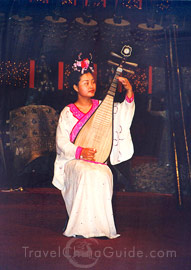 Chinese music is as old as Chinese civilization.
Instruments excavated from sites of the Shang
Dynasty (circa 1766-1027 BC) include stone chimes,
bronze bells, panpipes, and the sheng. When European
music was just experiencing its first breath of life,
a complete musical theory and sophisticated musical
instruments were already appearing in China.
The orthodox ritual music was advocated by Confucius,
who conceived of music in the highest sense as a
means of calming the passions and of dispelling
unrest and lust. By the Han Dynasty, the imperial
court set up a Music Bureau, which was in charge of
collecting and editing ancient melodies and folk
songs. Because of commercial contacts with
Central Asia, foreign music was introduced in China
and incorporated change and improvement in Chinese
music. By the time of Emperor Xuanzong of the Tang
Dynasty, the court organized the Pear Garden Academy
song and dance troupe which cultivated a large
number of musicians and laid a firm foundation for
Chinese music.
Chinese music is as old as Chinese civilization.
Instruments excavated from sites of the Shang
Dynasty (circa 1766-1027 BC) include stone chimes,
bronze bells, panpipes, and the sheng. When European
music was just experiencing its first breath of life,
a complete musical theory and sophisticated musical
instruments were already appearing in China.
The orthodox ritual music was advocated by Confucius,
who conceived of music in the highest sense as a
means of calming the passions and of dispelling
unrest and lust. By the Han Dynasty, the imperial
court set up a Music Bureau, which was in charge of
collecting and editing ancient melodies and folk
songs. Because of commercial contacts with
Central Asia, foreign music was introduced in China
and incorporated change and improvement in Chinese
music. By the time of Emperor Xuanzong of the Tang
Dynasty, the court organized the Pear Garden Academy
song and dance troupe which cultivated a large
number of musicians and laid a firm foundation for
Chinese music.
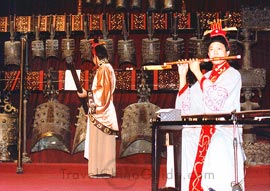
Melody and tone quality are prominent expressive
features of Chinese music, and great emphasis is
given to the proper articulation and inflection of
each musical tone. Most Chinese music is based on
the five-tone, or pentatonic, scale, but the seven-tone,
or heptatonic scale, is also used, often as an
expansion of a basically pentatonic core. The
pentatonic scale was much used in older music. The
heptatonic scale is often encountered in northern
Chinese folk music.
The variations of rhythm, beat, tone quality, and
embellishments in traditional Chinese music are
highly distinctive and unlike their Western
counterparts. This is mainly due to the unique
sounds and playing styles of traditional Chinese
musical instruments. Chinese musical instruments can
be divided into four basic categories based on the
method by which they are played. The first category
includes the bowed-strings, or Hu Qin, which are
made of wood with a piece of snakeskin stretched
over the sound box. They have two strings, and the
bow is permanently caught in between the two
strings.
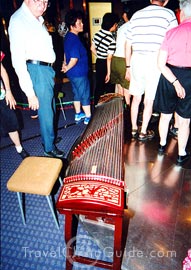 The
second category includes the plucked-strings, of
which there are three types: dulcimers, lutes, and
harps. The harp is made of either wood or bamboo
with steel strings. In the past, the strings were
made of silk. The third category encompasses the
woodwind section. There are flutes, pipes, and
Chinese trumpets which use double reeds like the
oboe but sound like a trumpet. The final category
encompasses the percussion section. The main
instruments include drums, timpani, gongs, and
cymbals. For some songs, bells, xylophones, tuned
gongs, and the triangle are used. The percussion
section is called the wu-ch'ang, or martial scene,
in traditional Chinese opera. The
second category includes the plucked-strings, of
which there are three types: dulcimers, lutes, and
harps. The harp is made of either wood or bamboo
with steel strings. In the past, the strings were
made of silk. The third category encompasses the
woodwind section. There are flutes, pipes, and
Chinese trumpets which use double reeds like the
oboe but sound like a trumpet. The final category
encompasses the percussion section. The main
instruments include drums, timpani, gongs, and
cymbals. For some songs, bells, xylophones, tuned
gongs, and the triangle are used. The percussion
section is called the wu-ch'ang, or martial scene,
in traditional Chinese opera.
In traditional Chinese orchestras, the
combination of all the different instruments served
to create a harmonious and beautiful auditory
atmosphere. Unbelievingly beautiful music was made
and is still made. Many Chinese instruments can
produce purely unique and amazing sounds. Some
famous traditional pieces have been amassed below
for your listening pleasure.
Modern Chinese Music
Today's Chinese music is quite similar to
modern Western music. Just like young Westerners,
now young Chinese attend the concerts of famous
Chinese pop stars. Modern Chinese orchestras play
both adapted versions of traditional pieces and
classical and modern symphonic compositions. Popular
modern music incorporates many aspects of Western
music from electric keyboards to guitars. Much of
today's popular music can be classified as R&B, rock,
blues, or dance music.
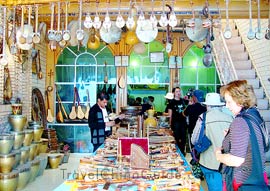
In modern Chinese music, many traditional facets
still remain. Many traditional Chinese instruments
are used in conjunction with popular instruments of
Western cultures. The mixing of traditional
instruments with western instruments creates a wide
variety of euphonious sounds and rhythms, and the
mixing with western styles of singing creates unique
Chinese sounds. Many modern artists also incorporate
traditional Chinese melodies into their songs, so
even music using only popular Western instruments
sounds different. The mixing of Western styles and
Chinese styles with traditional Chinese instruments
and other instruments allows for the creation of an
endless scope of expression with modern Chinese
music.
Many modern instrumental music pieces incorporate
traditional instruments while adapting a more modern
style. However, instrumental music is still very
traditional. Many works of traditional music are
still played by small quartets and large orchestras.
Chinese melodies are quite unique and incorporate
into many modern compositions. Chinese instrumental
music has changed because it is no longer restricted
to the traditional format. Even non-traditional
instruments such as the piano are used in creating
modern works.
|