|
Guqin
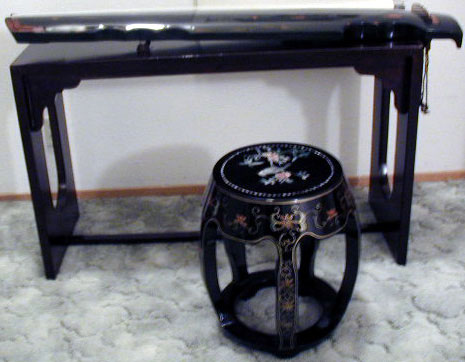
The guqin, a seven-stringed
zither, is China's oldest stringed instrument, with
a history of some 3000 years. In Imperial China, a
well educated scholar was expected to be skilled in
four arts: Qin (the guqin), Qi (the game of Go), Shu
(calligraphy) and Hua (painting). Historically, the
guqin has been viewed as a symbol of Chinese high
culture, but today only a few thousand people can
play it, and it is rarely seen in China.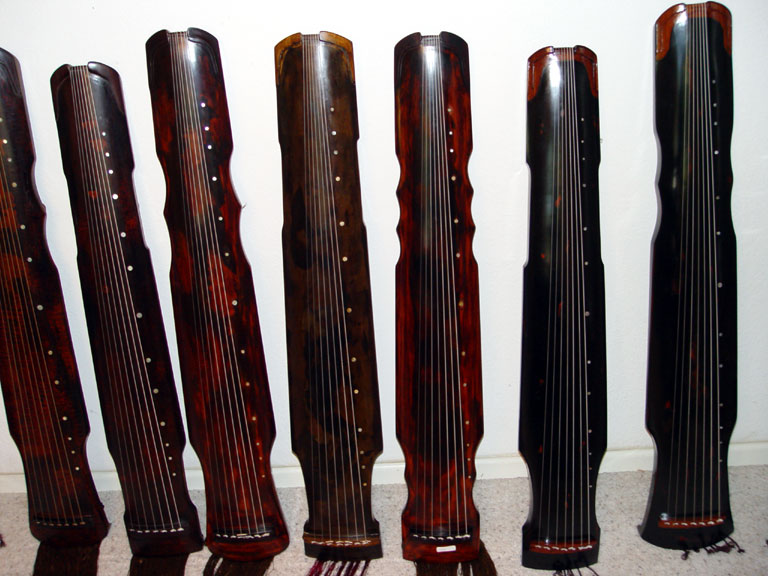
The
guqin is a unique instrument which needs to be hand
made by specialist craftsmen using special wood,
lacquer and a high degree of skill. Most guqins sold
in general music stores, even in China, are
virtually unplayable and are suitable only for
hanging on the wall for decoration. Professional qin
players never buy such instruments or recommend them
to their students. Not only are they unable to
produce an acceptable sound, they can even cause
injury to a student's hand.
Xiao
(vertical
flute)
Xiao
is a traditional Chinese wind instrument made of
bamboo. Its earliest appearance can be traced back
to the
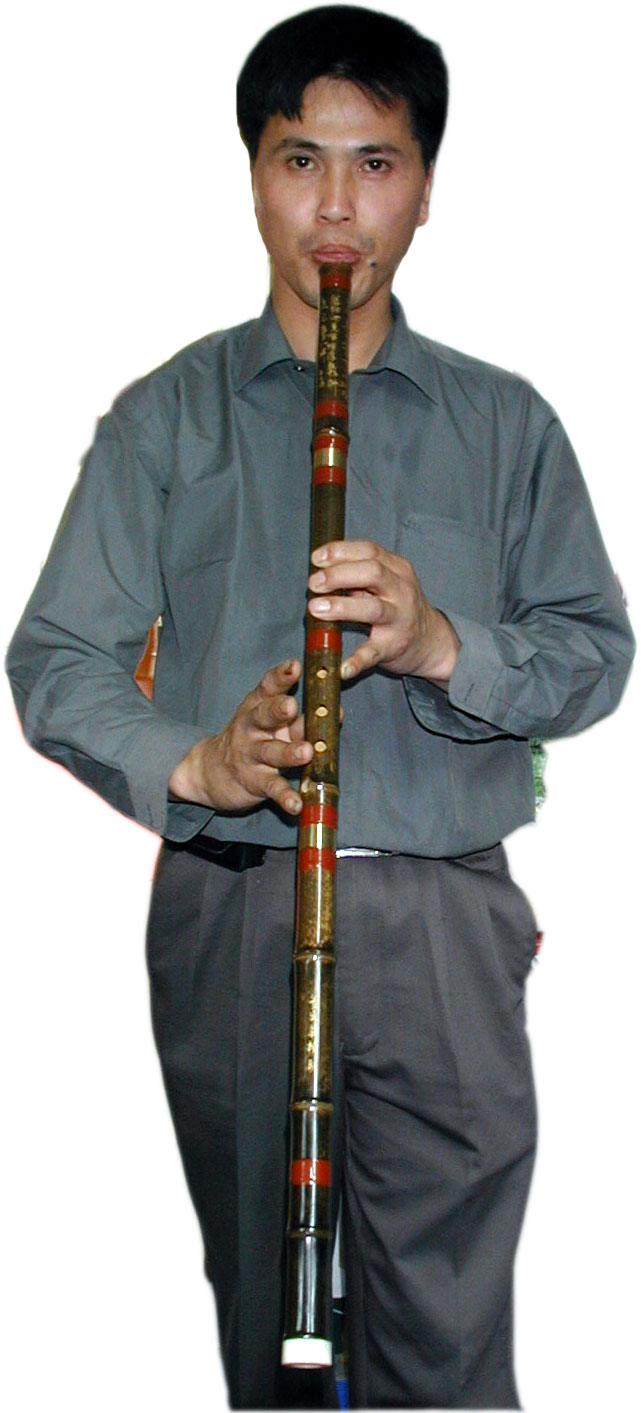 Qiang
nationality (one of the Chinese minorities of
China's Mid-West) in the 1st century. It became
popular nationwide around 600 A.D. Scholars, young
men and women were very fond of the xiao. Usually
played as a solo instrument, it is sometimes also
played with other instruments, though not many
people are actually able to perform with it. An
ordinary xiao has six tone-holes. The tone of the
xiao is extremely beautiful, suitable for expressing
a peaceful or melancholy mood. The xiao is often
featured in music of the "civil repertory",
typically used to accompany the quiet guqin. Qiang
nationality (one of the Chinese minorities of
China's Mid-West) in the 1st century. It became
popular nationwide around 600 A.D. Scholars, young
men and women were very fond of the xiao. Usually
played as a solo instrument, it is sometimes also
played with other instruments, though not many
people are actually able to perform with it. An
ordinary xiao has six tone-holes. The tone of the
xiao is extremely beautiful, suitable for expressing
a peaceful or melancholy mood. The xiao is often
featured in music of the "civil repertory",
typically used to accompany the quiet guqin.
Erhu (Two Stringed
Violin)
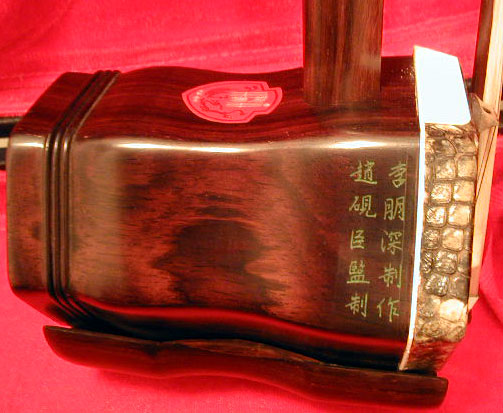
This is one of the
most widely used bowed instruments in China. It
represents a type of huqin constructed of various
hardwoods with the soundbox covered by snake skin.
The top of the neck is frequently carved, often in
the form of a dragon head. In Beijing opera it
matches, but an octave lower, the high-pitched
jinghu. The erhu has undergone a number of
modifications during its 500 year history, so that
its tone is both mellow and bright, making it
popular for both solo and orchestral performances.
Konghou
(Chinese
Harp)
The
Konghou is an ancient Chinese, plucked string
instgrument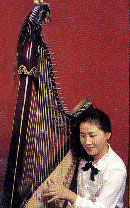 .
It is not of
Chinese origin, but was introdued into China from
the West into
the Han Danasty about 2,000 years ago. According to
historical records,
it was divided into
the horizontal Konghou and the vertical Konghou
because of difference
in shapes. The Konghou became
popular during the Han,
Sui and Tang Dynasties when the playing
technique
reached a high level. During the past hundred years,
however, this ancient musical instrument became
virtually extinct. A group of music scholars and
instrument craftsmen researched various historical
documents, and in 1980, a new type of Konghou was
born .
It is not of
Chinese origin, but was introdued into China from
the West into
the Han Danasty about 2,000 years ago. According to
historical records,
it was divided into
the horizontal Konghou and the vertical Konghou
because of difference
in shapes. The Konghou became
popular during the Han,
Sui and Tang Dynasties when the playing
technique
reached a high level. During the past hundred years,
however, this ancient musical instrument became
virtually extinct. A group of music scholars and
instrument craftsmen researched various historical
documents, and in 1980, a new type of Konghou was
born
Guzheng
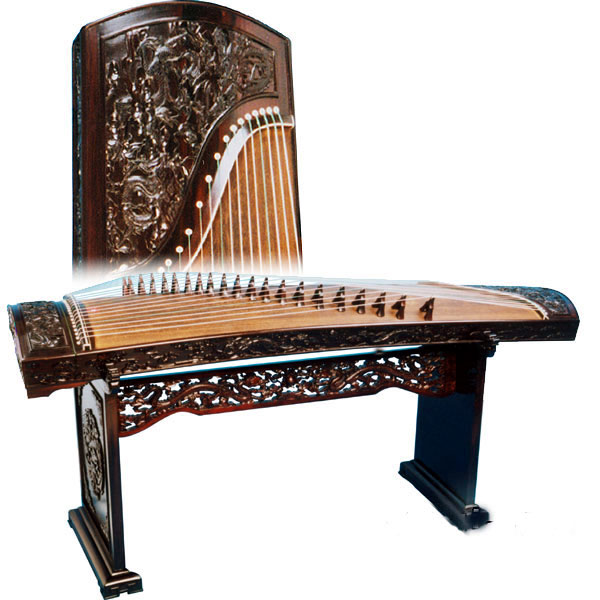
The guzheng, Chinese
forerunner of the Japanese koto and Korean kayagum,
originated over 2300 years ago and is one of the
oldest plucked instruments in China. Because of its
melodic qualities, the Guzheng was extremely popular
for both court and folk music. The sound box is made
of paulownia wood; the strings, varying in number
from thirteen to twenty-five, used to be made of
silk, but are nowadays metal or nylon. They are
tuned to a pentatonic scale with a range of more
than four octaves.
|