|
Chinese Folk Toys
 The
development of the modern toy industry in
China
has had an effect on what today's children play with,
but traditional folk toys continue to play a major
role in contemporary Chinese culture. As China
continues to grow and develop, traditional folk toys
are still flourishing. Toys represent the
fundamental ideas, desires, and concerns that are
central to both the lives of Chinese people and to
Chinese culture. The
development of the modern toy industry in
China
has had an effect on what today's children play with,
but traditional folk toys continue to play a major
role in contemporary Chinese culture. As China
continues to grow and develop, traditional folk toys
are still flourishing. Toys represent the
fundamental ideas, desires, and concerns that are
central to both the lives of Chinese people and to
Chinese culture.
Chinese folk toys enjoy a history as old as the
nation itself. Revealing aspects of the land and its
rich cultural heritage, they portray the wisdom and
creativity of folk artists throughout China. Many
practical, instructive and artistic folk toys are
favored by children and adults alike. Furthermore,
these toys serve as a means through which Chinese
people can express their hopes and desires, as well
as their affection towards their children. Infused
with a multitude of meanings, from the instructive
to the decorative, Chinese folk toys bring beauty
and art into ordinary lives.
Playing with History
Colorful glass marbles with flowers or
other designs inside of them are quite popular among
children across China. Used in a variety of games,
these toys, like the children who play with them,
have their own ancestral history.
 Among
the relics unearthed from the ruins of
Banpo Village
in Xi'an were some small clay and stone balls dating
back to the Yangshao Culture of the Neolithic Period
(4800-4300 BC). Archeologists believe them to be
ancient children's toys. The diameter of these balls
varies from 1.1 cm to 3 cm, too small and light to
be used as bullets or other weapons. Some of the
clay balls have decorative prints and scratches on
them. In addition, small pottery and glazed
porcelain balls from a later period (4400-3300 BC)
have been unearthed from the ruins of Wushan
Mountain in Sichuan Province. Scholars argue that
because they are more durable and decorative than
the earlier clay and stone balls, these are the
precursors to the contemporary glass marbles so
popular today. Among
the relics unearthed from the ruins of
Banpo Village
in Xi'an were some small clay and stone balls dating
back to the Yangshao Culture of the Neolithic Period
(4800-4300 BC). Archeologists believe them to be
ancient children's toys. The diameter of these balls
varies from 1.1 cm to 3 cm, too small and light to
be used as bullets or other weapons. Some of the
clay balls have decorative prints and scratches on
them. In addition, small pottery and glazed
porcelain balls from a later period (4400-3300 BC)
have been unearthed from the ruins of Wushan
Mountain in Sichuan Province. Scholars argue that
because they are more durable and decorative than
the earlier clay and stone balls, these are the
precursors to the contemporary glass marbles so
popular today.
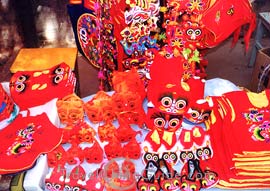
A large number of masks and centimeter-long
toys in the shapes of animals such as dragons and
lions have been found in several other ruins.
Closely linked to the lives of rural people in
ancient China, these toys were undoubtedly enjoyed
by both children and adults as their contemporary
counterparts are today. In today's
China,
masks and statuettes in the shape of historical
characters, beasts, and other animals can be seen in
the hands of many children.
Toy with Sounds
Toys with pleasing, rhythmic sounds have
always been favorites of children. Parents sing
lullabies and whistle tunes to coax their children
to sleep, but folk toys that make simple soothing
sounds are equally effective. Small cymbals, bells
and little gongs, familiar instruments of
traditional Chinese folk music, along with shaking-drums
and bird-shaped whistles are among the most popular
and common toys, particularly in rural areas.
 Whistles
of various kinds are perhaps the most common musical
toys. In ancient times, whistles were made and used
by hunters. At
Tieshan
Town in Lushun City, a saddle-shaped pottery whistle
dating back to the Neolithic Period has been
unearthed and, when blown, produces a sharp sound.
In later periods, clay cuckoos and other bird-shaped
whistles were made. Together with other musical toys,
they have been handed down from generation to
generation. Today children on city streets as well
as those in the countryside enjoy blowing clay and
plastic bird whistles. Whistles
of various kinds are perhaps the most common musical
toys. In ancient times, whistles were made and used
by hunters. At
Tieshan
Town in Lushun City, a saddle-shaped pottery whistle
dating back to the Neolithic Period has been
unearthed and, when blown, produces a sharp sound.
In later periods, clay cuckoos and other bird-shaped
whistles were made. Together with other musical toys,
they have been handed down from generation to
generation. Today children on city streets as well
as those in the countryside enjoy blowing clay and
plastic bird whistles.
Another popular musical toy is the bamboo
flute. Bamboo can be found everywhere in southern
China and musical toys made out of bamboo tubes
along with those made of reed pipes are quite
popular. The beautifully sounding bamboo flute,
which has several holes drilled into a piece of
bamboo, can be blown horizontally or vertically. A
traditional musical instrument, it continues to be
widely played by both adults and children. Another
traditional wind instrument for children is the
sheng, which is made of several reed pipes bound
together with an attached mouthpiece. Like the
bamboo flute, these reed-pipe instruments have a
long history in Chinese culture and are still
popular today.
Moving Toys
 Ancient
artisans were capable of producing elaborate movable
toys. Using ordinary materials and simple tools,
they made toys that were not only fun to play with
but also objects of great beauty. Ancient
artisans were capable of producing elaborate movable
toys. Using ordinary materials and simple tools,
they made toys that were not only fun to play with
but also objects of great beauty.
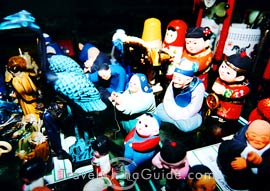
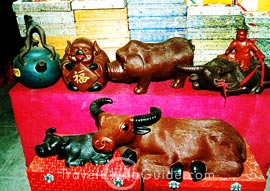
Clay "roly-poly" figurines are often seen for sale
at country fairs. Funny and attractive, these
figurines revolve on spherical clay pedestals and
never fall down, even when lightly struck by
children. Cloth lions and tigers open their mouths
and shake their heads or tails when a hand is placed
inside the toy's body. Chickens can be made to move
their heads up and down as if they were pecking at
rice.
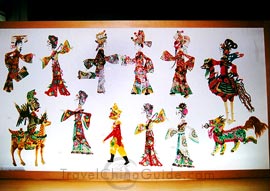
Among movable toys, shadow puppets enjoy the longest
history and best reputation. Made of colored
cardboard, leather, or hardened sheets of plastic,
they are used by children and adults in a variety of
puppet shows. With wires, strings, or sticks
attached to them, the puppeteers can move various
parts of their bodies.
Similarly made furniture is also used as
scenery in puppet shows. Many of the sets and
characters are from ancient Chinese history and folk
literature. Increasingly, however, contemporary
figures of soldiers, workers, and peasants enjoy
popularity among children. Reflecting various
aspects of modern Chinese life, these puppets
provide a medium for both artists and consumers to
express their ideas, concerns and desires. Moreover,
as certain figures grow in popularity and demand,
the puppets constitute a kind of cultural record,
which enables scholars and others to view changes in
and attitudes about Chinese culture.
|
 |
 |
Toys of Practical Use
Toys are most often seen in terms of their
ability to amuse. However, the Chinese people, who
are known for their thrifty and practical nature,
make toys for other purposes as well.
Foodstuffs have long served as a source for
artistic creation. Culturally expressive and
emphasizing traditional materials and culinary
devices, some Chinese foods serve not only the need
of eating but also the purpose of playing. A good
example is the sugar-molded figurines popular
throughout China.
Sugar-molded toys are children's favorites.
Melted sugar is poured into wooden or metal molds,
which are carved with various patterns. The most
common motifs are chickens, fish, pigs, horses,
lions, and tigers. Candy figurines are also made
without molds. In city parks, candy-making artists
create various figures with a few quick strokes of a
spatula. Fun to observe and eat, these figurines
represent figures and designs important in Chinese
culture. |