Countries
Home ResourcesAmazon BooksBartleby Quotes Genre Fluent Google Maps Lonely Planet MSN Encarta Virtual Tourist Wiki Travel Wikipedia |
New Zealand history and picturesNew Zealand is one of the most recently settled major land masses. Polynesian settlers arrived in their waka some time between the 13th century and the 15th century to establish the indigenous M�ori culture. New Zealand's M�ori name, Aotearoa, is usually translated as "Land of the long white cloud", reputedly referring to the cloud the explorers saw on the horizon as they approached. Settlement of the Chatham Islands to the east of the mainland produced the Moriori people, but it is disputed whether they moved there from New Zealand or elsewhere in Polynesia. Most of New Zealand was divided into tribal territories called rohe, resources within which were controlled by an iwi ('nation' or 'tribe'). M�ori adapted to eating the local marine resources, flora and fauna for food, hunting the giant flightless moa (which soon became extinct), and ate the Polynesian Rat and kumara (sweet potato), which they introduced to the country. 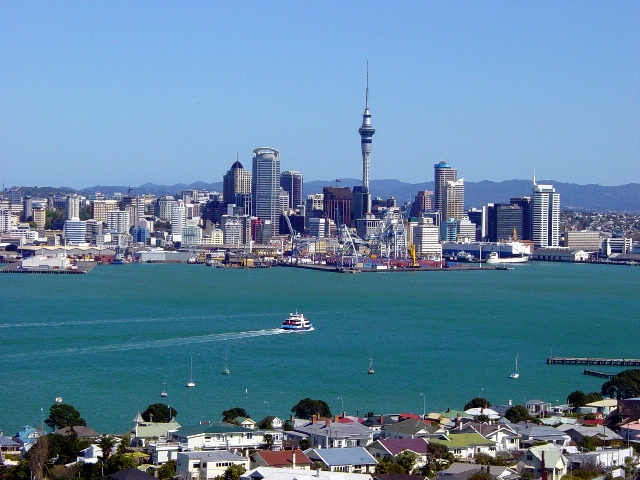
The first Europeans known to have reached New Zealand were led by Abel Janszoon Tasman, who sailed up the west coasts of the South and North Islands in 1642. He named it Staten Landt, believing it to be part of the land Jacob Le Maire had seen in 1616 off the coast of Chile. Staten Landt appeared on Tasman's first maps of New Zealand, but this was changed by Dutch cartographers to Nova Zeelandia, after the Dutch province of Zeeland, some time after Hendrik Brouwer proved the supposedly South American land to be an island in 1643. The Latin Nova Zeelandia became Nieuw Zeeland in Dutch. Captain James Cook subsequently called the archipelago New Zealand (a slight corruption, as Zealand is not an alternative spelling of Zeeland, a province in the Netherlands, but of Sj�lland, the island in Denmark that includes Copenhagen), although the M�ori names he recorded for the North and South Islands (as Aehei No Mouwe and Tovy Poenammu respectively[1]) were rejected, and the main three islands became known as North, Middle and South, with the Middle Island being later called the South Island, and the earlier South Island becoming Stewart Island. Cook began extensive surveys of the islands in 1769, leading to European whaling expeditions and eventually significant European colonisation. From as early as the 1780s, M�ori had encounters with European sealers and whalers. Acquisition of muskets by those iwi in close contact with European visitors destabilised the existing balance of power between M�ori tribes and there was a temporary but intense period of bloody inter-tribal warfare, known as the Musket Wars, which ceased only when all iwi were so armed. Modern New Zealand history
New Zealand was initially administered as a part of the colony of New South Wales, and it became a separate colony in November 1840. The first capital was Okiato or old Russell in the Bay of Islands but it soon moved to Auckland. European settlement progressed more rapidly than anyone anticipated, and settlers soon outnumbered M�ori. Self-government was granted to the settler population in 1852. There were political concerns following the discovery of gold in Central Otago in 1861 that the South Island would form a separate colony, so in 1865 the capital was moved to the more central city of Wellington. New Zealand was involved in a Constitutional Convention in March 1891 in Sydney, New South Wales, along with the Australian colonies. This was to consider a potential constitution for the proposed federation between all the Australasian colonies. New Zealand lost interest in joining Australia in a federation following this convention.
In 1893 New Zealand became the first nation to grant women the right to vote on the same basis as men; however women were not eligible to stand for parliament until 1919.
Colyton NSW 2760, Australia Phone: (02) 9862 0717 ?#060;BR> mailto:[email protected] |
Links to PlacesA B NewsBali Villa Rental Boat Share Books to Read Blog Wave Chemical Periodic Table City Cars Commodities Computer Technology Email Cash Google Earth Jupiter the Planet Lego Land Project LCSH Subject Mercury The Planet News that Matter Online Games Runescape Blog Scirus Science Search Search Engine News Sydney Event Calendar Tax Tips Virtual Library Venus the Planet |