Countries
Home ResourcesAmazon BooksBartleby Quotes Genre Fluent Google Maps Lonely Planet MSN Encarta Virtual Tourist Wiki Travel Wikipedia |
Denmark history and picturesThe earliest Danish archaeological findings date back to 130,000-110,000 BC in the Eem interglacial period. People have continually lived in Denmark since about 12,500 BC, and agriculture made inroads about 3,900 BC. The Nordic Bronze Age (1,800-600 BC) in Denmark was marked by burial mounds, which left an abundance of findings, including lurs and the Sun Chariot. During the Pre-Roman Iron Age (500 BC-AD 1), native groups began migrating south into Germania. The Roman provinces maintained trade routes and relations with native tribes in Denmark, attested by finds of Roman coins. Evidence of strong Celtic cultural influence dates from this period in Denmark and much of northwest Europe, and is among other things reflected in the finding of the Gundestrup cauldron. The first Danish people came to Denmark between the Pre-Roman and Germanic Iron Age, in the Roman Iron Age (AD 1-400). Before the arrival of Danish settlers, who came from Scandinavia and spoke an early form of north Germanic, most of Jutland and part of the islands had been vacated or partly vacated by the earlier Jutes, the descendants of populations known to be there from sources in ancient history (such as Tacitus and Ptolemy). A large part of the Jutes were known as the Angles and the Saxons. They vacated Jutland en masse to take up residence in the land now named after them, England. 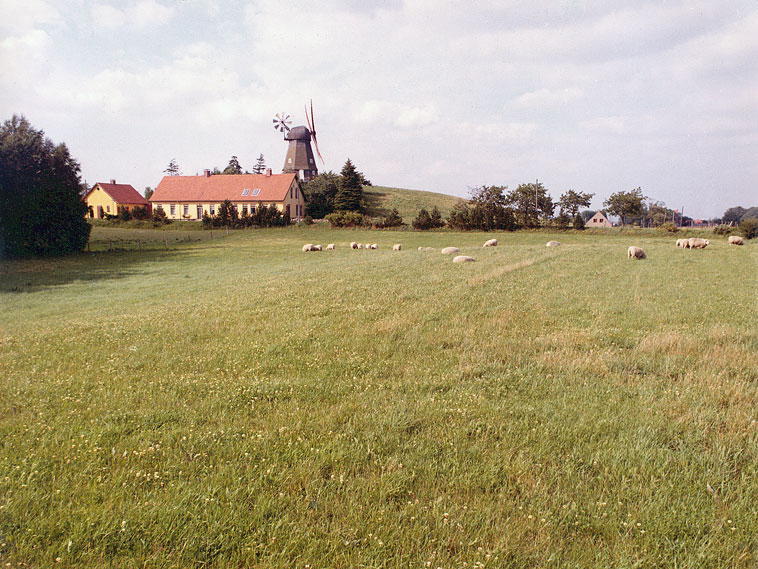
The exact origin of Denmark has been lost in history, but a short note about the Dani in "The Origin and Deeds of the Goths" from 551 CE by historian Jordanes is thought to be an early mention of a Danish people. The Danevirke defence structures were built in several phases from the 3rd century forth, and the sheer size of the construction efforts in 737 are contributed to the emergence of a Danish king. The new runic alphabet was first used at the same time, and Ribe, the oldest town of Denmark, was founded about 700. Modern Denmark history
Despite its continued neutrality, Denmark was invaded by Germany (Operation Weser�bung), on April 9, 1940. Though accorded self-rule (which ended in 1943, due to a mounting resistance movement), Denmark remained militarily occupied throughout World War II. The Danish sympathy for the Allied cause was strong; 1,900 Danish police officers were arrested by the Gestapo and sent, under guard, to be interned in Buchenwald. The invading Nazis attempted to force all Danish Jews to wear a yellow Star of David. However, Christian X, the king of Denmark at the time, soon began sporting a yellow Star of David on his sleeve as well (he was not Jewish). After a short time, almost every Dane was wearing one, Jewish or not. This made it impossible for the Gestapo to tell who was Jewish. In the end, the majority of Danes killed for being Jewish as part of this ethnic cleansing were not actually Jewish. This brave and courageous act showed Hitler and the Nazis that physically conquering a country can't change its character.
During the war, Iceland claimed independence and in 1948 the Faroe Islands gained home rule. After the war, Denmark became one of the founding members of the United Nations and NATO and, in 1973, joined the European Economic Community (later, the European Union). In 1979, Greenland gained home rule.
Colyton NSW 2760, Australia Phone: (02) 9862 0717 mailto:[email protected] |
Links to PlacesA B NewsBali Villa Rental Boat Share Books to Read Blogwave Chemical Periodic Table City Cars Commodities Computer Technology Email Cash Google Earth Jupiter Lego Land Project LCSH Subject Mercury The Planet News that Matter Online Games Runescape Blog Scirus Science Search Search Engine News The Simpsons The Sun Sydney Event Calendar Tax Tips Virtual Library Venus |