|
|
||||||||||||||||
| Role Playing Submitting Character Biographies Information on Geiko (Geisha)
What Geisha Do
Appearances and Rank
Geimyo
Geisha
Terminology Outside Links
Immortal Geisha Recommended Reading
|
Real Geisha
Japan has a rich cultural history, especially when it comes to the traditional arts and spiritual beliefs and practices. The nobility especially practiced and educated themselves in the arts--playing musical instruments, writing poetry, learning dances and practicing flower arrangement. Even the kimono they wore had special meaning and the people were very fashion concious. The rich aristrocracy lead a very artistic way of life. This is what the geisha do today. The geisha of Japan--called geiko in Kyoto--preserve much of what has been lost to the general public. Dispite popular belief, both in foreign countries and even in Japan, geisha are not prostitutes and never have been. As a matter of fact, Japan had its own class of prostitutes called yuujo, which consisted of the Oiran of Tokyo and Tayuu of Kyoto. Although both geisha and the yuujo painted their faces white and wore elaborate kimono, they were and still are two very different professions. Geisha are artists, and that is the very meaning of the word--"gei" meaning arts, and "sha" standing for a person. They are people of arts, and those arts include dancing traditional Japanese dance, playing musical instruments like the shamisen, flute, and drums, and being generally entertaining as hostesses of their customers. It is hard to explain the geisha without explaining a bit of their history. It is a little known fact the first geisha were men, not women, and they entertained the high classes with their skills in the arts. Back then the yuujo dominated as female entertainers, but then women started to become geisha themselves. Called geiko because they were women, they outnumbered the men within just a couple decades. Though the yuujo were popular because they were high class prostitutes, the geisha became more popular. Their appearance was much less elaborate and an evening with a geisha was not nearly as expensive. The geisha were, in whole, seen as much more classy for their simplicity, and they played a familiar, well known instrument while entertaining--the shamisen. Instead of seeming archiac, they became rather "chic." When geisha incorperated things into their style--say, fur stoles over their coats--other women would wear them too. They set what was popular in fashion at the time and were deemed role-models, and not just of other women. For example, a short kimono coat used to only be worn by men. The geisha, deciding to borrow this concept, turned it into a fashion trend, and soon enough everyone was wearing the short kimono coats. Eventually, the yuujo class nearly died out and the geisha soared. They themselves, over the years, became high class entertainers to the point that only the richest men in Japan could afford a party with their company, and even then they have to have a connection to the hanamachi to even get in. You can think of the Flower and Willow world as a very elite club. Today the patrons of geisha are usually older, rich company men and politicians. They can not only afford to have a party with geisha but may also have genuine interest in the arts. Or, sometimes, they hire geisha for a party just to show that they can. They may go for a fun evening after a hard day at work, to get drunk and play drinking games. Whatever the reasons, the Flower and Willow world would not survive without their customers, and many are determined not to let their customs die out. Today, the geisha are the only ones whom, on a daily basis, keep the old arts and culture alive.
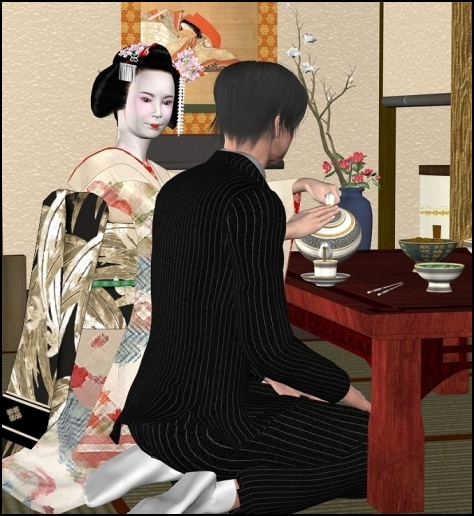
Ozashiki Arts Ozashiki are the dinner parties hosted in ochaya, or tea houses. Customers make appointments to arrange an evening of entertainment. Whether it be for himself and a few friends or the president of a company and his staff, ozashiki are set up to provide the perfect entertainment for any particular host and his guests. Not only are geisha and maiko (the apprentice geisha) chosen, but the food is carefully prepared to match the tastes of the customer's pallete, the scroll hanging on the wall will be in accordance to his status, and the entertainment itself is carefully planned. Does the customer like a quiet evening of dancing and soft music? Would he perfer a fun evening of drinking games and telling traditional stories? Everything is taken into account to make the customer have a good time and feel as if he has entered another world, and in a sense he truly will, at least for a few hours. The job of a geisha is to be a perfect hostess for her customers and to make them feel as if they are the most important people in the world. Throughout their period as maiko and geiko they are cosntantly learning and improving their conversational skills, which a geisha needs to survive in the profession. She will learn to skillfully cajole and flatter the men (and sometimes women!) she entertains. In a sense, as it is said, the Flower and Willow world was created for the entertainment of men. It is a 'perfect world' where they can sit by pretty young women who are the traditional image of Japanese sex appeal. They are classy, smart, and fun. Although witty conversation is definitely important, the geisha wouldn't be geisha without their more traditional arts. They spend around five years as apprentices, called maiko, learning to dance in the traditional Japanese style, learning to play various instruments, flower arranging, and even the art of kimono. They are fashioned into the ideal artful woman and eventually become geisha. Instruments the geisha play include flute (fue), drum (taiko), hand drum (tsuzumi), and most importantly the shamisen. It is a lute with a long neck and three strings, and is played using a plectrum. It is the signature instrument of the geisha.
The Hanamachi
Hanamachi are the "Flower Towns" that geiko
and maiko live and work in. There used to be six hanamachi but today there
are five, collectively called the gokagai. The five districts are as
follows, and each have their own distinct mon (crest). Each district has
their own way of doing things and even slightly different ways of
dressing, either normally or on special occasions. Each district also has
a certain school of kyomai, or traditional style dance, that they follow.
Annual performances performed by the five districts, Odori are put on for the public. They geiko themselves arrange, pay for, and sell tickets to their performances. These involve very elaborate songs and dance and, depending on the district, can be the same every year or vary in its theme and stories. They can have either kabuki-like pieces involving maybe ten or less performers, or involve every maiko and geiko in the district to put on a big colorful dance. Some dances tell festive stories, others sad. Often, odori are the only chance the general public get to see geiko perform. Each district has their own Odori.
Gion Kobu - Miyako Odori in April
Contact DrowElfMorwen |
|||||||||||||||