|
|
|||||||||||||||||||||||||||
| Role Playing Submitting Character Biographies Information on Geiko (Geisha)
What Geisha Do
Appearances and Rank
Geimyo
Geisha
Terminology Outside Links
Immortal Geisha Recommended Reading
|
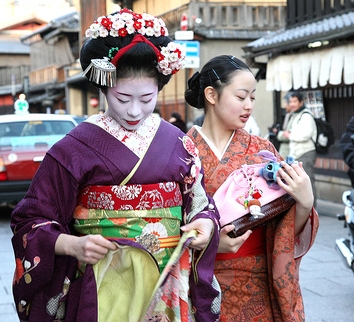
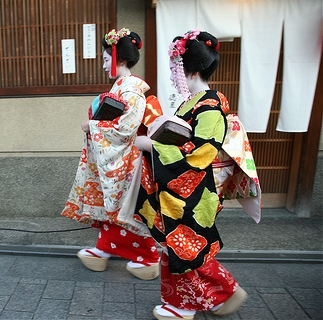
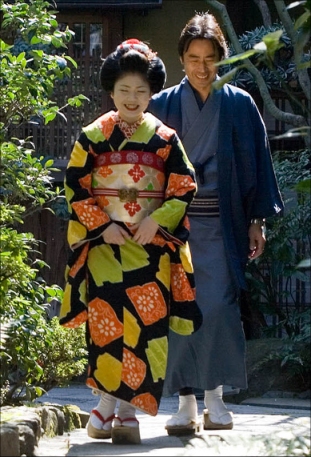
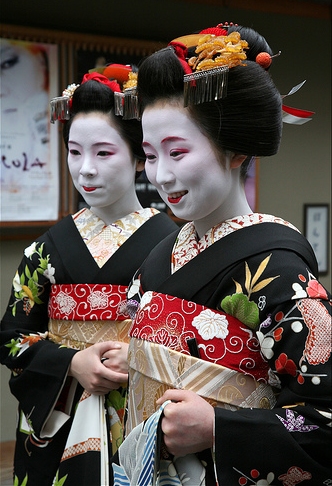
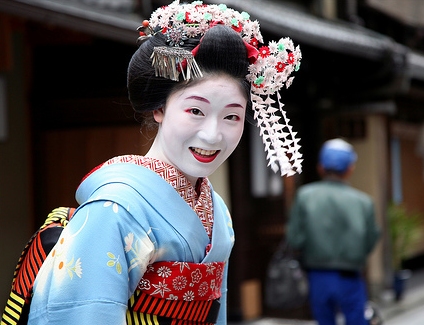
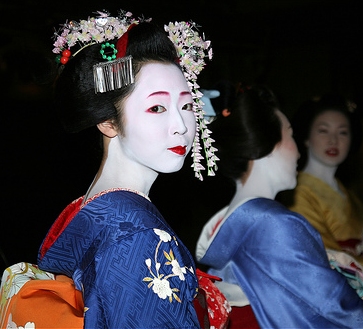
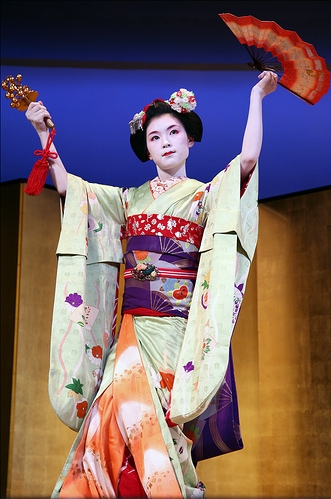
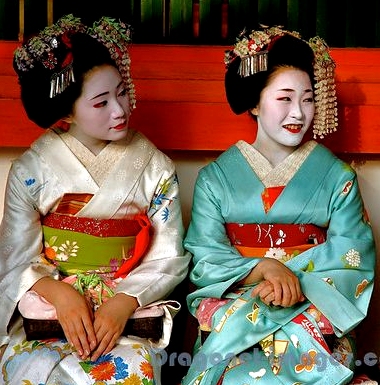
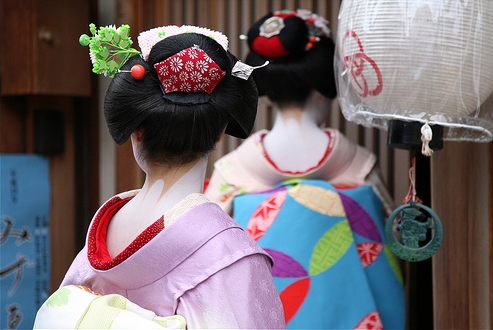
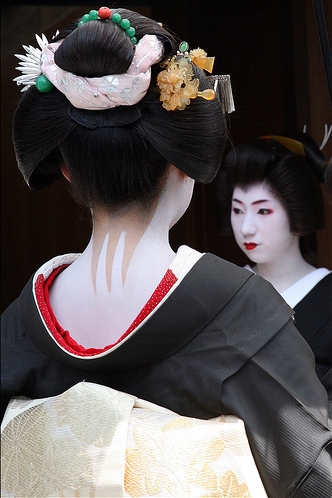
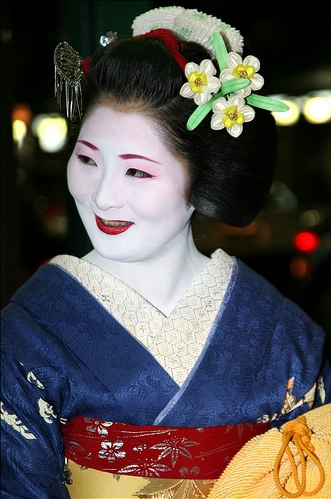
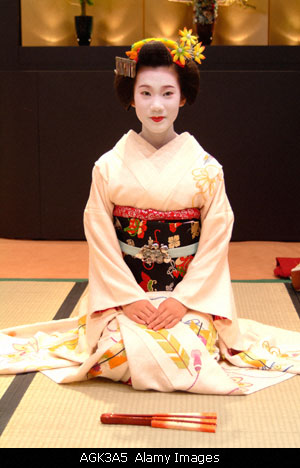
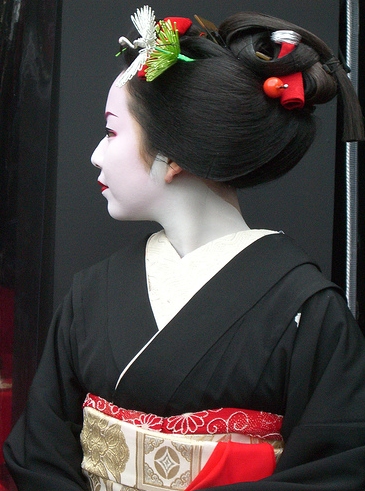
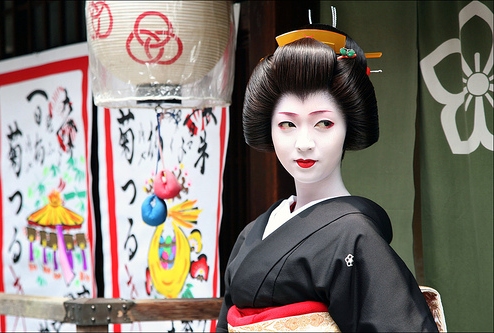
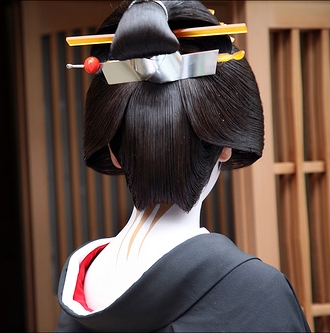
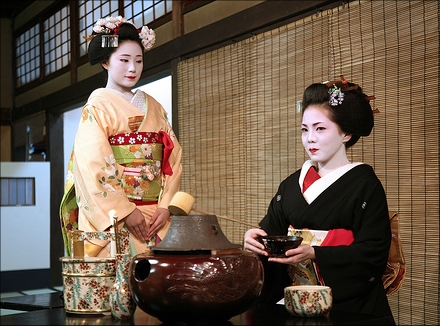
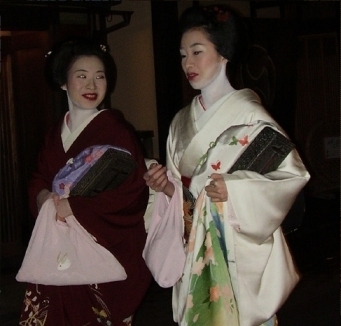
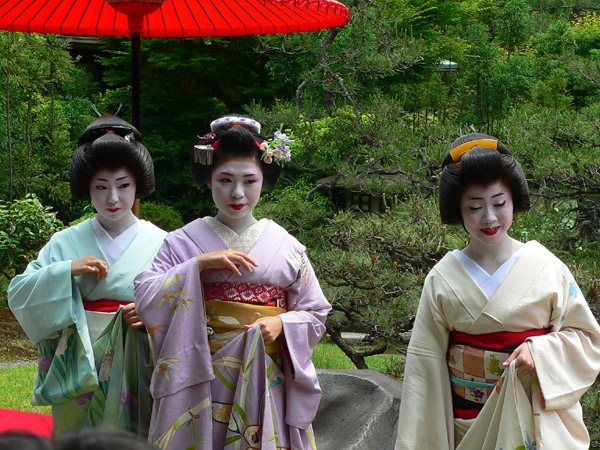
Appearances and Rank The geiko and maiko (apprentices) of Kyoto are the most recognized of geisha in all Japan. Though they exist elsewhere as well, most people who go to Kyoto take time to try to ‘play paparazzi’ by snapping photos of them in something of a favorite pastime. Unknowingly, many people take pictures of tourists or other people who dress up as maiko or geiko who are not real--these fakes are called maiko henshin. Also people will take pictures of regular women in kimono and call them maiko or geisha, or take pictures of maiko and call them geisha, which is incorrect of course; the maiko are only apprentice geisha. Geisha and maiko wear elaborate ensembles to entertain. They consist of an expensive kimono, obi, and proper accessories to go along with them. They are most recognized by their white-painted faces; actually, when people talk of ‘geisha’ they more often than not are picturing a maiko or talking of a maiko. A maiko’s costume is like a young child’s just as a geisha’s costume is that of an older woman, though both are worn in more exotic ways than other people would wear their kimono--for example, the tell-tale sign of a low back collar, exposing the painted neck and a bit of back. Depending on where a maiko is in her training certain aspects of her ensemble can change. Maiko and geiko dress can also change depending on what the season is or for certain holidays. I have compiled information based on years of my own research of maiko and geiko "rules of dress." Though some rules vary by district, what I have listed is base for all hanamachi unless otherwise noted. Also, I will provide information on how to tell real maiko from a fake, and hopefully this information on real maiko can help you determine a real from a fake "maiko henshin." I will start with the lowest ranks and work my way up, starting with a shikomi. First, I will present the varying parts of their full professional dress. A Maiko Ensemble When anyone dresses up in kimono every aspect of the outfit must be taken into consideration down to the smallest detail. Certainly for maiko and geisha, who wear kimono daily and for work, have many rules about their own kitsuke, many of which can be picked up through visual study alone. I will describe each piece of the ensemble and if I can, the significance of it as well. Rules of kitsuke (dressing up in kimono) are extremely important and this not only pertains to matching the season but what message a woman's ensemble should convey by how it is worn. A young lady, who should portray herself as innocent, reserved, obedient and cheerful (from Dalby's "Kimono" book) should wear her ensemble to portray such characteristics. This includes a high worn obi, an obijime set slightly above the center, a collar crossed as a wide V and a collar back set close to the neck and not dipped too much. An older, more sophisticated woman would wear her collar with a dip, her obi will sit low on her hips, the V-neck of her collar will be narrower and her obijime set in the center of the obi. This conveys an image of maturity and adulthood. Geisha themselves embody the traditional ideal of a sexually attractive woman. Therefore a maiko's ensemble has it's own message to convey appropriate to their chosen profession: one of being prim, young and innocent, but also sexy. From Liza Dalby's "Kimono": "A maiko's full dress kimono sports many youthful characteristics--bright colors, , deep swinging sleeves, the front of her collar overlapped high and close to the throat, the obi tied high on the torso with the obiage showing conspicuously, obijime tied slightly above center. But when the maiko turns around, the back of her collar is pulled down as far as any adult geisha's would be, exposing her nape practically down to her shoulder blades. Napier is definitely sexier. This example shows clearly how kimono signifiers can be rearranged and combined according to a logic of relations in order to express different combinations of social characteristics--in this case youth and sexiness..." Now, for a description of each piece of their ensemble. Juban - the under-kimono of a maiko's ensemble is visible underneath her kimono and at the collar. The collar of the juban is pure red, while the sleeves and skirt area are red with white decor (or gold or silver if it's a special occasion). The body of the juban is white but this is never visible. Han-eri - the collar worn by maiko or geiko is sewn onto a juban and wrapped firm in place with koshihimo (silken ties, never visible) right above the juban. For a maiko just beginning her career, the collar will be mostly red with some white design in the front, and be totally red in the back. As she gets older this appliqué becomes heavier until it is embroidered all white in the front and is red in the back. It will become a totally white collar when she becomes a geiko. Although collars are usually only red and white, occasionally other colors like gold or pink can appear on the design, though this is usually only for special occasions and ensembles. Kimono - this of course is
the most obvious part of the ensemble. Maiko kimono are a special type of
furisode (long swinging sleeves) called hikizuri or susohiki, because they are
kimono with a trailing bottom and are worn slung low on the back of the neck to
expose the upper back and neck. They are also distinguishable by having basting
mid-sleeve and again at the shoulder, to fit the girl appropriately (basting is
when cloth is gathered and loosely sewed together, and appears as a line in the
cloth). Obi - a maiko's obi is wide and very long. It's about 24 feet in length, wrapped around multiple times and then tied in a style called 'darari', with two tails of obi dangling near to the ground. Sometimes obi motifs lead into a season so you can see maple on an obi before you would normally expect to see them. Usually obi are of a contrasting but equally bright color from the kimono. Each obi like kimono belong to a particular okiya and therefore each obi as the okiya's crest at the bottom. Obiage - this is a red and white-silver silk scarf worn wrapped around the top of the obi, covering the obimakura in the back under the hanging obi tails. As with the obi it helps set the season for the kimono being worn. Until their last two stages of training (yonninmae and sakko) it is worn wide as is proper for a child's kitsuke, though the width at which it is worn will grow smaller when it's close to being tied. In the last two stages, it is knotted and tucked into the obi for a more sophisticated adult look. While it is worn wide, there are slight variations by district. For example, Gion Kobu maiko always wear theirs rather flat and thin, while Miyagawacho maiko wear theirs wider and a bit thicker looking. Obijime - this is a cord wrapped around the obi. Maiko wear a wide, flat obijime, sometimes one color or multicolored stripes. However, they do not wear them with formal black crested kimono. In contrast, geiko will wear them for formal occasions, and a geiko's obijime is thinner than a maiko's. Instead of wearing an obidome with it it will be knotted. Obidome - an obidome is worn in the center of an obijime. It is an "obi stone" and is a decorative, very expensive, and semi-large piece of jewelry. Only maiko wear them. Okobo - tall wooden clogs with straps called hanao and a soft weave on top for cushioning the feet. Young maiko and minarai have red hanao, and older maiko will wear other colors like pink, green or blue. However, they do not wear them all the time. Often if a maiko has to go to a place that wearing the okobo would not be allowed, or for other reasons like weather, they done zori instead, no matter their rank, though younger maiko seem to have a tendency to stick with red ones. The juban, han-eri, obi, obiage,
obijime, obidome and kanzashi all set a kimono to a particular season. If a
maiko wears a particular kimono in May, she will wear the proper accessories to
match the Spring season. Then she may wear it again in October, but wear Fall
accessories. For example, a hakata ori obi sets a kimono in the Summer season.
O-shiroi - shiroi means white in
Japanese, and o-shiroi refers to the white make-up so distinguishable of maiko
and geisha. It should be noted that a number of traditional performers and other
artists wear o-shiroi, including kabuki actors, participants in festivals and
tayuu. This make up is highlighted with red lipstick, and also red at the
corners of the eyes, traditionally believed for keeping demons away. Red is a
very prominent color in maiko ensembles and is present, lightly, in geiko
ensemble too. It symbolizes youth and femininity.
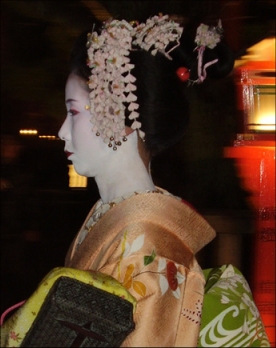
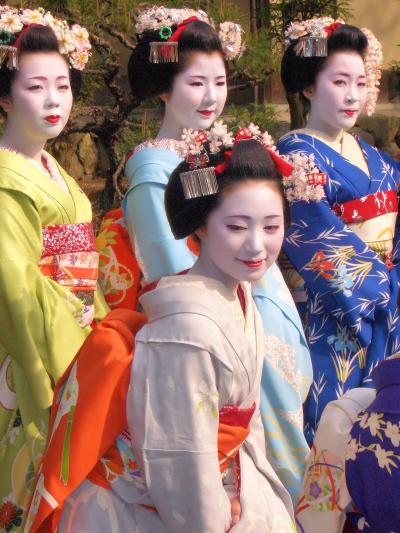
Minarai The next stage toward becoming a geiko is to become a minarai (‘to learn by observation’). Minarai have their hair done up in the ‘wareshinobu’ style which is the first hairstyle a maiko wears. Let me tell you about this hairstyle
in detail. It is identified by the silk band woven through the bun, which shows
red at the top and bottom. This is called an arimachikanoko. A kanokodome is
actually the tied red silk band towards the front of the hairstyle. A tama
(ball) kanzashi is always placed at the back left side of the bun. During the
four summer months, June through September, the red coral akadama kanzashi is
exchanged for a green jade one. It is said coral breaks apart in the cold of
winter when dipped in poison and the pin used to be used for detecting poison in
customers’ drinks. Chart of Kisetsubana Kanzashi by Month
Misedashi The next stage is a maiko during her
misedashi. Misedashi means ‘open for business’ and is a girl’s first day as an
official maiko. Hanninmae Next is a maiko in her first stage
of training. She is called ‘han nin mae’ because she is not considered a full
professional yet. At first, only her bottom lip is painted red. Another exception of maiko
just beginning their training is wearing the shidare kanzashi. These are strings of
tsumami (folded silk petals) that hang by
the face near down to the chin. They do not wear them all the time, but first
stage maiko and minarai can wear them and often do. Maiko will wear them just a
little while pass painting their upper lip. So it is very rare to see a maiko
with both lips painted and wearing shidare kanzashi. Painting the Upper Lip Next in a maiko’s training is paitning the upper lip. However, her collar is still mostly red, and the obiage is still worn wide and not tied. She also still wears the wareshinobu hairstyle, and the straps on her okobo, called hanao, are still red. Heavy Collar
Following painting the
upper lip, a
maiko gets a collar that is red in the back but now white in the front. However,
it is not plain white. The appliqué of white is so heavy
now there is no red in the front, only in the back. A maiko will still wear wareshinobu and an
unknotted obiage in this stage.
Mizuage The next stage in a maiko’s career is her mizuage.
This is when she gets to change her hairstyle from wareshinobu to ofuku. The
ofuku style of a maiko is only a bit different from the wareshinobu. Instead of
the kanoko band, a chirimen tegarami cloth is pinned to the bottom of the bun
(which, although covered by the tegarami, is open). The bun also sits a bit
lower on the head. The silver, green and orange nezashi kanzashi is exchanged
for a kanzashi made of metal. Sometimes, the back kisetsubana piece is replaced
with a kushi (comb), either covered in silk petals or shiny thread.
Maiko with ofuku also wear the special katsuyama hairstyle during the month of July, celebrating the Gion Matsuri. This hairstyle is most recognized by the large, silver flowery piece called bonten stuck through the bun of hair. It should also be mentioned that whenever a maiko is in formal wear (a black crested kimono and gold obi with no obijime) she has "sanbonashi" painted on the back of her neck, which shows three prongs instead of the normal two. They will also wear sanbonashi during sakko period.
A senior maiko as in her 'last stage' ties and tucks her obiage into her obi instead of wearing it wide. At some point, the red tegarami is replaced with a pink one. She will wear a comb in front of her bun and usually one or three large flowers in front. Depending on the district, and perhaps the okiya, the time a maiko is in this stage varies. Sakko (Sakkou) Finally, a maiko will don the sakko
hairstyle. Depending on the district, this could be a month or just a couple of
weeks before eri-kae, or ‘turning the collar’ and becoming a geiko. While she
wears this hairstyle, during the first and last days of sakko she will wear a
formal ensemble. In this formal attire for the sakko (a black crested kimono or
a regular hikizuri, but both with a formal gold obi) she also wears a
pure red collar with gold sparkling, except in Gion Kobu and Gion Higashi. Also,
even wearing 'karage' (everyday kimono) it will be crested. Now, there are other indicators of
rank among maiko. Generally, the older a maiko is the less design will be on her
kimono. It will be more ‘adult’ and not so noisy. The design of older maiko
kimono is mainly on the lower sleeves and skirt. Younger maiko usually have it
more spread out. Erikae: Becoming a Geiko When a maiko becomes a
geiko it is known as her ‘erikae’ or turning of the collar. The geiko now
exchanges her red patterned collar for a plain white one, hence the name erikae.
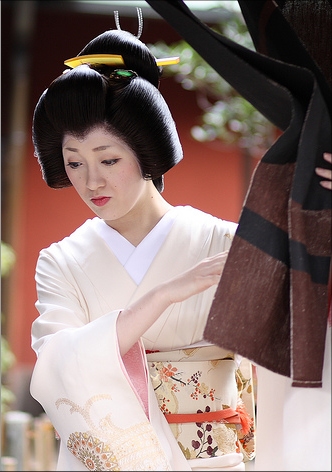
She will also wear a wig (katsura) in the tsubushi shimada style. In this
katsura she wears a few tortoiseshell kanzashi for her erikae: a comb, a small
pin near the front left side of her hair, and a couple of stick kanzashi in the
back. Having a whole new ensemble of kimono and obi, erikae is planned about six
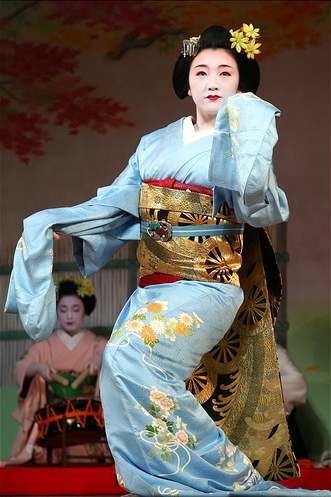
months in advance. A geiko’s obi will be tied taiko style (box or ‘drum’ shaped)
and her kimono are less noisy and with shorter, less curved sleeves. On the day
of her erikae, her kimono ensemble will be the most formal: a black crested
kimono with a gold obi. A geiko’s appearance is one that is elegant, graceful, attractive, and
grown up, versus a maiko who appears as playful and childish.
Geiko Daily Ensemble On a daily basis, like maiko,
geiko have a general ensemble that goes with the season. She will wear her
oshiroi, and change the way she applies her eyebrow and eye make up to give
herself a more mature look, rather than young. She will also wear her katsura
(wig) with a small ornament on the left upper side reflecting the season, a
kushi in front of her mage, as well as a tama kanzashi on the right side and a
small silver, wire-like kanzashi on the back of her mage. Depending on the occasion and
district other kanzashi are added or taken away as needed.
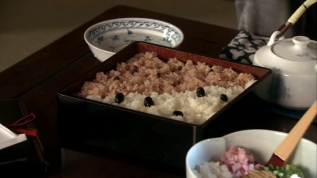
Hiki Iwai Hiki Iwai is when a geiko decides to leave the Flower and Willow world and retire. An announcement is made that the geiko is retiring and parting gifts of cooked rice in boxes are prepared for various people in the hanamachi, including teahouse mothers, teachers, her own okaasan and oneesan and anyone else she feels indebted to for past kindnesses. The rice in the box can either be white or red. Red rice means she has no intention of returning. White rice means she may return one day, depending on outside circumstances. Triangular paper notices are handed out as well, with the characters hiki and iwai printed in the middle. There is also a small, brushed phrase stating "[geimyo of geiko] kai kai (has reverted to) [her original name]." (As stated in Liza Dalby's "Geisha" book).
Contact DrowElfMorwen |
||||||||||||||||||||||||||