Divide Whole Numbers: 3+ Digits by 1-Digit
Dividing a three or more digit whole number by a one-digit whole number
usually requires using long division. Remainders occur when numbers cannot be
divided evenly. For example, 11 divided by 2 is equal to 5 with 1 left over
(remainder).
Tutorial
It may be helpful to verify that the student understands the process of long
division. Also, confirm that the student comprehends remainders. The following
is an example of a division problem that involves long division and a remainder.
Solve: 569 divided by 4.
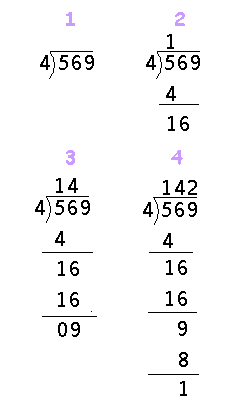
Step 1: Write the problem in long division format.
Step 2: Find the quotient of the hundreds (5) divided by the divisor (4). For
this problem, the quotient is 1. Multiply the quotient with the divisor. This
gives a product of 4. Subtract the 4 from the 5 (1). Bring the tens (6) down.
Step 3: Find the quotient of the tens (16) divided by the divisor (4). For this
problem, the quotient is 4. Multiply the quotient with the divisor. This gives a
product of 16. Subtract 16 from 16 (0) and bring the ones (9) down.
Step 4: Find the quotient of the ones (9) divided by the divisor (4). For this
problem, the quotient is 2. Multiply the quotient with the divisor. This gives a
product of 8. Subtract 8 from 9 (1).
The correct answer is 142 with a remainder of 1.
Shortcuts to Dr. Ferguson's Website
| Home
Page | Assignment
Policy
| Assignments
|
Homework
Tips | Discipline
Policy
|
Classroom
Rules | Math
| Compass
Math | Reading
| Funbrain.com
Tests
| News
| Calendar
| Did
you know? | Parent
Letter | ???
| Why
Chess?
| Recognition
Spotlight | Links
| Teachers'
Corner |
Index
by Topic |
Copyright © 2002 and 2003 by Robert Ferguson. All rights reserved.
Revised: January 21, 2003
.