Background Information:
Saturn is the sixth planet from the Sun.
It has a large amount of moons and a huge ring system. Saturn has one very large moon named Titan, that is
larger than several of the planets. Saturn is the nicest planet to look at through a telescope, because
the rings are clearly visible. It is possible that the rings were caused by a moon that got too close to the
planet when it's orbit decayed, and was pulled apart. In 2004, the Cassini spacecraft will arrive at Saturn and go into
orbit. It will also deliver a probe that will land on it's moon Titan.
Saturn Images:
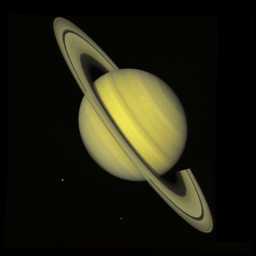
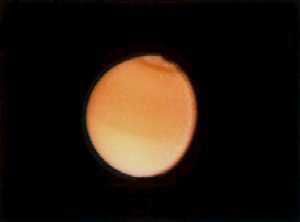
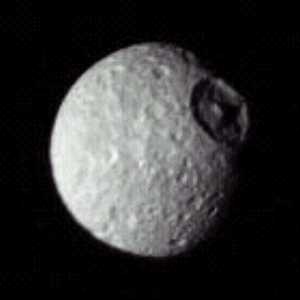
There have been several fly-by missions to Saturn, and an
orbiter will arrive in 2004. These are a couple of the images returned:


Orbital & Mass Data:
- Average Distance from Sun : 9.539 billion kilometers
- Length of Year : 29.46 Earth years
- Length of Day : 10.2 Earth hours
- Diameter : 120,660 kilometers
- Mass (Earth=1) : 95.15
- Surface Gravity (Earth=1) : 1.16
- Escape velocity : 35.6 kilometers/second
- Average surface temperature : -180 degrees C. at the cloud tops
|