Background Information:
Jupiter is the fifth planet from the sun.
It is so large that it contains about seventy percent of the mass of the solar system outside the Sun.
Jupiter has a large number of moons and a faint ring. There are four very large moons close to the planet,
called the Galilean moons, some of which are larger than a couple of the planets. These four moons are all visible
from the ground with a moderately powerful telescope. If you look through a telescope at different times you
can actually see them lined up differently with the planet.
Jupiter Images:
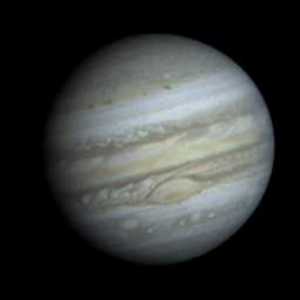
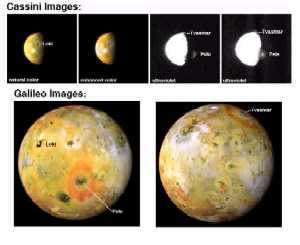
We have sent several spacecraft to fly-by and orbit Jupiter.
These are a couple of the images returned:


Orbital & Mass Data:
- Average Distance from Sun : 778.3 million kilometers
- Length of Year : 11.86 Earth years
- Length of Day : 9.8 Earth hours
- Diameter : 143,800 kilometers
- Mass (Earth=1) : 317.89
- Surface Gravity (Earth=1) : 2.64
- Escape velocity : 61 kilometers/second
- Average surface temperature : -110 degrees C. at cloud tops
|