Background Information:
Mercury is the closest planet to the sun.
It has an appearance that is almost identical to our moon, but it is a little larger. Mercury is very
hard to see from the Earth because it is so close to the Sun.
Because it orbits so close to the Sun, you always have to look for it very low on the horizon, just after sunset or
just before sunrise. It is never visible more than two hours before sunrise or two hours after sunset.
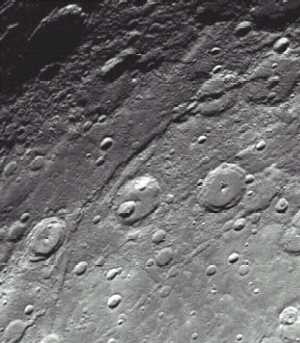
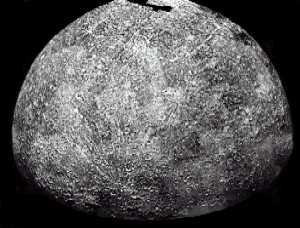
Mariner 10 Images:
Mariner 10 conducted three fly-bys of Mercury in 1974.
These are a couple of the images returned:


Orbital & Mass Data:
- Average Distance from Sun : 57.9 million kilometers
- Length of Year : 87.969 Earth days
- Length of Day : 58.646 Earth days
- Diameter : 4,878 kilometers
- Mass (Earth=1) : 0.0558
- Surface Gravity (Earth=1) : 0.38
- Escape velocity : 4.3 kilometers/second
- Average surface temperature (Day) : +350 degrees C.
- Average surface temperature (Night) : -170 degrees C.
|