Main
page About
author
<<
Chapter1
Chapter2
Chapter3
Chapter4
Chapter5 >>
5. Some problems solved by using methods of neorelativistic
mechanics
Four components of the vector  ,
having the form (4.1), give general solutions only for four functions t(t
), x0(t ), y0(t
), z0(t ) from the
problem of two bodies (3.8). Practically these four functions can be determined
only after the function
,
having the form (4.1), give general solutions only for four functions t(t
), x0(t ), y0(t
), z0(t ) from the
problem of two bodies (3.8). Practically these four functions can be determined
only after the function  ,
depending on the invariant argument
,
depending on the invariant argument  ,
where
,
where  and
and  as in (3.5), is found. Three functions xAB(t
), yAB(t ), zAB(t
), which determine dAB, one can obtain from (3.8) after
considering three variations dxAB(t
), dyAB(t
), dzAB(t
) in the functional (3.8). The corresponding vectorial differential equation
for the unknown invariant vector
as in (3.5), is found. Three functions xAB(t
), yAB(t ), zAB(t
), which determine dAB, one can obtain from (3.8) after
considering three variations dxAB(t
), dyAB(t
), dzAB(t
) in the functional (3.8). The corresponding vectorial differential equation
for the unknown invariant vector  looks in the particular case of
 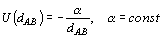 as follows:
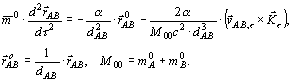 (5.1)
(5.1)
Here
 , (5.2)
is a constant invariant vector. This  do not change in any inertial (neorelativistic) frame of reference. The
equality (5.2) expresses one more neorelativistic law of conservation,
that generalizes the classical second Kepler’s law. But in this new law
the rate of change of the area
do not change in any inertial (neorelativistic) frame of reference. The
equality (5.2) expresses one more neorelativistic law of conservation,
that generalizes the classical second Kepler’s law. But in this new law
the rate of change of the area 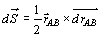 ,
where
,
where  , is not constant:
  is changing in proportion to
  .
If
.
If 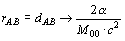 , then
 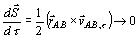 ,
but vector
,
but vector  in (5.2) remains
constant and
in (5.2) remains
constant and  .
.
It is very important to emphasize: the second term in right part of
(5.1) is Lorentz’s force (and not only in Coulomb’s field but in gravitation
field also, because both are analogous from mathematical point of view).
Such is the result of our “fantasy” in formulae (3.7)…
Reader can notice that in case of  (see 4.7), because of
  it may occure that we will have such particle, which has zero invariant
defective mass
it may occure that we will have such particle, which has zero invariant
defective mass  but its
intrinsic moment (spin)
but its
intrinsic moment (spin)  will be not zero, because of
  (particles like neutrino and photon).
Equations (5.1) and (5.2) show that any transformation of the seven
generalised coordinates  ,
when transformation is belonging to the abovementioned g
-group, does not change anything both in vectorial or scalar magnitudes
entering these equations, i.e. those magnitudes remain unchanged in any
neorelativistic inertial frame of reference.
,
when transformation is belonging to the abovementioned g
-group, does not change anything both in vectorial or scalar magnitudes
entering these equations, i.e. those magnitudes remain unchanged in any
neorelativistic inertial frame of reference.
So we have got the neorelativistic form of the relativity principle
(which is not declared but which naturally follows from the equations):
as equations (5.1), (5.2) and (4.1) do not change both their outer appearance
or their algorithmic revealing in any neorelativistic frame of reference,
all real physical and mechanical processes involved in these equations
do not undergo any changes as well.
From the equality (5.1) it follows that if  by
by  and
and  being constant vectors, i.e. if
  is a linear function of t , then the
right part of this equality becomes equal to zero. Denoting this right
invariant part
is a linear function of t , then the
right part of this equality becomes equal to zero. Denoting this right
invariant part  one may
consider it as the interaction force between objects A and
B, thus obtaining the neorelativistic generalisation of the first
Newton’s law. Let us emphasize that in case of gyration vector
one may
consider it as the interaction force between objects A and
B, thus obtaining the neorelativistic generalisation of the first
Newton’s law. Let us emphasize that in case of gyration vector  in (5.1) is antiparallel to
  .
If
.
If  , then
  (see (5.2)) may be not so small, and in right part of (5.1) we will have
  .
So, when radius
.
So, when radius  , then
interaction force is absent and velocity
, then
interaction force is absent and velocity  .
.
Nevertheless, together with the invariant interaction force  ,
(right part of (5.1)) we also have to deal with two noninvariant
forces of acting, namely, with the noninvariant force
,
(right part of (5.1)) we also have to deal with two noninvariant
forces of acting, namely, with the noninvariant force  representing action of object B upon object A, and with the
noninvariant force
representing action of object B upon object A, and with the
noninvariant force  representing
action of object A upon object B. In neorelativistic mechanics
the three forces
representing
action of object A upon object B. In neorelativistic mechanics
the three forces  and
and  are, generally speaking, not equal.
If three-dimensional noninvariant "vectors"  which one can consider in the given fixed frame of reference
 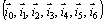 (in space
  ), fix correspondingly
material particles
), fix correspondingly
material particles 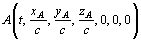 and
and 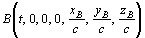 and their center of mass
 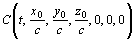 (relatively to another unit vectors
 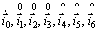 in the same space), then (as in space
  also) we will have:
 . (5.3)
Reckoning 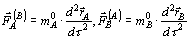 , taking
the second derivatives of expressions (5.3), and defining
, taking
the second derivatives of expressions (5.3), and defining  from (4.4) by
  , one obtains
the forces
, one obtains
the forces  and
and  .
It appears here that
.
It appears here that
 . (5.4)
Consequently, the force of action, say,  ,
and the force of counteraction
,
and the force of counteraction  satisfy the third Newton's law only in two cases:
1) when  , i.e. when
  ;
;
2) when  , i.e. in case
of gyration in the problem of two bodies or two charges.
, i.e. in case
of gyration in the problem of two bodies or two charges.
Using noninvariant "vector" of the action force  ,
we can exact the classical expression for the Coulomb force, determining
the action of an electric charge qB upon another charge
qA, when those charges are concentrated on masses
,
we can exact the classical expression for the Coulomb force, determining
the action of an electric charge qB upon another charge
qA, when those charges are concentrated on masses  and
and  . If
. If  and
and 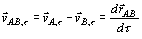 then in the case
of
then in the case
of  ,
, 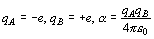 ,
and according to equality
,
and according to equality  ,
from (5.1) and (5.4) we obtain the expression:
,
from (5.1) and (5.4) we obtain the expression:
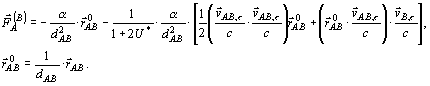 (5.5)
(5.5)
The second term in (5.5) is a correction to the usual Coulomb formula.
This additional term is very small by its magnitude when  and
and  are small. (It is
supposed here that all vectors in (5.5) are “mapped” on “our” space
are small. (It is
supposed here that all vectors in (5.5) are “mapped” on “our” space  ).
But in case of very small values of dAB it may happen
that
).
But in case of very small values of dAB it may happen
that  and
and  .
A big magnitude of the second term in (5.5) will occur when
.
A big magnitude of the second term in (5.5) will occur when  ,
,  ,
and
,
and  . Then this additional
force will be opposite to the classical Coulomb force. In such case two
like charges will attract one to other. All this has also direct pertain
to the problem of head-on collision of an electron beam with an analogous
positron beam and also to the problem of experimental determination of
the size of a particle (for instance, like in Rutherford’s experiment).
. Then this additional
force will be opposite to the classical Coulomb force. In such case two
like charges will attract one to other. All this has also direct pertain
to the problem of head-on collision of an electron beam with an analogous
positron beam and also to the problem of experimental determination of
the size of a particle (for instance, like in Rutherford’s experiment).
Now let us consider two unlike charges +e, -e located
almost at the same point A with the difference of their velocities
at the given instant  denoted
as
denoted
as  . We, for instance,
may imagine a kind of a tiny "boat" A carrying a positive charge
+e and a negative charge -e moving along "rails", affixed
to this boat, with the corresponding velocities
. We, for instance,
may imagine a kind of a tiny "boat" A carrying a positive charge
+e and a negative charge -e moving along "rails", affixed
to this boat, with the corresponding velocities  and
and  . Let analogous "boat",
carrying unlike charges +e, -e, be located at the point B,
and let the difference of charge velocities in B be
. Let analogous "boat",
carrying unlike charges +e, -e, be located at the point B,
and let the difference of charge velocities in B be  .
This gives us an image of two "elementary electric currents"
.
This gives us an image of two "elementary electric currents"  and
and  which are quite invariant
because canon velocity
which are quite invariant
because canon velocity  and velocity
  are invariant
in corresponding pseudoeucledaen spaces
are invariant
in corresponding pseudoeucledaen spaces  (
( ). In this "problem of four
charges" the classical Coulomb force disappears completely, due to the
fact that the distance between "boats" dAB is much greater
than the sizes of "boats" themselves. The corrected Coulomb formula (5.5)
now explains appearing of pure magnetic interactions.
). In this "problem of four
charges" the classical Coulomb force disappears completely, due to the
fact that the distance between "boats" dAB is much greater
than the sizes of "boats" themselves. The corrected Coulomb formula (5.5)
now explains appearing of pure magnetic interactions.
From above mentioned problem of “four charges” one can obtain two magnetic
forces  and
and  ,
acting between these two “boats”. These invariant vectors
,
acting between these two “boats”. These invariant vectors  and
and  in general case are
not equal and not parallel. These magnetic forces are as follows:
in general case are
not equal and not parallel. These magnetic forces are as follows:
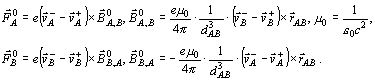 (5.6) - (5.7)
They are quite analoguos to those obtained from the well-known Ampere’s
formula, which describes two magnetic forces  and
and  acting upon two electric
conductors characterized by two elemental length-vectors
acting upon two electric
conductors characterized by two elemental length-vectors  ,
and conducting electric strength currents IA and IB,
dAB being the distance between
,
and conducting electric strength currents IA and IB,
dAB being the distance between  ,.(In
Ampere’s formula element
,.(In
Ampere’s formula element  from the first conductor has NA ”tiny boats” and IA
= NA iA ; element
from the first conductor has NA ”tiny boats” and IA
= NA iA ; element  has NB ”boats” with “elementary carrent” iB,
IB = NBiB). And here we
mean that every positive charge
has NB ”boats” with “elementary carrent” iB,
IB = NBiB). And here we
mean that every positive charge  in metal conductor is concentrated on three quarks in proton, and the system
of three quarks (in keeping with “confinement idea”) has common mass
in metal conductor is concentrated on three quarks in proton, and the system
of three quarks (in keeping with “confinement idea”) has common mass  .
Every such charge
.
Every such charge  is “statistically
free”. In this case
is “statistically
free”. In this case  .
.
Here we have full coincidence between the theoretical neorelativistic
solution (5.6) and experimental data thus verifying this theory. In this
connection it should be reminded that the most general case of Ampere's
formula cannot be confirmed by methods of classical special theory of relativity,
because relativistic mechanics (STR) tries to explain phenomena of magnetism
operating in its attempts to correct the classical Coulomb formula only
by some scalar factors. But it can not change the direction  of usual Coulomb force in (5.5).
By using the neorelativistic law of energy conservation (4.5), was examined
the model of the simplest timepiece (a linear harmonic oscillator in the
form of two equal masses  ,
joined together with an ideal spring and placed into constant gravitational
field with potential function
,
joined together with an ideal spring and placed into constant gravitational
field with potential function  ,
where
,
where  g0
and R0 are unchanged). Instead of dAB
here we can consider the invariant magnitude
g0
and R0 are unchanged). Instead of dAB
here we can consider the invariant magnitude  . In this case the magnitude
  ,
where l0 is a free length of the spring, determines the
strain energy and the potential function
,
where l0 is a free length of the spring, determines the
strain energy and the potential function  ,
where kc is a spring rigidity.
,
where kc is a spring rigidity.
Neorelativistic solution of this problem is based on equality (4.5)
and it reveals an usual relationship between invariant magnitudes of x(t
) and t in threedimensional pseudoeucledean
space R3 , k = 2 (because now y0(t
) = z0(t ) = 0
and yAB(t ) = zAB(t
) = 0), i.e.
 . (5.8)
As one can notice, the process of changing x(t
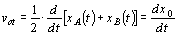
) does not depend on the constant gravitation field with 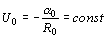 and on the usual pseudovelocity
  .
.
But the invariant time t is, in fact,
an "extrasensoric" one, and it should be noted here that in the course
of the experiment one can measure only noninvariant magnitude t(t
), which in these circumstances becomes the "pseudotime", since the magnitude
dt represents only the first coordinate of the invariant vector  ,
with the magnitude
,
with the magnitude  no
more being constant. From the conservation law Et = const,
as in (4.2), one can derive a copmplicated enough relationship
no
more being constant. From the conservation law Et = const,
as in (4.2), one can derive a copmplicated enough relationship
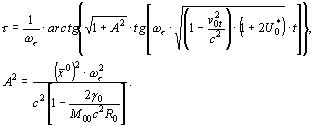 (5.9)
(5.9)
From (5.8) and (5.9) one can eliminate invariant time  and obtain the relationship of
  ,
where
,
where
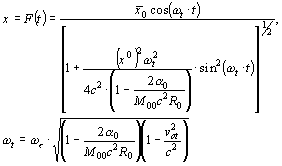 (5.10)
This last function in contrast to (5.8) has a pseudoperiod  ,
which is noninvariant and which depends on vot and on
the gravitational field U0,
,
which is noninvariant and which depends on vot and on
the gravitational field U0,
The function x = F(t) when  (i.e. very strong gravitation) describes a process which looks like so
called “pulsar”. This apparent, but nevertheless distored, pulsatory process
is in agreement with modern astronomy observations. Also the pseudoperiod
Tt is in full agreement both with the Pound-Rebka experiment,
based upon the Moessbauer effect, and with the well-known theoretical solution
offered by the Einstein general theory of relativity. (Here one only needs
to find from second formula (5.10) two pseudoperiods
(i.e. very strong gravitation) describes a process which looks like so
called “pulsar”. This apparent, but nevertheless distored, pulsatory process
is in agreement with modern astronomy observations. Also the pseudoperiod
Tt is in full agreement both with the Pound-Rebka experiment,
based upon the Moessbauer effect, and with the well-known theoretical solution
offered by the Einstein general theory of relativity. (Here one only needs
to find from second formula (5.10) two pseudoperiods  and
and  , where h is the distance
between two such timepices).
, where h is the distance
between two such timepices).
Thus, real invariant vibrating process (but extrasensorical one!) of
the “flying” linear oscillator in constant gravitation field is determind
by formula (5.8). But the inhabitans of the planet Earth with their destored
sensations can “see” only noninvariant relationship in the form (5.10).
Approximatly such mistake these “inhabitans” will make when during two
years they wil fix the position of planet Mars among “resting” stars on
a starglobe: instead of “extrasensorical” elliptic trajectory of Mars they
will have quite a destored trace.
From first two equalities (4.2) one can find that 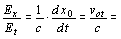
 .
This value determines the constant (fixed) direction vector
.
This value determines the constant (fixed) direction vector 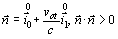 ,
in subspace
,
in subspace  belonging
to the space
belonging
to the space  , in which
we had “immersed” our mechanical problem. But the canonic velocity
, in which
we had “immersed” our mechanical problem. But the canonic velocity  of the same centre of mass M00 = 2m0
is not uniformly because
of the same centre of mass M00 = 2m0
is not uniformly because
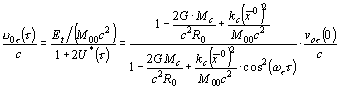 , (5.11)
where
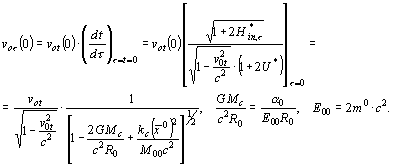 (5.12)
Here MC is the mass of body creating the constant
gravitation, R0 - is an invariant “algebraic distance”
between MC and our timepiece centre of mass, i.e. R0
do not depend on a very small value x(t
); G - is gravitation constant. Expression (5.11) gives full information
about de’Broglie vawe, which associate the little flying particle, like
our flying timepiece.
We shall finish on that that the inventor of a microscope Leeuwenhoek
was not a microbiologiest at all, but he was sure that his microscope showed
what it showed. We expect same attitude to “the mathematical microscope”
offered here.
Here are some of “pictures”, which demonstrate our “microscope” (we
also include here references with Ukrainian text using label “U.t.”):
1) Neorelativistic functional of action – (3.7), (3.8) and (7.10) “U.t.”.
2) Invariant vector of energy  (in two-body problem) and its four component (they are the same for any
multy-body problem) – (4.1), (4.2) and (7.19), (7.21) “U.t.”
(in two-body problem) and its four component (they are the same for any
multy-body problem) – (4.1), (4.2) and (7.19), (7.21) “U.t.”
3) Invariant Hamiltonian function – (4.5) and (7.27) “U.t.”
4) Modulus of energy vector  - (4.8) and three type of mass
  – (4.7).
5) Generalized and quite invariant Newton’s equation of motion in two-body
(or two charges) problem; if  ,
then (in case of gyration) the invariant force of interaction
,
then (in case of gyration) the invariant force of interaction  tends to zero; - (5.1).
6) Generalized second Kepler’s law (5.2) and linear equation of interaction
(5.1).
7) Generalized magnetic and gravitional (Lorentz’s) force (the second
term in right part of equality (5.1)).
8) Generalized (noninvariant) Coulomb formula – (5.5) (also in gravitational
case for two masses  ).
).
9) Ampere’s law for interaction between two “elementary currents” –
(5.6), (5.7); both magnetic forces  and
and  are quite invariant
vectors in subspace
are quite invariant
vectors in subspace  , belonging
to pseudoeuclidean space
, belonging
to pseudoeuclidean space  ,
and (contrary to STR) they do not turn into electrostatic in any “mooving
classical frame of reference”.
,
and (contrary to STR) they do not turn into electrostatic in any “mooving
classical frame of reference”.
10) Interaction force  between “elementary current” and free mooving electron with velocity
  - (8.5) “U.t.” (the last two terms in (8.5) do not depend on velocity
  ).
).
11) Interaction force  between two currents (loop contour), when both planes of contours are parallel
to plane
between two currents (loop contour), when both planes of contours are parallel
to plane  and distance
between their centres
and distance
between their centres  ,
and also the torque
,
and also the torque  -
(8.30), (8.31) “U.t.”.
-
(8.30), (8.31) “U.t.”.
12) An ideal oscillator mooving with velocity  in gravitation fied;
ŕ) neorelativistic vibration process
relatively to invariant time –
(5.8);
b) relatively to nonivariant “pseudotime” t – (5.10), when “pseudoperiod”
Tt depends on gravitation and velocity  .
.
13) Oscillators “pseudoperiod” Tt and relationship  in very strong gravitation field, when
  ,
is like at so-called “pulsar” - (5.10).
,
is like at so-called “pulsar” - (5.10).
14) More correct definition of Einstein’s principle of equivalence –
(9.13) “U.t.”.
15) Neorelativistic verifeing of the well-known Pound-Rebka’s experiment
– (9.12) “U.t.”.
16) The vibration velocity  - (5.11) of the ideal “flying oscillator”, describing de’Broglie’s vawe,
which associate the mooving centre of mass.
- (5.11) of the ideal “flying oscillator”, describing de’Broglie’s vawe,
which associate the mooving centre of mass.
So author (using his own intuition) had realized his main perpose: from
all complications of STR and GTR – again back to usual outward appearance
of classical equations and their solutions (only by changing absolute time
t on invariant time t, when principle of relativity is only a logical consequence
of these utterly invariant solutions). Thank goodness and God…
Main
page About
author
<<
Chapter1
Chapter2
Chapter3
Chapter4
Chapter5 >>